22-23 April 2025
Belmore Park in Sydney is the stuff of legend. By that I mean that it is notorious for not being the sort of place you’d like to find yourself in after dark: the streetlamps are dim, wayfinding is a mess, and I’ve been told of at least two muggings that took place under its leafy canopies. And yet there we are: Daniel, Eugene, Sunny and me, lugging our suitcases through its labyrinthine paths.
I never expected to find myself here. I thought I’d said goodbye to Australia for good. Not that I hated the place or anything, but I’d set my sights on emigrating to Europe the previous year, and the possibility that I’d look backwards — the very idea that I’d be heading the other way, back to the land I spent five glorious months in — never really occurred to me. But those plans got pushed back, one thing led to another, and now the four of us are in Sydney, our luggage filled with the detritus of four days’ travel.
It’s been a heck of a ride so far: sunset at the Opera House, meetups with old friends, Eugene driving across the Harbour Bridge at full tilt while desperately hankering for a toilet. Now it’s time to focus on Melbourne, that fantastic, dreamy city of my youth — but we need to get there first, which is why we’re now underneath the awesome sandstone arches of Central Terminal, about to embark on a journey none of us have done before.
You see, travelling to Melbourne by air would be a piece of cake; the air route between the two cities is, after all, the fourth-most frequented route in the world. But I’d already done it twice before, and stumbling through two airports first thing in the morning sounded like hell to me. And so an alternative popped up in my mind: why not do it by night train? I’d done it two years ago, travelling from Vienna to Hamburg in one night, and it was both an exhilarating and memorable experience (although I suspect Charmaine might see it differently). Surely the XPT between Sydney and Melbourne would be just as efficient, just as excellent?
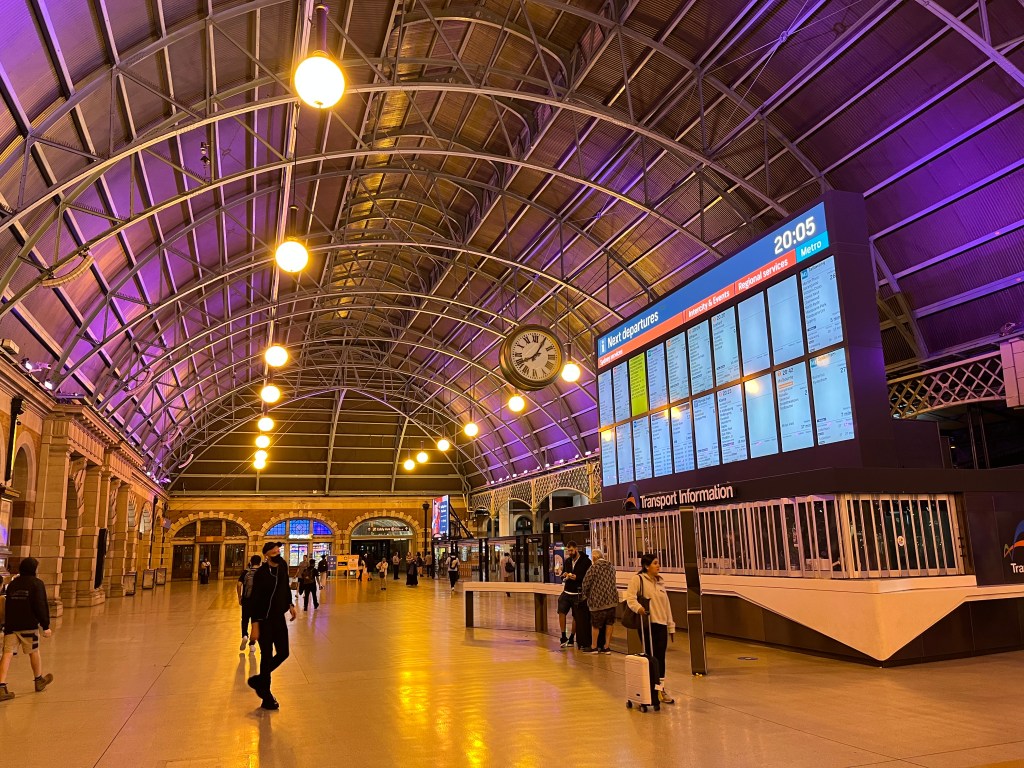
Well, we’re about to find out. The chilly air of autumnal Sydney gives way to the slightly fetid warmth of Central Terminal as we step inside its grand concourse, a vaulted space illuminated by lights of violet and yellow. The train to Melbourne is now sitting quietly at platform 2, but access to said platform is not for another quarter of an hour, and so we simply stand in the middle of the hall, a little nervous, waiting for our appointed time. “Do you think we’ll be able to charge our phones onboard?” asks Daniel to pass the time. I don’t really know how to respond, and he walks disappointed towards the loos.
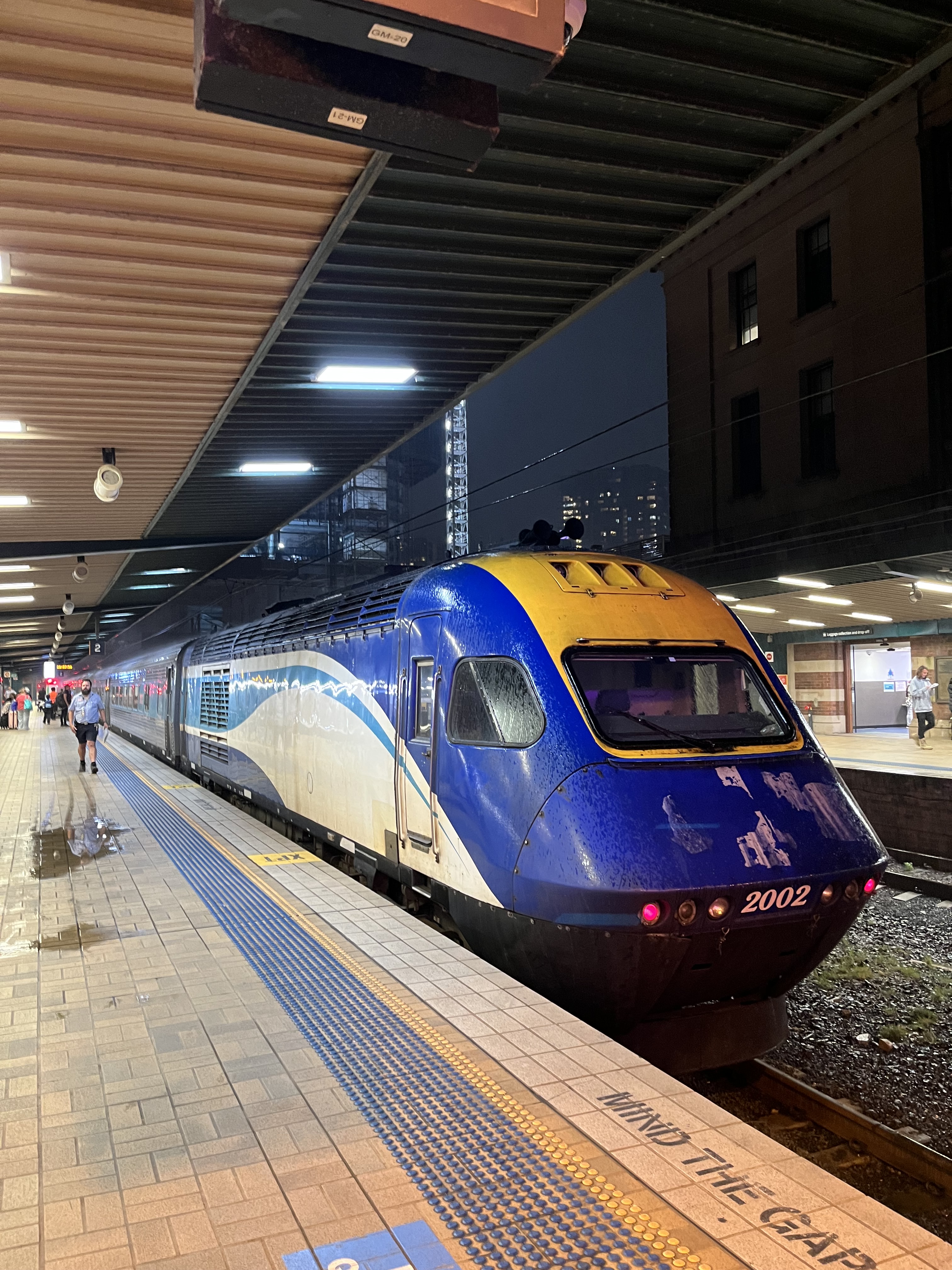
At last the announcement rises for the XPT; all around Central Terminal, travellers are galvanised into action, funnelling into the sliver of platform that serves as an entryway to the huge, lumbering locomotive that sits beside. Our bags (though not our luggage) are given a rudimentary glance, and then we are heading down the long, long platform, pointed towards the very desolate end where absolutely nobody else is standing. The wind picks up and begins to roar; the clattering of the passing suburban trains, far off on the other side of the station, echoes through the rudimentary canopies. Just as we’re halfway down, the heavens open, and rain starts pouring like a Niagara onto the tracks and the platform. By some miracle or other it slows just enough for the four of us to swing our suitcases onboard, before resuming with a mighty ferocity as we dust ourselves off and look around to catch our bearings.
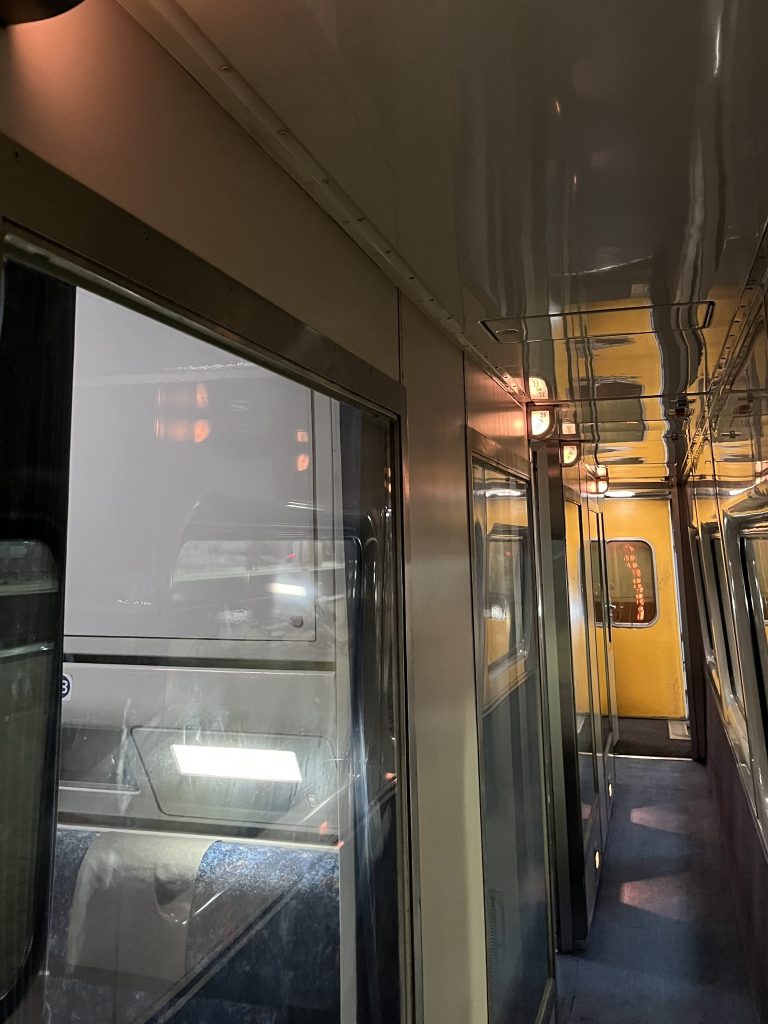
Thanks to the efforts of an Australian friend (hello Xavier!) we have managed to procure four berths near the back of the sleeping car. These are housed in two side-by-side rooms, which have doorways so cramped that they barely fit the average girth of a single person, let alone two men with enormous suitcases. The cars having been built at the turn of the 90s, their décor is a bit old and there’s barely room to swing a cat, but it’s mostly clean and the small scale gives the place a sort of compact charm. Far more of a problem is the lack of ventilation: despite the chill of the air outside, none of that is flowing into our compartments, which are so atmospherically dead that walking in feels like entering a sauna. We all had jackets on while walking through Belmont Park earlier, but these are quickly sloughed off in the warmth of the train.
Stuck in between our two compartments is a tiny toilet. Well, calling it a toilet is to overstate things; only a feet or so of space separates the bowl from the door, forcing you to sit down regardless of what you’re expulsing from your body. In addition, I read to some consternation that this tiny water-closet also doubles as a shower space: fold up the toilet seat — dumping everything you’ve just shot out of your body down a small gutter in the process — draw a waterproof curtain across the door, and there’s your bathroom. The other boys take one look at it, and decide that they will go without for one night.
An attendant stops by to takes our breakfast orders. He half-apologises for the stultifying atmosphere — “we’ve set the air-conditioning to 22°C, but it’ll get better” — rattles off a bunch of information which I couldn’t remember then and certainly can’t remember now, and finishes off by telling us that we should press the button to call him and his colleagues when we want our beds made up.
“And what would be the best time for us to ring you up?” I ask timidly.
The attendant fixes his gaze on me that’s equal parts amusement and exasperation. “Never,” he says.
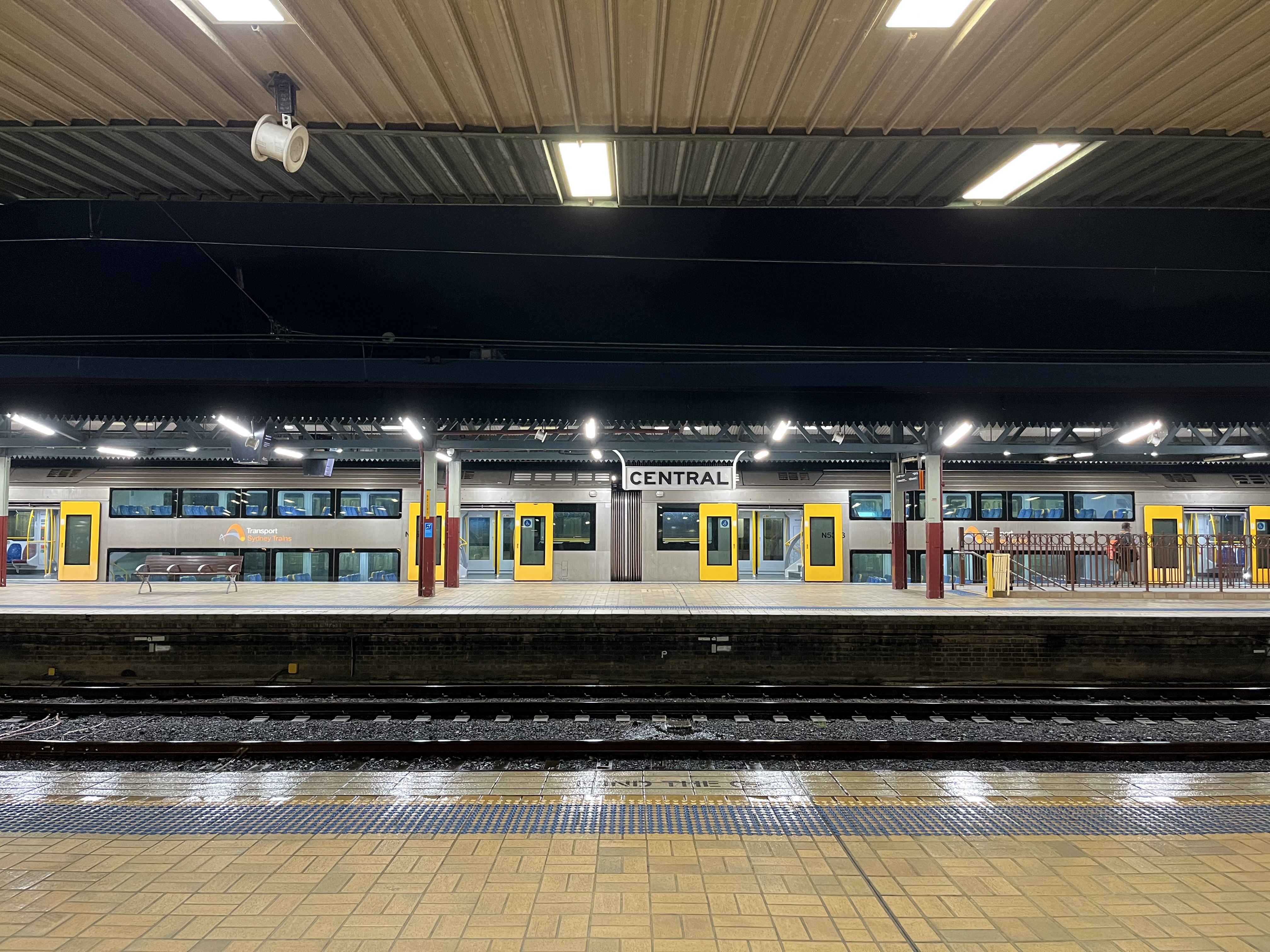
Eight forty-two. The rain has subsided, the passengers are boarded. I’m in the middle of a conversation with Sunny about the toilet when the train judders into action. Slowly but surely Central Terminal slides past us, and then we are in the pitch black night, surrounded only by a thousand artificial stars from the skyscrapers of Sydney. We trundle out of the railyard, past Redfern station, and pick up speed: soon we are rushing past suburban stations, the names of which I’ve only seen on the map: Kingsgrove, Revesby, Macarthur. They flash past one by one, their lights strangely alien and bleak, an island of human activity in amongst the void.
The other lads are, perhaps unsurprisingly, not interested in any of this, and once we pass Campbelltown station and enter the blank hinterlands of New South Wales, I too turn my attention to the complimentary box of goodies that we’ve found on our seat. It’s a ragtag bunch of things: biscuits, cheese, toothbrush, earplugs; but all of them very thoughtful and practical. My favourite part of it, though, is a packet of generously spiced crackers which for some mystifying reason have been labelled as “wheat snacks”. They’re very good, but make me absolutely thirsty, and I crack open the complimentary bottle of water which they’ve also packed inside. While I slake my thirst by chugging down most of its contents, Eugene heads off to visit the restaurant car, which is really just a small bar with distinctly unappealing food options — sandwiches, salads, and one solitary pie. He heads back to our rooms, much disappointed.
With Sydney long gone, it’s time to wash up. The others may have decided to withhold personal hygiene for the night, but I’m not about to be dissuaded by a lack of space. Lift up the toilet seat, disrobe, realise I’ve left my pyjama trousers in my room, hastily slip on my briefs and rush back to get them, then realise they were on the toilet counter all along and head back inside, drawing the shower curtain. The water is cold and the soap little more than a thin Palmolive bar, but such is the heat from the air-conditioning that I only sneeze once. Far more of a problem is keeping my balance: multiple times I stumble as the train goes round a bend at speed, but since the cubicle is so tiny there’s nowhere to fall — you just crash against the shower curtained door. “Oh God, please don’t let the door give way, I’m naked,” I mutter as the carriage does another almighty shake.
Emerge from the bathroomlet with my dignity mostly intact and rejoin my friends. Eugene brings out a pack of cards, and we play card games with my suitcase as a table. This is no mean feat: such is the size of our room is so cramped that Daniel has to basically sit in the passageway, throwing cards towards my luggage while my feet squirm uncomfortably next to his shoulders. Perhaps this is why, as the towns whizz by, he’s never really able to break through: despite having a series of winnable hands (which, due to my advantageous perch, he keeps on accidentally revealing to me) he keeps on tossing out the wrong cards, and ultimately ends up coming dead last in every single game.
Or maybe it’s just that four long days of travel have begun to take its toll on him: as someone who works in a very stressful admin job and overtimes almost every day, it can’t be much of a relief for him to spend a restful Easter holiday jogging up the Blue Mountains or visiting countless beaches on the other side of the equator. By the time the clock strikes eleven, his already-soft voice has dipped to an incoherent mumble. Given that the others, too, are yawning and we’re due in Melbourne at half past seven, we decide to call it a night. The attendants lower our beds, and soon we have turned off the lights, and settled onto the thin but comfy mattresses.
Sleep, however, does not come so easy. For a start, I made the mistake of waking up at a late hour today, and my brain is not ready to switch off just yet: so for what seems like an eternity I gaze into the pitch black, trying to shut down while a thousand thoughts run screaming across my head. Then there is the fact that the ride seems to have worsened: every movement the train makes seems to have an outsized effect on our room, pitching it around and sending vibrations juddering through my spine. Lying there on my mattress I think back to my last night train journey, where I managed to fall asleep on my barely-mattressed bed. No such thing on the XPT, where every thirty seconds or so I am flung towards one end of the bed and then towards the other. The effect is not unlike being onboard a ship sailing through the Pacific during typhoon season. Is it possible to get seasick on a train?
Manage to doze off for a bit after what feels like an eternity, but respite is brief when a particularly violent turn jolts me back awake again. For a few moments, my confused brain struggles to process how I’ve suddenly got onto a Disneyland dark ride before reality reasserts itself. There is some steady breathing coming from below me, but it stops and starts at intervals, so I know that Sunny isn’t having the best of nights either. Unplug my ears to let them breathe a little, then plug them again after the racket from the train makes it all but impossible to sleep. Descend the ladder to visit the toilet and am slammed against the toilet door multiple times; ascend again half-terrified that in the dark I will somehow miss the bed at the top and split my head open against the ceiling or the edge.
Snuggling back into the sheets, I shut my eyes and feel the sway of the train against my body. Such was the heat last night that, after everybody turned in last night, I took off my shirt and slept topless; but now the sheets feel icy and clammy, and sliding back in feels like wading into a mountain stream in December. Grope around for my T-shirt in the dark, my head buzzing with motion sickness, and my body shivering with cold.
Somehow I must have gotten back to sleep, because the next thing I remember is a loud knocking at our door. Before I can even rub my eyes Sunny has turned on the lights (MY EYES) and flung the door open, whereupon two staff members hustle in with our cornflakes and ask us to get out while they put the beds back into sitting position. Hurriedly scrabble my things off the mattress and almost jump six feet onto the floor; looking at the berth next door, Daniel and Eugene are already up and dressed for the day, glumly munching on their cornflakes and yoghurt while their seats are being converted back to the upright position. Outside the sky is still a dark shade of blue; check my phone, and discover that it’s barely quarter past six.
“Get any sleep?” I ask Daniel. (As readers of my South Korean journal — and his personal friends — can attest, there is no point in asking Eugene this question; the man will sleep through nuclear annihilation if need be.) He shakes his head. “Very little. The train kept on shaking.” His eyelids are heavy, his voice still soft: I can already foresee the momentous effort needed to drag him through the streets of Melbourne for the rest of the day.
Sitting on the seat, munching on my cereal and yoghurt, I can’t help feeling a little glum as well. I had hoped that tonight would be an interesting experience: we don’t get night trains in Hong Kong, and having spent most of our Sydneyside journeys on a private car, the night train felt like it could be a change of pace: accommodation and transport, all rolled into one. Yet the XPT has been a let-down: bumpy, untimely, and generally anxiety-inducing — not exactly endearing attributes, and certainly a far cry from the Nightjets of Europe. Public transport down under, from what I’ve seen and read, still has a very long way to go: people still travel from city to city, from district to district, in their own cars; buses, trains and trams still remain something of a secondary choice. There is talk of improvements (for one, the XPT might buy some new carriages in the next few years) — but until those come, travellers like us will have to bear many an uncomfortable ride, and be introduced, bleary-eyed and sleep-deprived, to a new place in Australia.
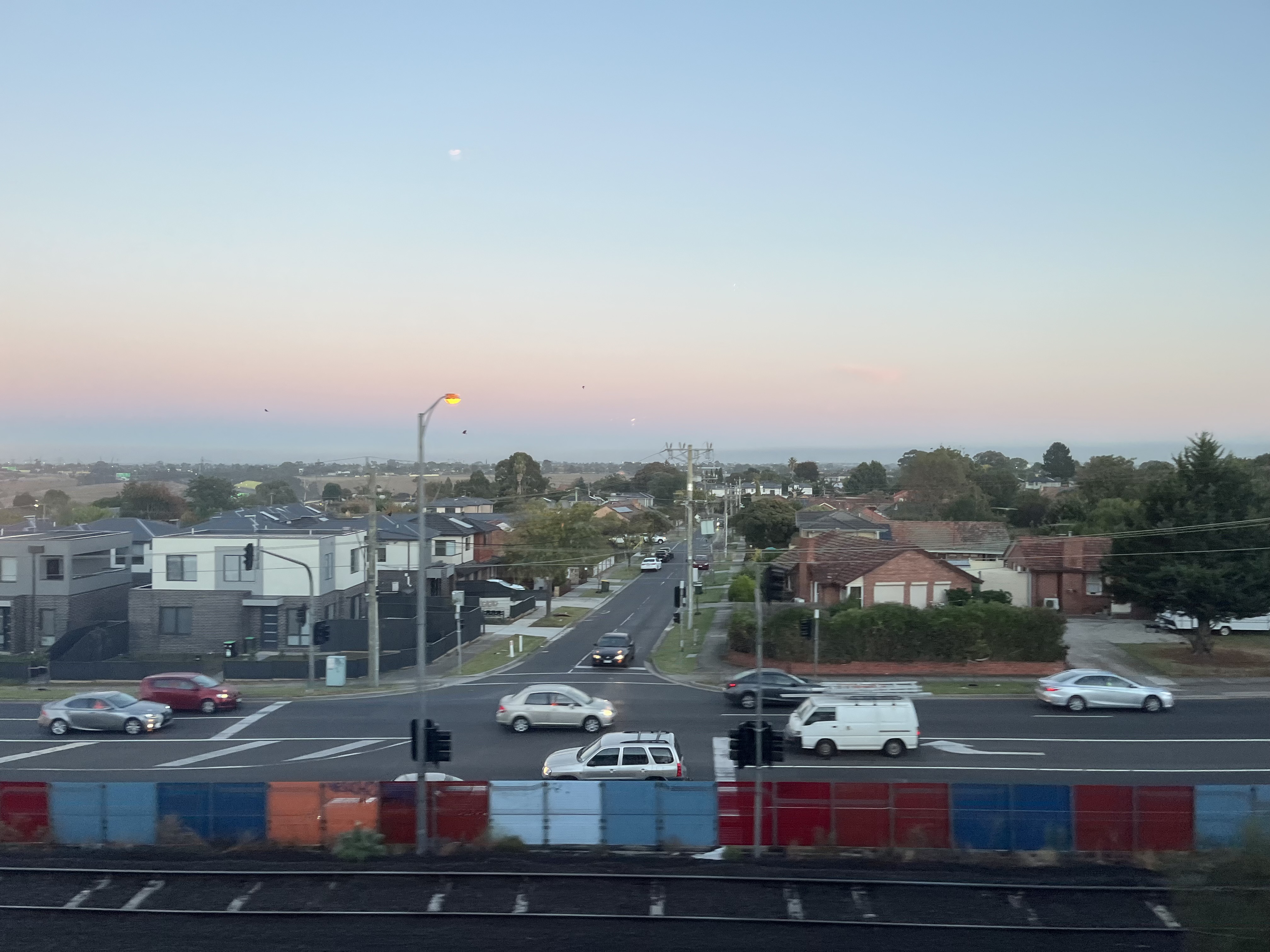
The train has just left Broadmeadows, the last stop before it reaches the city centre. As we pass through the suburbs the sun rises and flashes on the glass, while the sleepy bungalows and houses slowly begin to stir. The light casts a bright blanket over the outside scenery, merging it all into one blinding orange haze. Then a more definite skyline — the Melbourne I know and love — creeps up on the horizon; there are the office blocks, the motorway bridges leading into the city, Marvel Stadium. I’ve waited for this moment ever since I last left Melbourne, almost seven years ago; it feels surreal that I’m actually getting to see it all again.
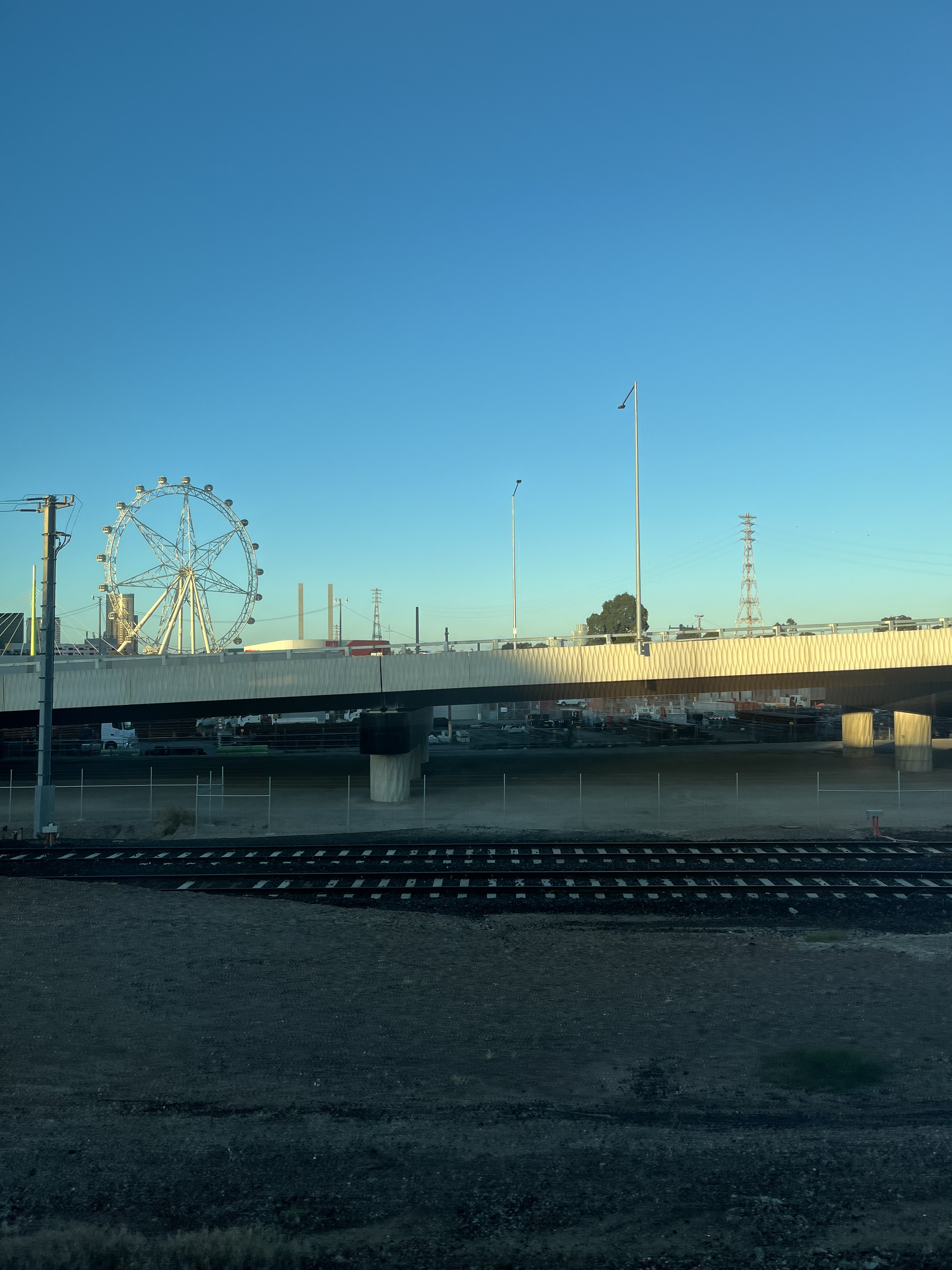
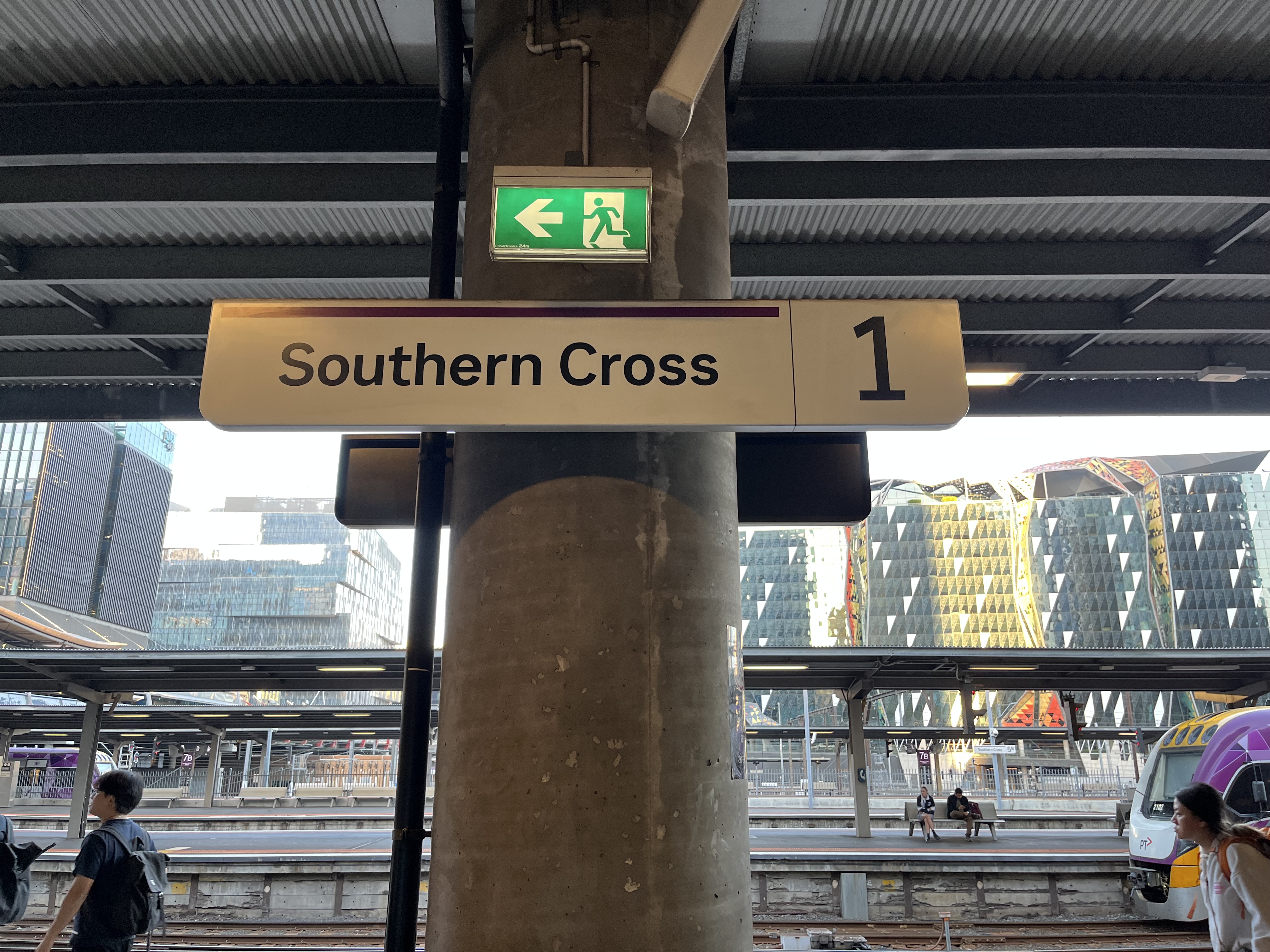
At last, Southern Cross station. Before it comes to a complete halt half the passengers are already up, queueing at the doors, ready to spring off at a moment’s notice. As we make our way through the carriage corridor, the attendants are already hard at work, getting ready for the return journey to New South Wales in an hour. There’s a calm method to their work as they rearrange the seats and check the toilets for anything left behind; they give us a curt but friendly “goodbye” as we walk towards the doors.
The first scent of my return trip to Melbourne is diesel: the fumes from the engine are still swirling in the air as we step onto the platform. It lingers as we make our way towards the Spencer Street entrance, and is only gradually replaced by a crisp, slightly dusty gust of morning breeze. It’s that slight smell of grit and grime that excites me though: so many times I’ve smelt it, walking down the Yarra or Swanston Street during my five months on exchange; it is that scent that proves, once and for all, that I am back in the Victorian capital, back in the city that gave me so many memories to treasure.
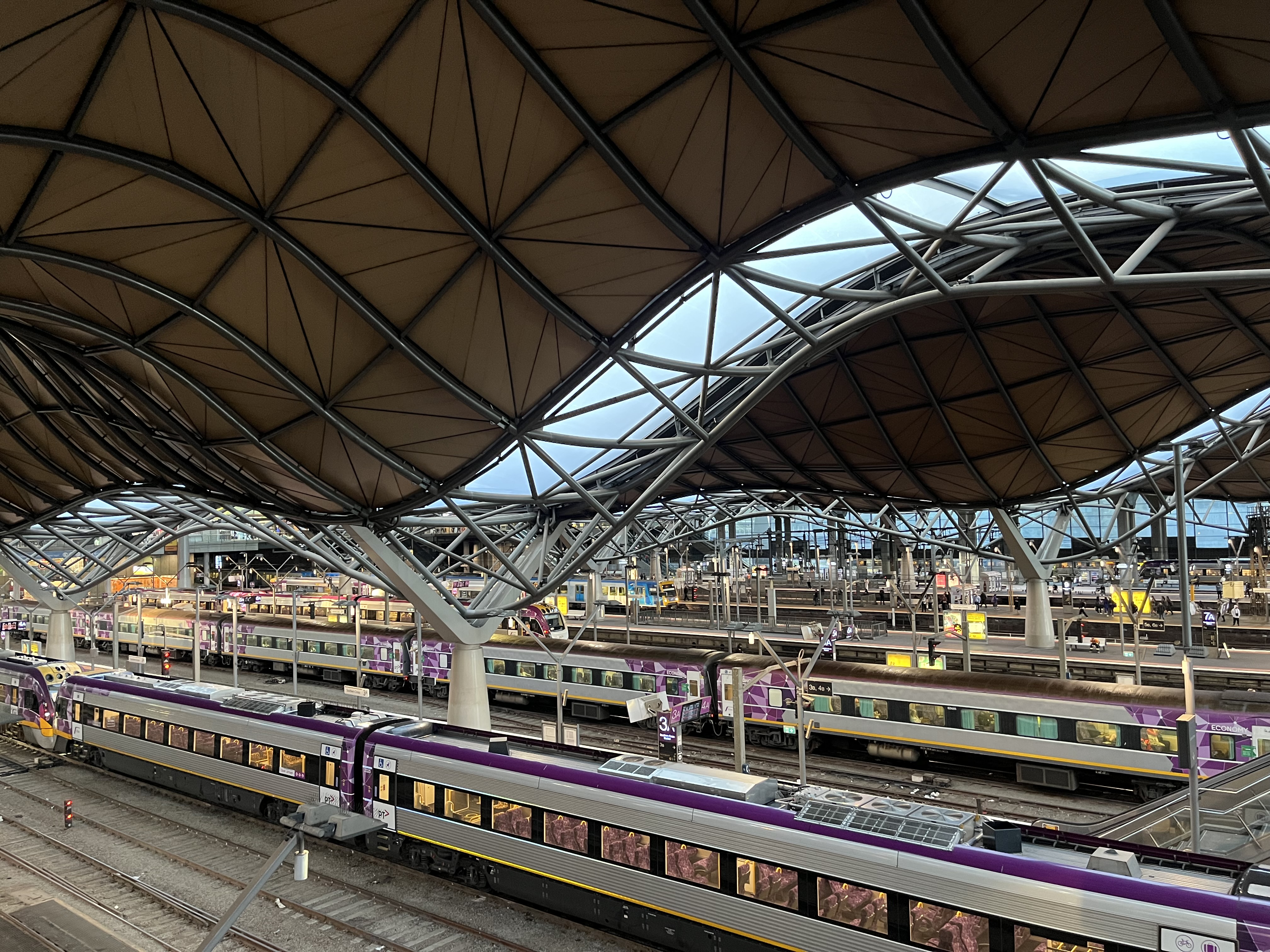
I look up, up into the skies and the metallic ceilings of Southern Cross. This place has always been compared unfavourably to its sister station just down the road at Flinders Street; it has none of the latter’s classical charm, none of its neatness, none of its calm efficiency. Yet I’ve always loved the newer station more: there is something awe-inspiring about walking under its undulating canopy, and seeing the little dots of light coming down from the skies; many’s the time when I’ve stood on platform 9, waiting for the Hurstbridge train, and been comforted by the sounds of the trains, the announcements, and the sight of the night sky beyond the metal sheets. It’s a wonderful introduction to Melbs, and I’m happy to see it again.
While my friends blink uncertainly in the morning light, I lead them up the escalators and onto the Bourke Street bridge. Is that a thrill of recognition I feel as I walk along the concrete, or just the autumnal chill? Here and there I register places and sights that had given me so much joy: the arches of 735 Collins Street, the view of the Spencer Street railyard from the bridge. But seven years’ absence has also brought its changes: the Nando’s where I had my last Melburnian meal has disappeared; so too have the steps where I watched the NBA Finals on a huge screen with the Melburnians one lazy winter morning.
And yet the most important thing of this corner of Australia remains, eternal, immovable. A lift takes us down from Marvel Stadium onto Harbour Esplanade. The doors open, and suddenly our eyes fill with light as we look onto the waters of the Docklands inlet, lapping gently at the wooden mooring posts and washing onto the piers next door. A slight breeze blows on our faces, cool and bracing, while weak sunlight shines from the stadium behind us onto our backs. In the distance, the colossal Bolte Bridge rises above the harbour, its white and red frame in the morning light.
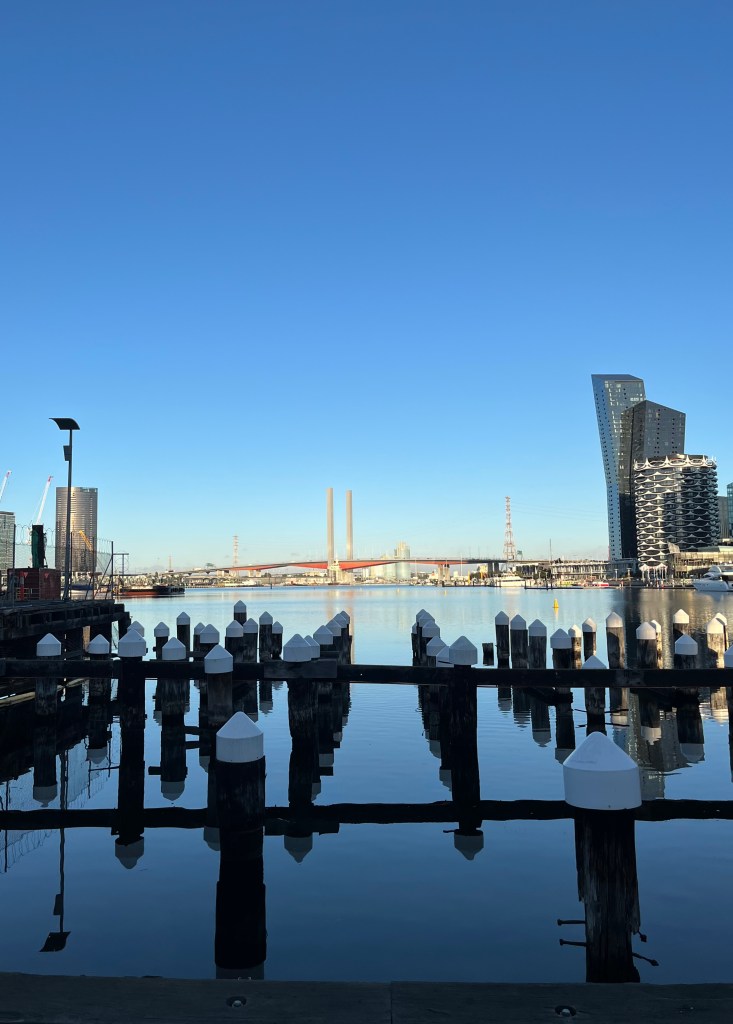
I must’ve seen this sight a hundred times: the Docklands was my favourite district to walk around during my exchange, and every single component here I have replayed in my mind a thousand times. But seeing it again still takes my breath away, and from the way my friends have also stopped to stare, I’m not the only one who feels that way. Standing there on the shore, I realise how blessed I am to be here again, to be with my friends in a city that has given me so much joy in the past, and will doubtlessly do so again for the next four days. We are tired and sore from a night of travel, and there’s more to come in the next four days — museums, libraries, the Shrine of Remembrance. There will be inclement weather, rushed trips to the supermarket, more meetups with people whom I never expected to see again. But we are in Melbourne, and right now, that’s all that really matters for me.

 Inkpot Shuffles in the Twilight