30 March
Our last day in South Korea. Has it already been four days since we touched down at Incheon International Airport? I find myself folding my clothes with slight regret. This time tomorrow, I will be safe in my own familiar bed, probably fast asleep, yet I feel like I’ve barely scratched the surface of this delightful city, to say nothing of the country it’s in. One of the saddest things about travel lies in how your attachment to a place only really solidifies when you’re about to leave it; I’d never thought this might be possible for Korea, being a Europhile and all, but there’s still a slight twinge of sadness as I close my suitcase for the final time, and we head down in the lift.
At Seoul station at 10:30. Not because we’re catching a train somewhere else, but because there’s apparently some sort of luggage transport service hidden somewhere in the bowels of this station, and we’d like to save ourselves the trouble of lugging our suitcases everywhere today. We roam the endless hallways of the metro, travel up and down escalators, yet the sheer size of the station complex means that the alleged luggage office remains frustratingly elusive. Just as I’m about to give up and suggest we use the lockers instead, Eugene locates the office, hidden in a kink of a busy corridor. The staff eyes us warily as we struggle to tie up our luggage and extract what we need for the day while crowds swerve around our general chaos, but eventually we manage to pack everything up and put our suitcases in storage for transport to Incheon Airport tonight.
Seoul station is a wonderfully large area; spacious, bright, and full of people meeting and greeting each other. More tourists obviously lost than the other big stations of the world — even in Copenhagen or Paris, the adrift look like living sculptures, pausing to take stock of the beauty around them — but the sight of all the suitcases and the sound of the different languages make clear that this, this is an international melting-pot, this is where the peoples of the Earth gather. (As well they might; the platforms of the train to Incheon Airport lie a dozen levels under our feet.) At the far end of the station, we spot an enclosed room that seems to be populated entirely by men in uniform; a sign above the entrance says “reserved for ROK Army personnel”. As demonstrated just last week, this is still a country very much on edge, and very much in deference to its defenders.
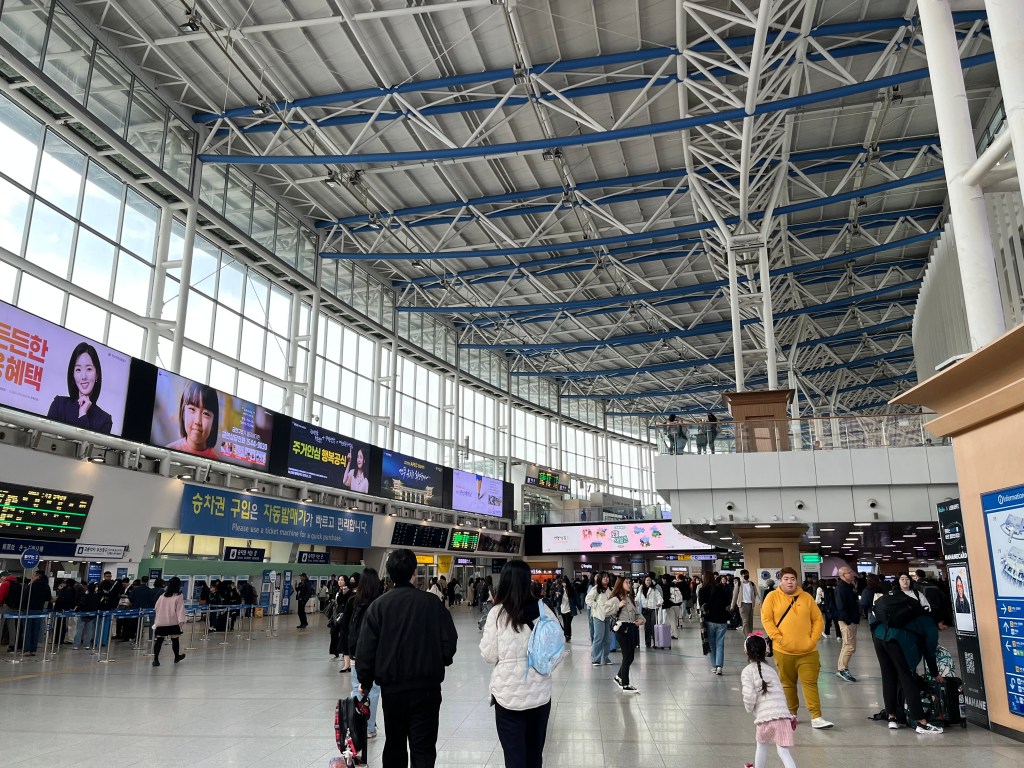
My stomach begins to rumble. Having escaped our hotel without first partaking in sustenance, I am becoming what the younger generations these days call “hangry”. Loads of fast food joints on offer here — astonishing just how much Korea has made Western culture their very own — but it just feels way too early to be indulging in greasy burgers and thick milky coffee. The restaurant we ultimately opt for seems to suffer from something of an identity crisis: on the left, a dark and moody Japanese restaurant, and on the right, a brightly-lit place serving Korean fare. Pick the latter, and after a bit of the usual menu second-guessing I choose a seolleongtang, an ox-bone soup that’s light and still absolutely delectable, a fine counterpoint to all the rich stuff we’ve been eating this past couple of days. While inhaling the steam from the pot in front of me, I just about catch myself before my eyes close; five whole days of exhaustion all rush to my brain in an instant and it takes all of my body to rise, stretch, and yawn my way out of that tiredness. Meanwhile Eugene is staring quizzically at his beef stew, a deep brown void with copious amounts of oil floating on top. He looks at me, then at the Japanese restaurant next door. “Isn’t this just the sukiyaki with a bit more water?”
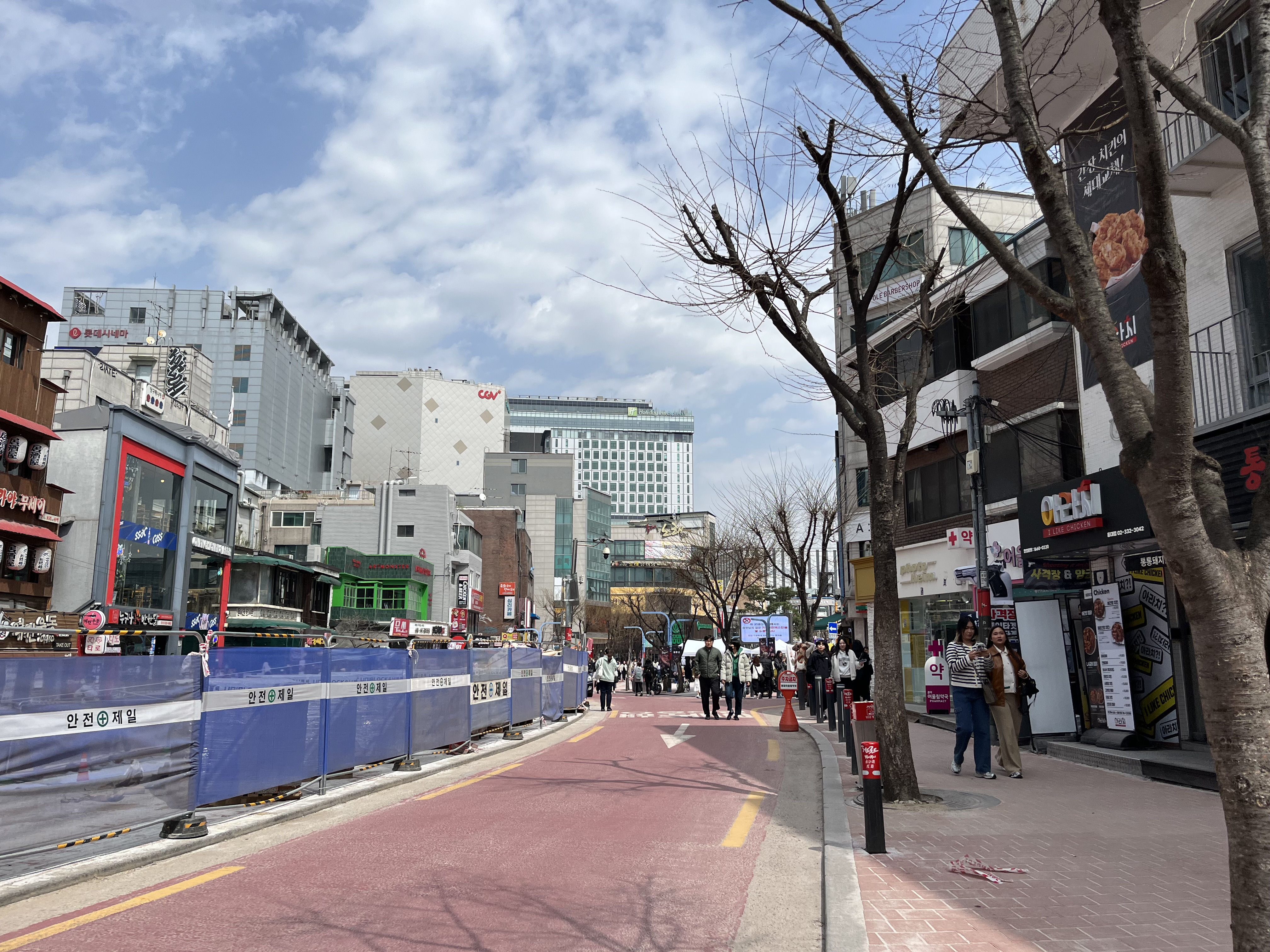
Later. As the clock strikes twelve, we find ourselves back in Hongdae, that trendy and youthful neighbourhood that we passed by yesterday. (We know it is youthful because a shop just behind us is loudly proclaiming its sale of “SEX TOYS”.) Even by daylight, it reveals itself to be a very raucous and bohemian district: music plays in stores and speakers along the street, markets with endless items on sale for a fraction of normal retail price, and the smell of a thousand different foods waft out from the hundred different restaurants crowded onto the pavement. There is an Irish pub and a Spanish restaurant, sitting in amongst the countless cafes and grilled-meat places; something for every nationality of student that happens to find themselves in Seoul, no doubt.

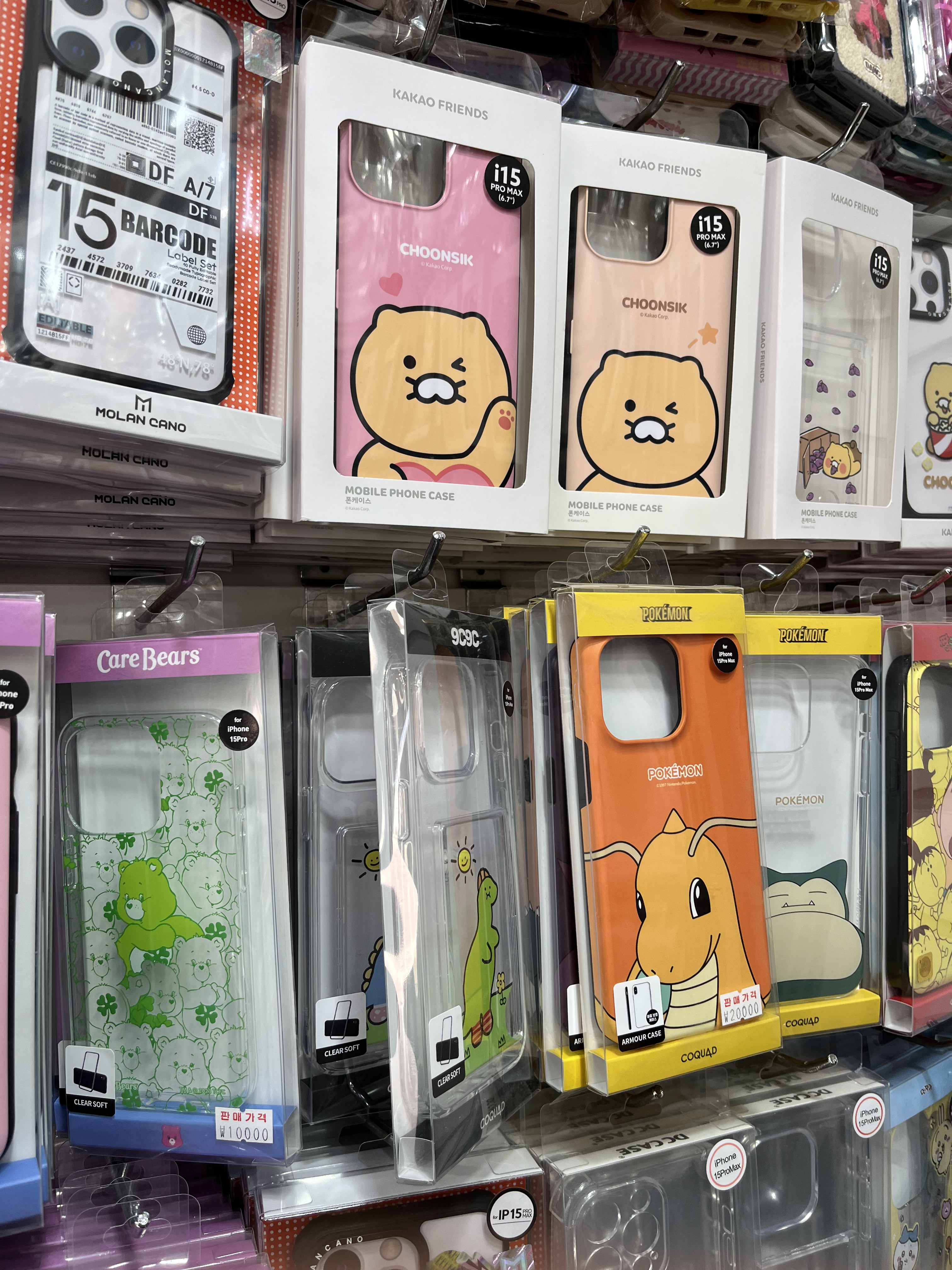
We walk inside a shopping centre situated right next to the metro. It’s lunchtime, but compared to the streets outside this place is much quieter: in only a couple of shops do we see more than a few people milling about. Dessert stores, clothes shops, restaurants — all doing decent business, but not the booming sort you might expect in a trendy area like Hongdae. “Where is everybody?” I ask the gang as we progress through the levels, and find ourselves greeted by empty floor after empty floor. Turns out they’re all on the top one: dozens if not hundreds of them, crowded into one store which sells comic books and anime figurines; such are the swells of people inside that when I get briefly separated from the others, I have to squeeze between two people multiple times just to rejoin my friends. Best to stay outside, I think. Beside that huge statue of a scantily-clad anime girl. Hopefully nobody gets the wrong idea.
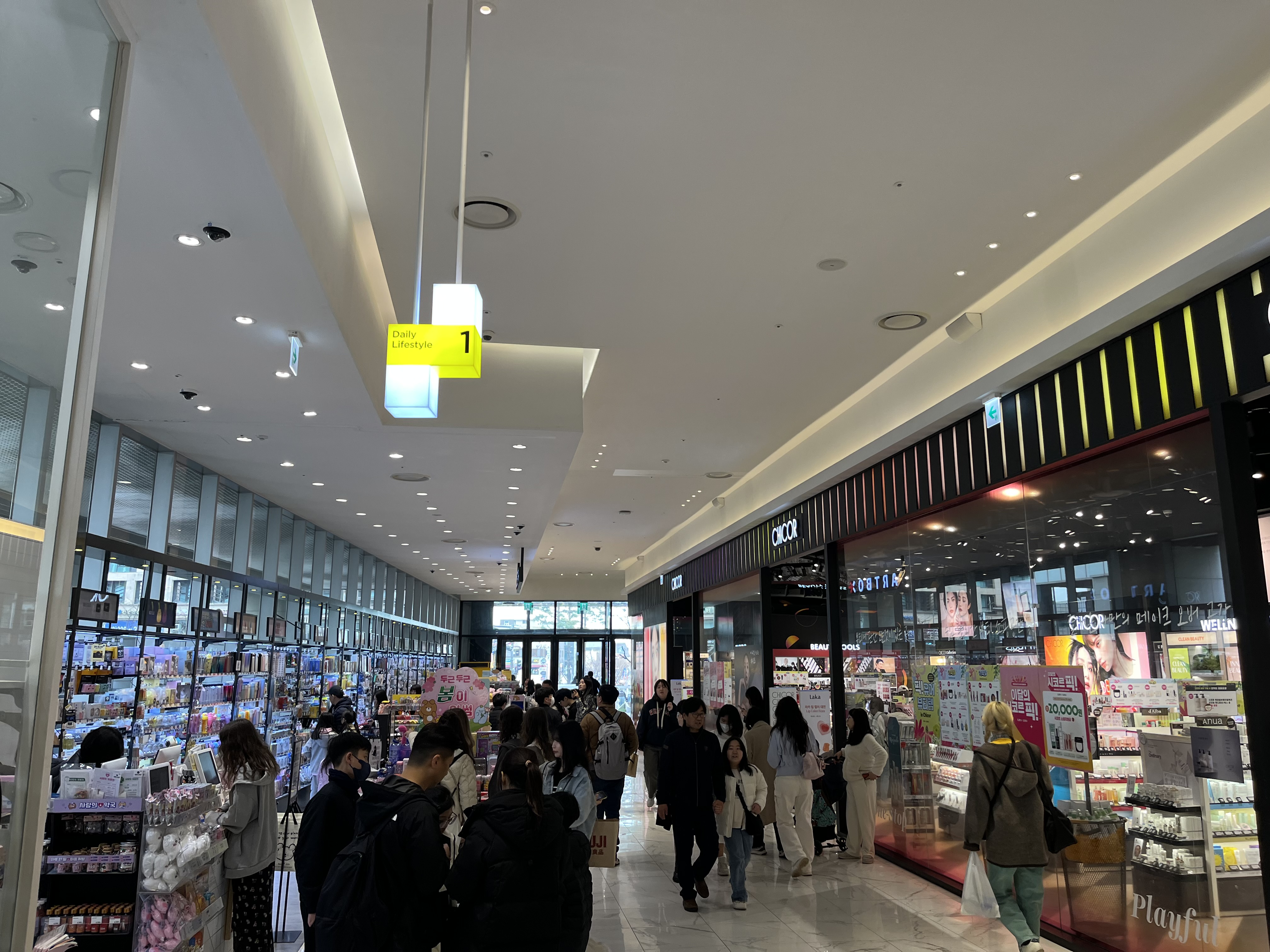
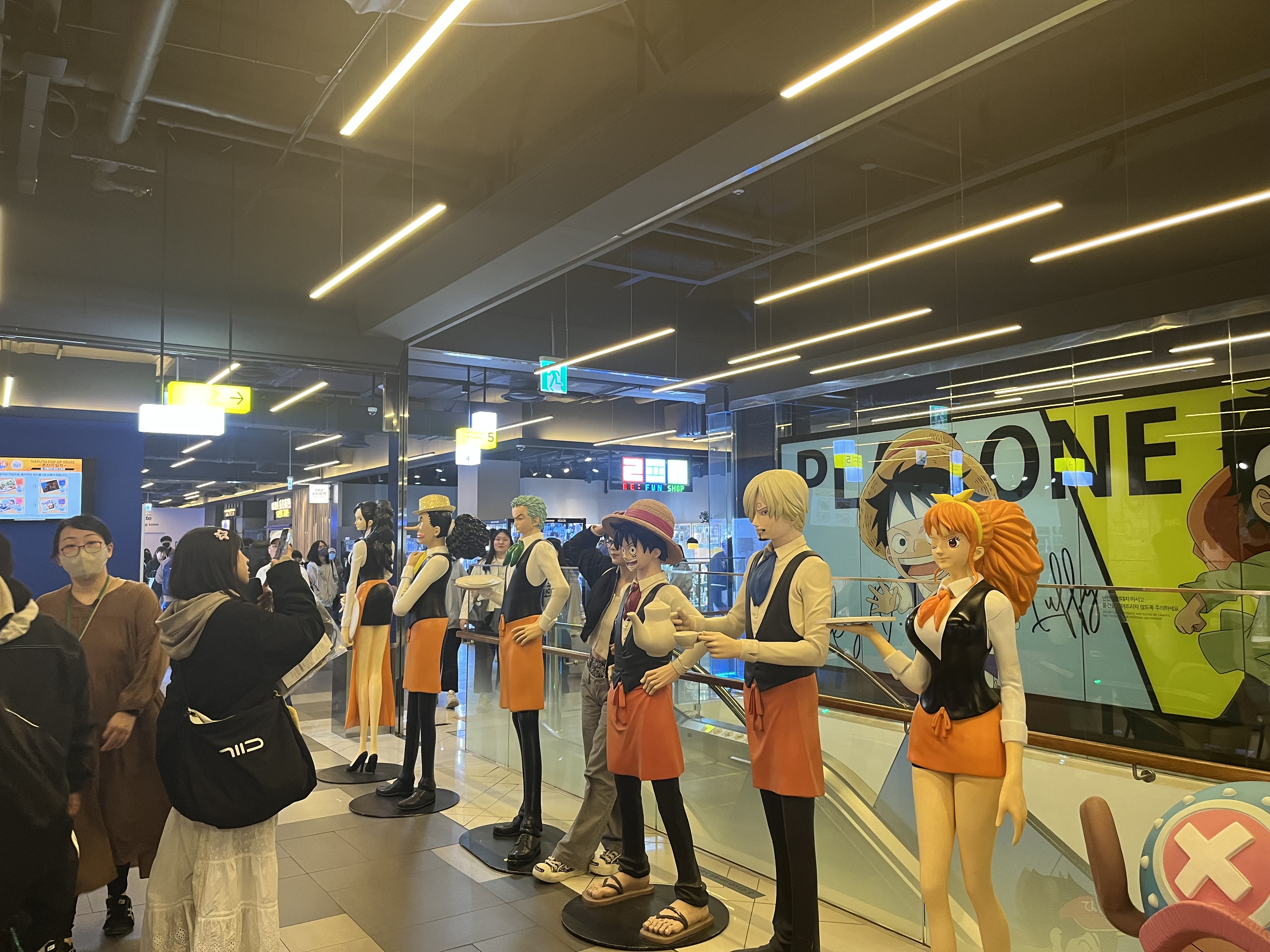
Step back out into the sunshine and go walking down the streets, checking the map as we go. Although I’ve done 90% of the itinerary planning for this trip, the others have been chipping in, and Eugene in particular has been very eager to visit a “Museum of Illusions” situated somewhere within this labyrinth of alleyways. I’m a little less sure: the last time I visited that sort of museum, the receptionists made me stand at the desk for half an hour before letting me into a very underwhelming room about the size of a classroom, which means I have a deep suspicion of that sort of place, as well as of the entire city of Berlin. But I’ve had complete control for the past five days, and so it only feels decent to let the others choose a destination for a bit.
But first we have to find it. South Korea’s addresses are a mishmash of unreadable characters and multiple numbers, and here at Hongdae the numerous side-streets make navigating a positive headache. Eventually locate the street the museum’s supposed to be on, only to discover that the buildings on either side of the road are decrepit or downright derelict, and do not look like they could hold a museum. Surely this isn’t an optical illusion itself? Surely they aren’t that good? Daniel spots a staircase on the corner that matches the listings on Google Maps, but it leads nowhere but downwards to the basement, where we are greeted not by a collection of trippy art, but rather a café decked out in vaguely tropical decorations. Eugene heads inside to clarify with the proprietors, but within a few minutes, he returns, crestfallen. “They say they’ll only let us in if we also buy a drink,” he says.
Two fifty-five. We emerge from yet another draughty metro exit and stumble back above ground, into the shadow of yet another enormous structure.
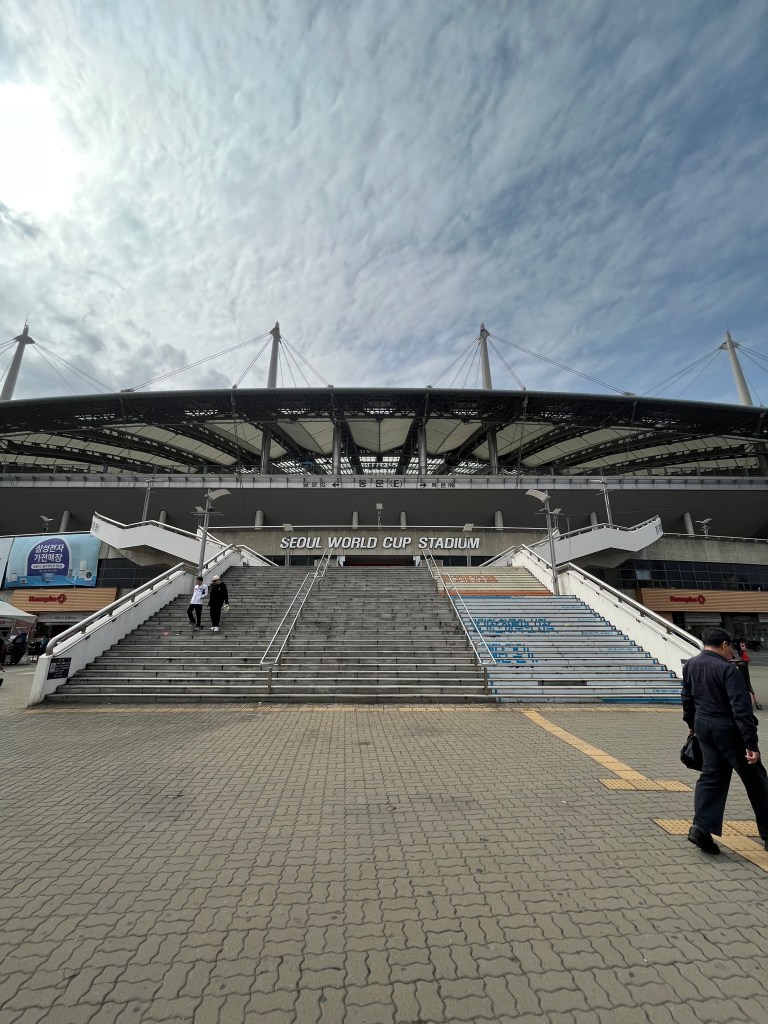
I’m too young to remember it, but it was a huge deal when South Korea co-hosted the World Cup with Japan back in 2002. It was, after all, the first time that it had been held in Asia, and excitement was sky-high around the entire continent (I remember seeing leftover merch from this World Cup floating around Hong Kong, even a few years after FIFA had moved on to other countries willing to shell out billions of dollars just to host a five-week football tournament). Unlike their neighbours to the east, however, South Korea still holds that World Cup in almost astronomical levels of regard; on magical form during that summer, they managed to squeeze into the final four and almost got the drop on the German team in the semis, creating a run that still remains the high watermark of Korean football — and now here we are, at its high temple, hoping to pay our own respects.
But if we are to do so, we have to move fast. There is a guided tour of the Seoul World Cup Stadium that is set to begin at three o’clock, and finding the right entrance at this monster of a building is like trying to find a needle in a sea of metal objects. Not only does this stadium present different levels, but navigating between them requires some Herculean feat of concentration, which we do not have after 99 hours of non-stop travel. Every sign we see gives directions to every conceivable spot within the stadium except the gathering place; as we rush across the large, gusty plaza, I fancy I can hear the roar of a crowd within the walls, taunting us with our inability to gain access. On our way downwards, we stumble across a convention centre, where a wedding reception seems to be taking place; the mismatch between event and venue has never felt more alienating to lost tourists like the four of us.
Finally, I spot it: “entrance to the guided tour”, emblazoned in large letters over a doorway deep in shadow. We rush in at three-oh-five: just late enough for the tour to have started, but not late enough that we can’t cajole our way in, right? Tourists do that all the time in the tours I’ve done. At the counter, a solitary male receptionist eyes us with cool disdain as we walk in. Upon hearing our request to join the guided tour, he takes out his phone and begins to type. Seconds pass by in loud, awkward silence; we shuffle around uncomfortably on the soles of our feet and I affect nonchalance even though part of me would like to strangle this dude for his overtly laconic response. Finally, with impeccable bureaucratic tranquillity, he shows us the results of his texting on Google Translate: “the quota for tours is full today. Please come back on April 6.”
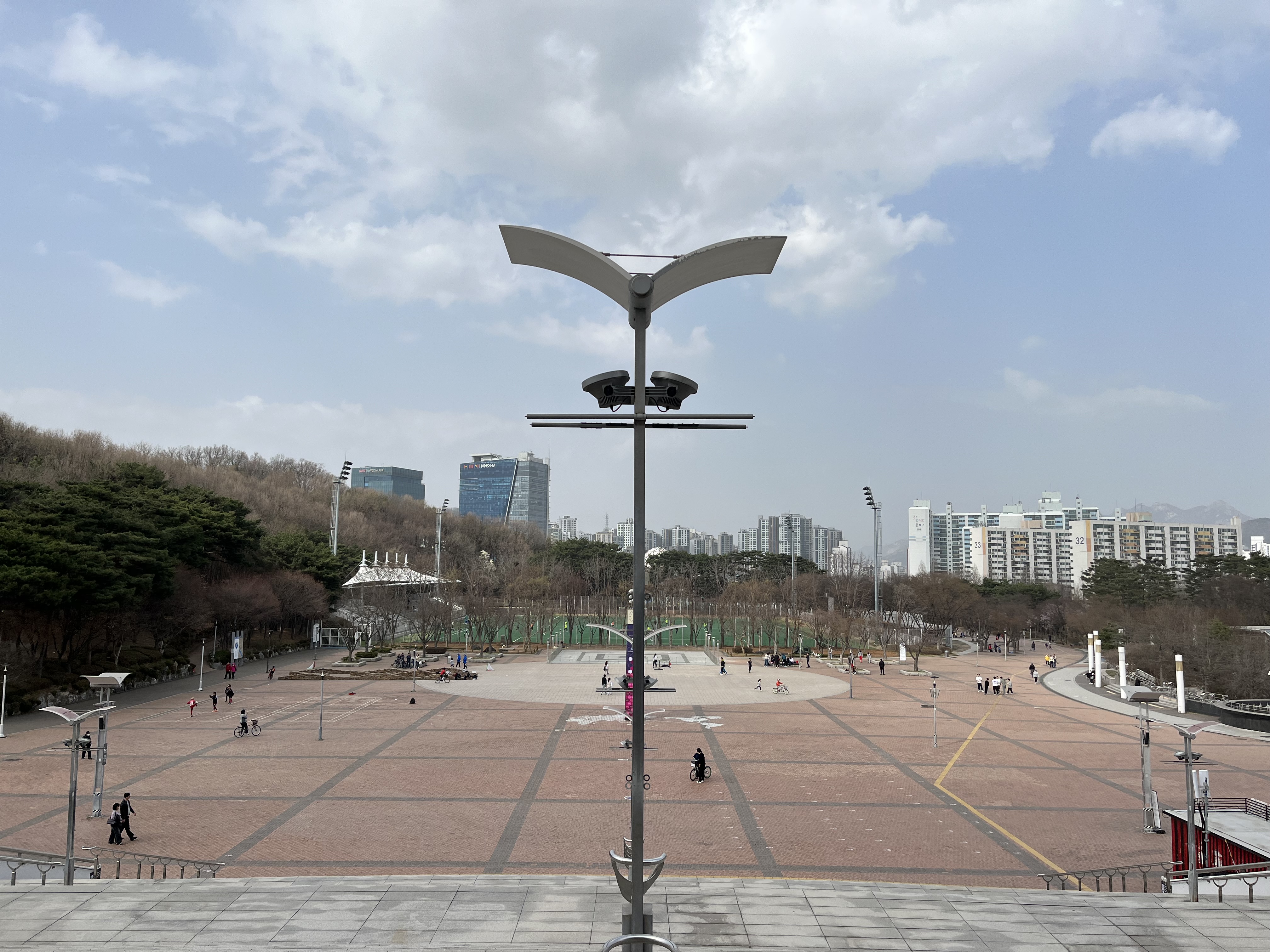
We trudge back out into the sunshine and sit in the shadow of the stadium, halfway down the steps. The cold wind breezes across the platform; the afternoon sun shines faintly in the distance, beaming down onto a park where skaters are busy showing off their moves and parents follow their children as they stumble across the park. It makes for a very suburban part of Seoul, which makes the huge edifice behind us all the more out-of-place, an great white extraterrestrial elephant landed in the middle of a riverside meadow. With both tentpoles of the day’s itinerary nullified at a single stroke, we have to find something else to do — but in this godforsaken area, halfway on the road to Incheon, this’ll might be difficult.
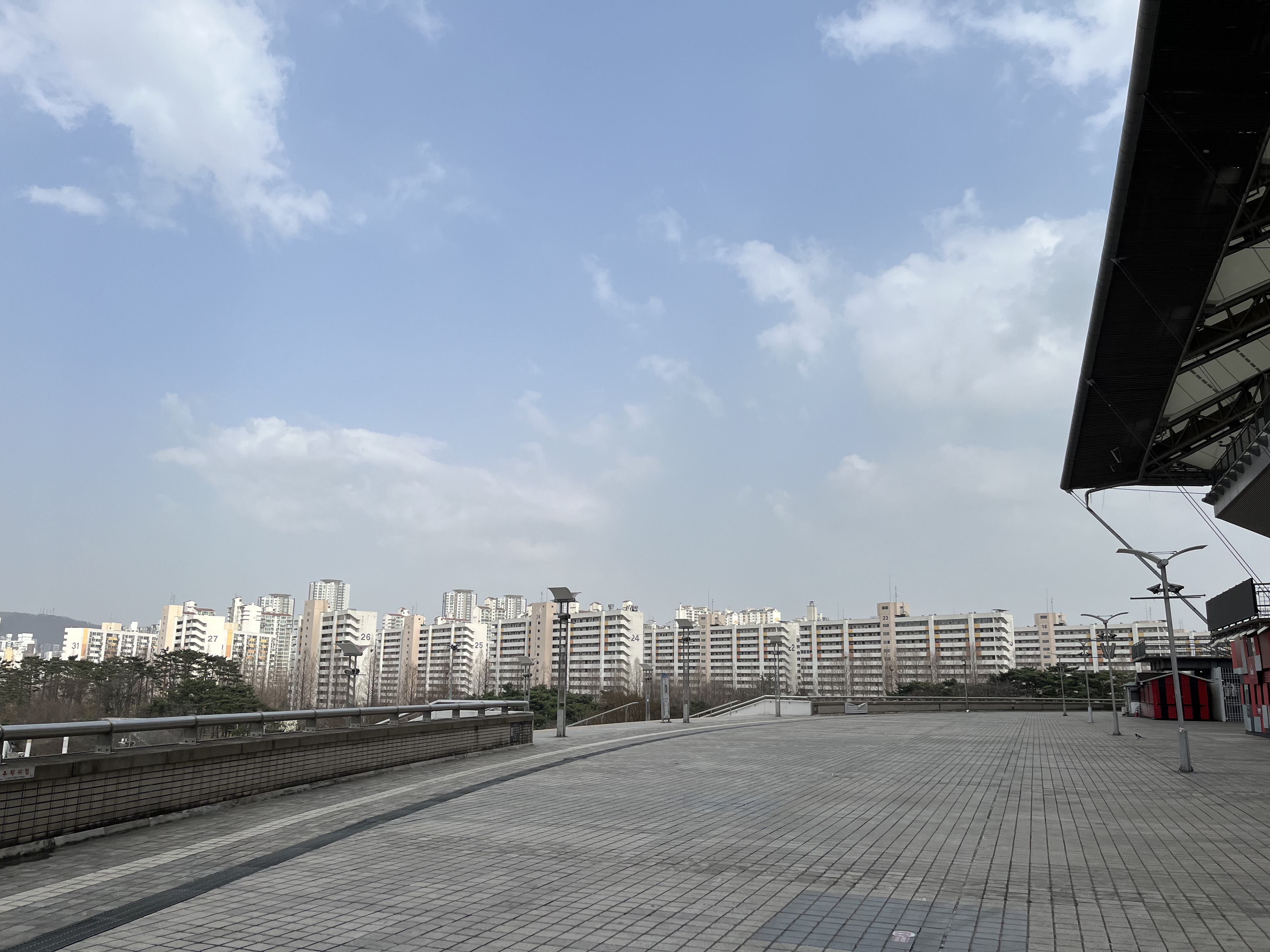
Still, the information boards, few though they may be, DO provide some ways out for the despondent traveller. There is, for instance, the constant advertisement of a “hypermarket”, and the emphasis is on the prefix: they have devoted not a small section, but an entire FLOOR of the stadium to this market of markets — and make no mistake, this is an entire floor of the national stadium we’re talking about here. There are food kiosks and wine kiosks and hair salons and hat stores and an endless array of other stores that have slipped my mind since I went there seven months ago; it was just such a huge place that it’s difficult to even remember a fraction of what this place is like. No sooner have we entered the hypermarket and walked past the first smoothie place then the other boys’ legs conveniently give out, and a half-hour sitdown is immediately requested. “We haven’t had anything since the stews this morning,” they plead. Amateurs.
While the others recuperate and slurp strawberry and banana shakes I trudge on, walking past the shoe section and the wine section and the clothes section and all those other sections. I know that tours of the stadium are out, but while doing my research I read about this other place that was the real deal: not a boring walk-around of the stadium’s changing rooms and football pitch and toilets (I did that back in Berlin, anyway), but an ACTUAL exhibition, one that would provide me with the context and the knowledge I needed to understand football in South Korea, one that could feed my daily museum addiction. Yet I walk past the food court, past the toilets, past the machine rooms, even… and still no museum.
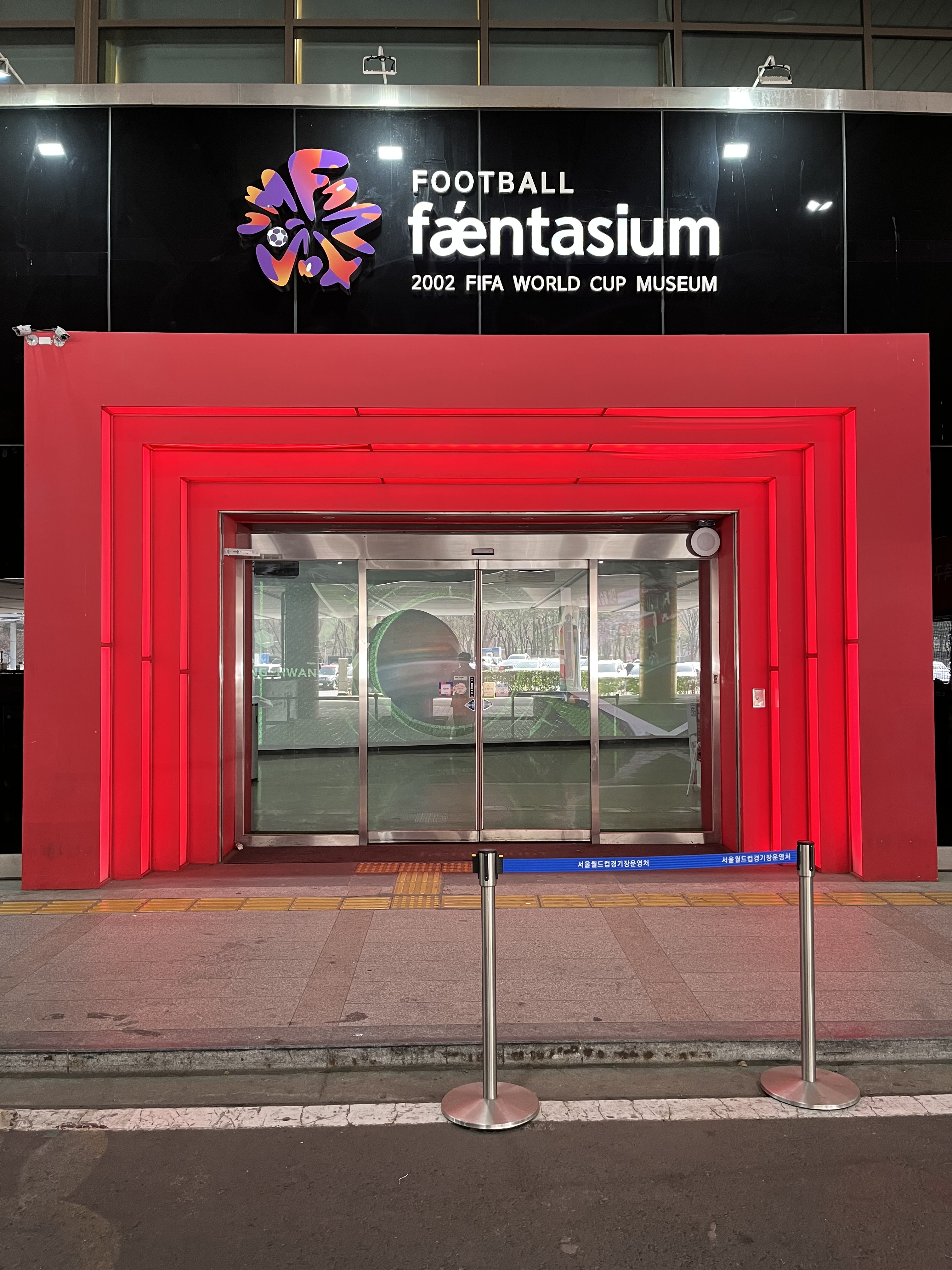
Am just about to give up and walk back to the smoothie store when I see it: a staircase leading down, a sign that says in huge capital red letters: “2002 FIFA WORLD CUP STADIUM”. At last. Something to gloat to the other boys over. I sprint downstairs and hurry inside the stadium, where I am hit by a wall of aircon precisely five degrees above freezing — no small feat, considering that the outside temperature is only ten more above that. Once the fainting spell has passed I take a look around, and almost pass out again: the interior is an epileptic melange of flashing screens and lights; shots of famous footballers, mostly South Korean, lining up to take a shot, a loud mishmash of voices, and a futuristic looking set of barriers leading inside the exhibition. A young woman sits at a lacquered reception desk, its gaudy red colour bulging out in the dim light. Enquire tentatively how much it would take to get in. “The entry price is fifteen thousand won.”
My mouth drops open. “Fifteen THOUSAND?”
“Yes.” And the receptionist gives me a little glare, as if to daring me to challenge her. Time was that I would have gladly forked out the money and then rushed in — but this is not one of those days. I am tired from lack of sleep and overabundance of activity, my mind is already suffering from informational overload, and the last thing I need is to pay even more money to learn about a sport which only appeals to me in terms of its statistics. I sigh, and walk back outside, the cold spring breeze whistling through the underground passageways. Decide to spend some of the money I’ve saved on gelato in the food court I’ve just passed instead.

Perhaps it’s just because we’ve been turned away from too many things today, but sitting there on my lonesome, I find myself progressively souring on the whole idea of South Korean football. The country’s still part of the big league in terms of Asian football, but the amount of hype that I’ve seen in its local media over the years just feels wildly overdone. Every single goal scored by a Korean footballer in a football tournament is treated like the Second Coming (and I don’t think Jesus Christ himself would receive as rapturous a reception were he to appear on Running Man); 22 years after their admittedly excellent performance at the games they hosted they are still clinging on to that split second of glory — an Asian version of England ’66. While other countries in Asia are beginning to get good at this sort of thing (I’m honestly looking forward to seeing Jordan and Uzbekistan at the World Cup), South Korea still holds their history in thrall, and I can’t help but wonder whether this fetishisation of the past presages the end of the national team’s dynamic days, and the beginning of a slow slide into moribundity.
My phone buzzes. Their smoothies finished, the boys are now heading downstairs to pick up souvenirs for the girls back home. For a while, I find it impossibly hard to get up: this food court is quieter than most, the air here is deliciously warm, and I don’t want to start the journey back home. But eventually I manage to summon up all the energy in my body and stand, and I amble down the corridor… and into one of the biggest stores I have ever seen in my entire life. This is not your average market, nor is it your average supermarket. Every single grocery you can imagine seems to have its own aisle — the number of potato chips/rice chips/nachos on sale alone would generate choice overload for eons, a point amply demonstrated by how the boys then spend ten minutes trying to figure out which ones make the most impressive purchases. Elsewhere, huge sacks of rice dominate a corner, pasta sauces stretch as far as the eye can see, and I find myself contemplating a family-size pack of ginseng chicken soup. Is it a breach of international law, I wonder, to transport a whole cooked chicken and its accompanying soup across borders?
“Is this the apex of our trip now? Just drifting around supermarkets like normal housewives?” I ask as we shuffle from aisle to aisle. We are, I notice, the only people around who look twenty-something: the rest of the clientele here are either older ladies with their shopping trolleys, or parents with their children in tow; it’s a weird way to spend a normal Saturday afternoon, let alone your last day in a foreign country.
And in that moment I feel much more jaded than I’ve ever been: this will be my life someday, not going out to lunch and dinner with friends and gossiping over the latest member of our social circles to get married, not going rock-climbing or museum-visiting or German-learning like how I’ve spent recent Saturday afternoons — if I ever settle down, I will be like this, following (or possibly dragging) my partner along on grocery shopping, exhaustedly figuring out which cornflakes won’t kill my child and surrendering myself to all those adult things — and that all seems like so much to handle. This is a recurrent thing for me (longtime readers of my blog will note that this is not the first time I’ve griped about adulting) but watching all these happy families do their weekend shopping, it’s hard not to feel that this period of my life is closer than never before, and that I, a person well into my late twenties, am desperately unlike any of these people.
But this is the sort of thinking to do at home, alone, on a Sunday afternoon. Right now, we are on holiday, and the task at hand is to finish off our trip with goodwill and cheer, as well as give my journal a nice pat ending. And so it is that I pick up a hat from one of the stalls crowded around the exit of the supermarket, and we make one final trip on the Seoul Metro back to Seoul station, where it all began. As we exit, the hordes of commuters flood towards the main station building, but we turn left and walk towards a quiet side entrance instead. The road outside is again only moderately busy, belying the fact that it’s five thirty on a Saturday evening; we dive into the warren of side-streets that squiggle through the commune on the other side. We are barely fifteen paces in when the noise dies down completely, and we find ourselves surrounded only by short village houses and the barking of a sole dog in the distance — we might as well be in the middle of Gangwon Province, with nothing but fields just outside this little circle.


The barbeque place we’re looking for is so unobtrusive that we walk past it twice before recognising it. The interior is a world away from the eatery we visited on our first night in Seoul: that one was aesthetic, organised, its waitstaff always ready. This one looks like we’ve wandered into somebody else’s living room — and to illustrate the point, the owner’s baby grandson comes waddling into the place after we sit down, noisily pushing his toy car. His grandfather follows him noiselessly, turning on the stove and bringing us food while his feet makes almost no sound on the floor; his wife is only marginally more communicative, taking our orders with reserved politeness, patiently waiting while we bicker in front of her what exactly it is that we want. It all looks spectacularly amateur.
And yet there is something more enticing about this restaurant, with its makeshift tables and its homely vibes; something that makes us relax a little bit more. The rowdy street scenes of the past five days have been shut out, the crowds of Itaewon and Myeongdong a distant memory; now, we’re just four travellers who’ve been kindly taken in by a local family and given space to dine. Maybe it’s the tiredness finally catching up with me, but as dinner progresses and the sun continues to make its way down toward the horizon, I’ve never felt more at ease in South Korea than I am now: the soft light shining through the windows, the sound of sizzling fat on the barbeque, the taste of tofu stew hot and spicy on the tongue.
But above all of this is the warm glow of friendship, the giddiness that comes from the camaraderie of four brothers-in-Christ who’ve known each other for a total of 110 years. When I first planned this trip with Daniel, Eugene and Sunny, it came with no small amount of trepidation: despite two decades of friendship, I’d never really spent anything more than a few hours with any of them at a time, and planning for this trip brought me no end of “what if the ugly stuff comes crawling out the woodwork” paranoia. But the astonishing patience from these three churchmates have been nothing short of revelatory (especially from the hyperactive, emotional Daniel) and even as we struggle to work out how long our slivers of beef and pork should stay on the hot iron surface, I feel no tension or urgency from any of us — just casual banter, light teasing of each other’s foibles, and even more admiration all around. “I think it’s safe to say that we have become, together, experts at Korean food,” jokes Eugene, as we clink our cups together and look forward to other trips ahead.
And this would be a perfect place to leave the narrative, but I decide to push my luck just a little bit further. We may have a plane to catch in a couple of hours, but the sun is still not fully set and we still have 45 minutes to spare. So we turn away from Seoul station and head up the road instead, back towards the centre of town. The traffic lights are blinking green as we walk up to the junction; we rush across with a few seconds to spare, and then head down — but for once, not into the metro.
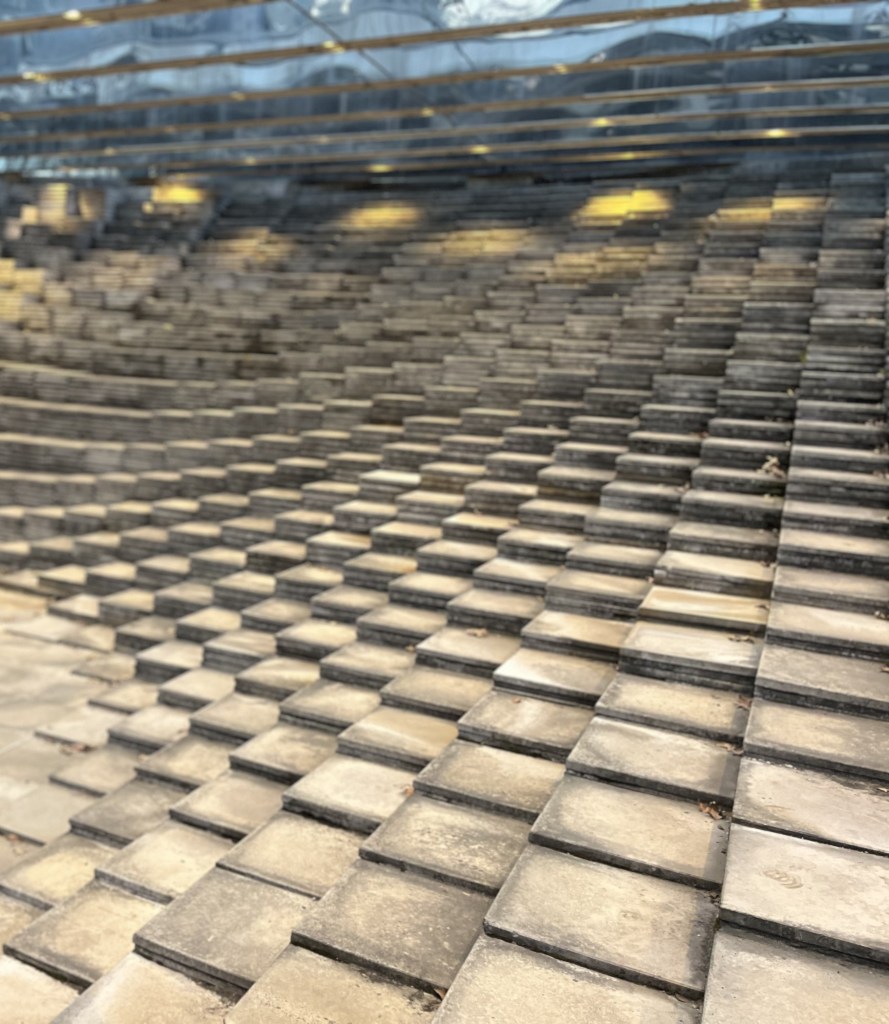
This is the beginning of Seoullo 7017, the city’s answer to the High Line walkway in New York. Quite why it needs to begin underground as a 3D bar chart is beyond me: not only is this little recess in the ground extremely well-hidden in amongst the concrete of the pavement just beyond the traffic lights, but it is also as vast as it is eerie; walking into it feels like walking into a well-guarded necropolis. This corner of the walkway would be TERRIFYING at night (who knows what might lurk under those concrete blocks?), but in the soft twilight it looks like an ideal place for some lovely photography, and I ask the three other boys to be my models, one last time.
This done, we walk onto Seoullo 7017 itself. From very early on it’s apparent that this is a copy of the High Line only in spirit: in place of lush greenery and unexpected detours through skyscrapers, the Seoullo offers only bonsai in concrete boxes and various views of decidedly unglamorous construction sites. There are occasional gaps in the buildings clustered around the walkway, but access to these views is frequently obstructed by some inconveniently placed trees, which means your vista of the city beyond is criss-crossed by pieces of wood and general shrubbery. And even when that isn’t a problem, great steel beams slice across the thick slabs of smudged glass on either side, making any close-up views awkward and physically painful.
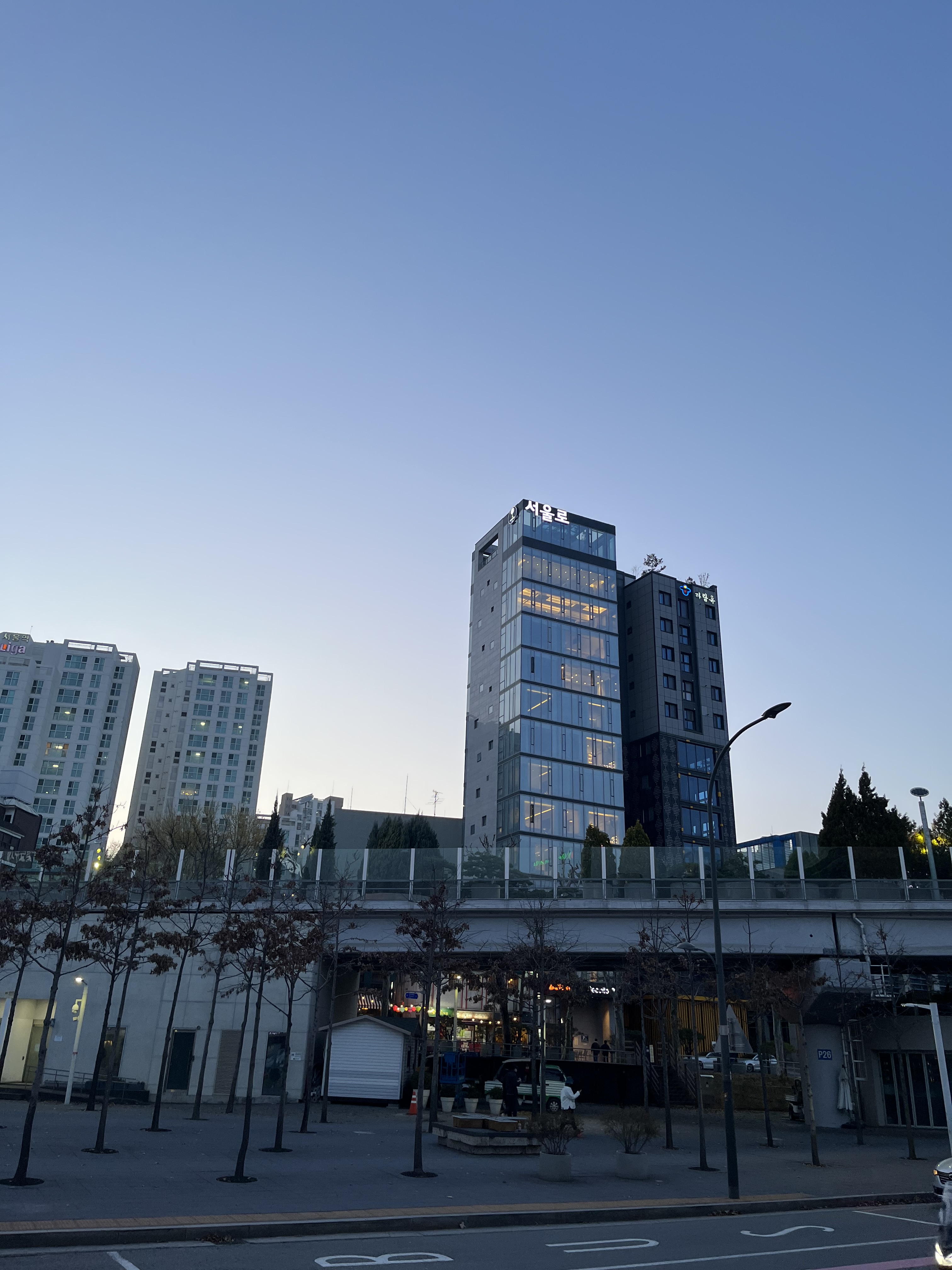
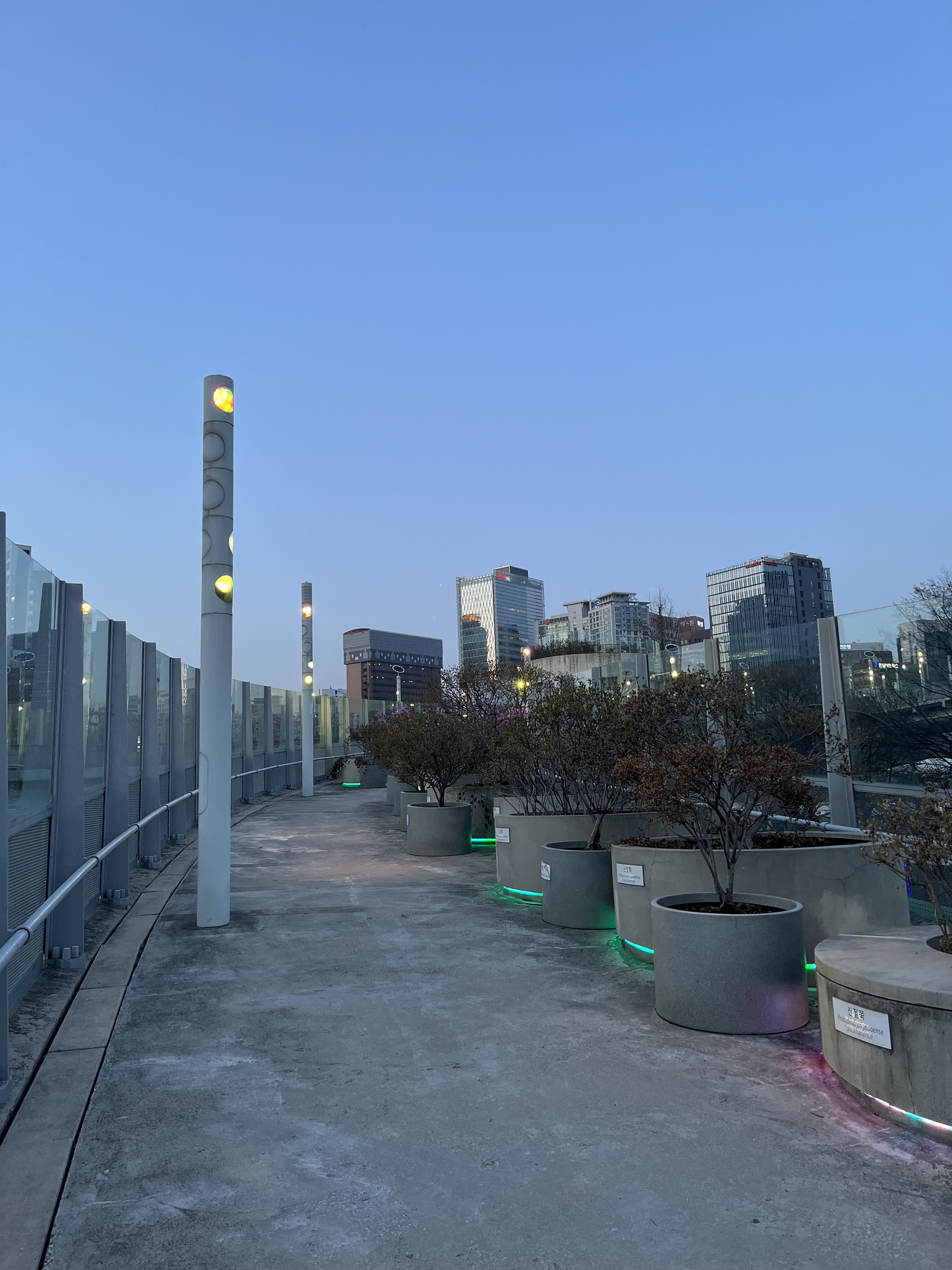

And yet in the evening light, I can’t help but be charmed by the Seoullo. Of course, the plants and views here leave something to be desired, but there are no lack of quirks in and around the walkway: the spiral staircases that lead back down to street level, for instance, or the circular meeting room-cum-restaurant that just happens to pop up halfway along. And all of this is bathed in soft yet fluorescent colours: blue, green, red, so much more; they glow with mystery in the twilight, wordlessly inviting you to walk in and have a look.
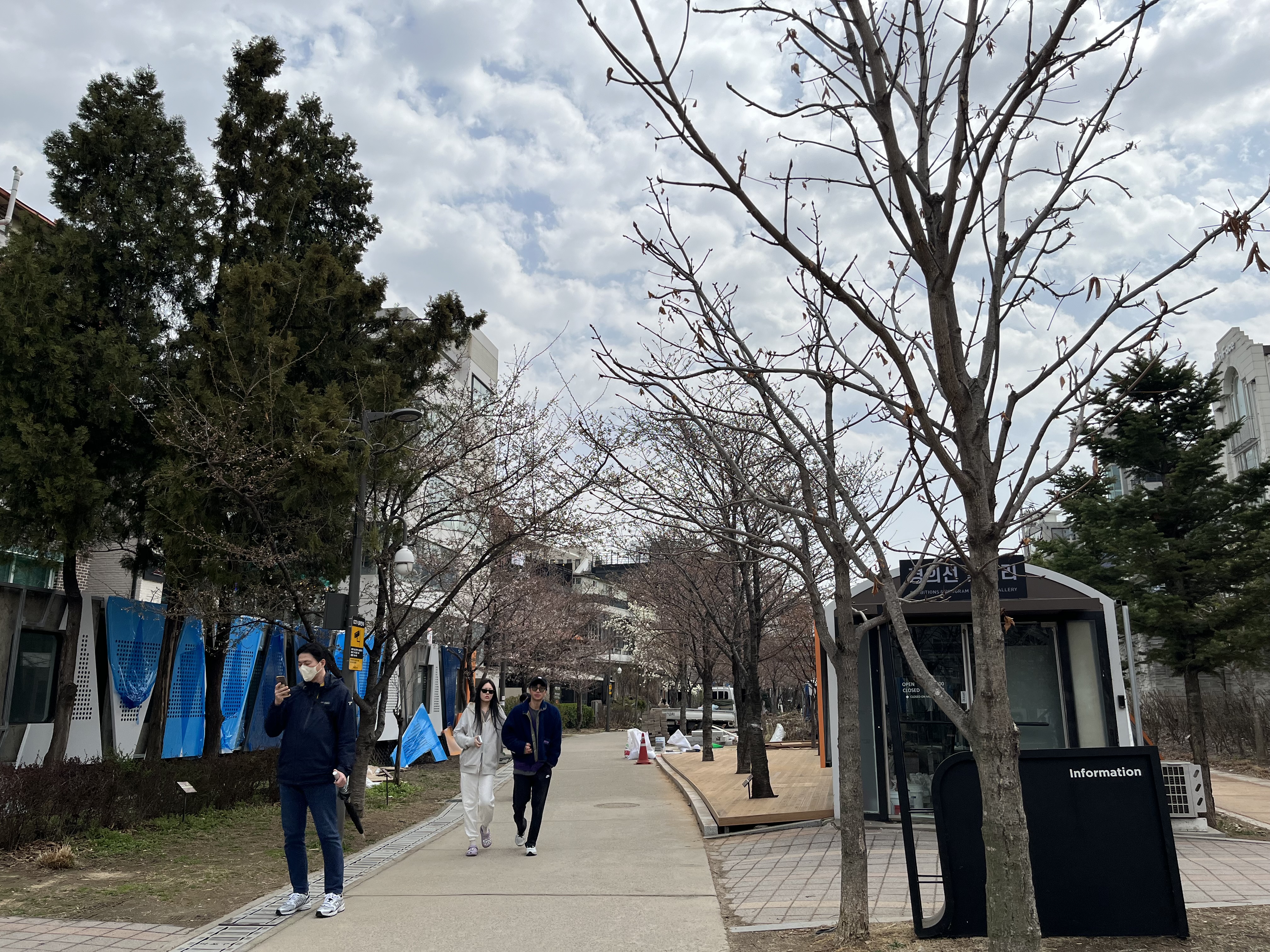
And there’s no other way to put it: this place looks stunning at this very hour. It just wouldn’t be this charming were we to visit it any other time of day: in the daylight, the Seoullo would just be a bare concrete white elephant, a glorified bridge that slices across a perfectly good cityscape; in the darkness of night, the shadows this place provides would terrify would-be visitors out of their wits. Yet now, with the blue hue of the sky slowly deepening and the sun slowly transforming into a faint white patch on the horizon, this place looks absolutely magnificent. The streetlamps here bathe the bare branches of the trees on either side with an ethereal glimmer, as if Christmas has returned to this place already. A sakura tree just past the entry ramp is in full bloom, almost too full to be real — a plastic imitation, or the real deal? I don’t reach out to check, partially because it’s way too tall for my puny self to reach, but also because that would spoil the illusion. And I don’t want that right now.
Standing there on the Seoullo, watching the whole place silhouetted against the dying of the light, I find myself looking back on the entire trip. Back when we first picked Seoul as a holiday destination I had my doubts: as I said way back in the Introduction, I wasn’t a fan of K-pop, or K-dramas, or K-orea, for that matter. What did a young man in his twenties have anything to do with any of those? This place just seemed too different, too faraway from my own interests. But over the past few days I’ve been steadily coming round to this place: from the things I’ve seen to the food I’ve eaten, and above all in the endless surprises that have popped up along the way. I hadn’t expected the Gyeongbukgung to be so majestic, or the Cheonggyecheon to be so calming. I hadn’t thought that there would be so much I’d love to discover — hell, there’s still so much I’d love to discover.


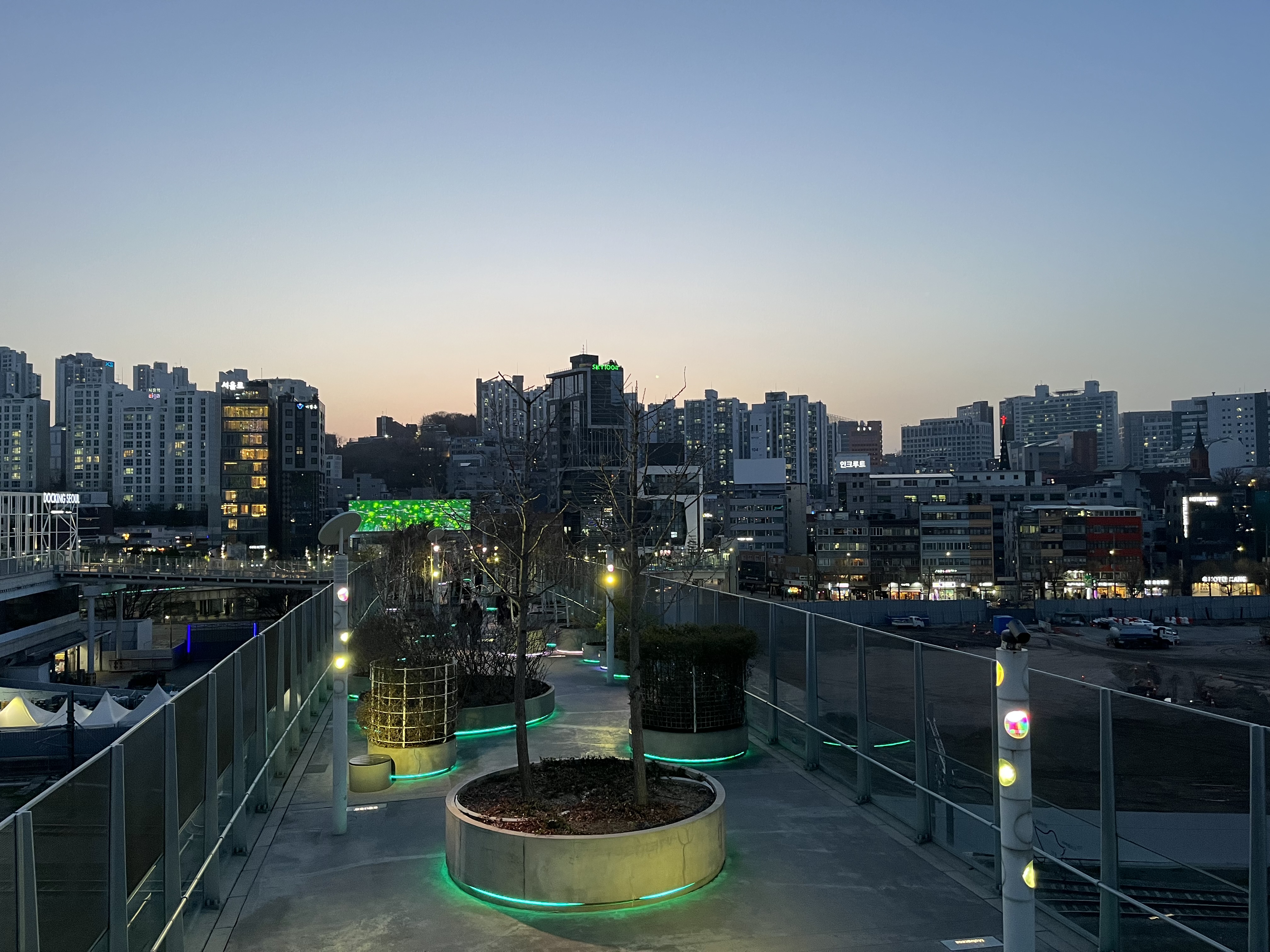
This is not to say, of course, that Seoul is my new #1 holiday destination — I can completely understand why so many of my fellow citizens have made a point of visiting the place every three months, but this isn’t me. It’s too busy, for one thing, and the scale of it sometimes felt a little too much to handle. The constant reminders that this was a battle-hardened and -ready country also meant that there was always a bit of edge to the fun; it’s hard to fully relax when your attention is always being drawn to how paranoid your host country is.
But I do find myself missing the city; even eight months after I left it, I still find myself savouring little moments, little sights, that I ran into during my days in South Korea. This place, this bare concrete walkway with its flora that may or may not be real, this seems like the perfect encapsulation of my South Korean adventure: immense spectacle over guarded substance, already fraying a little bit round the edges despite desperate attempts at rejuvenation. But right now, the spectacle is still beautiful, and damn well capable of surprising, and I’ll be sad to leave it, and get back to the chores of daily life.
One last ride. Descend back down into the depths of Seoul station, striking deeper and deeper with every escalator. Perhaps unsurprisingly, the carriages of the airport metro are only moderately full on this Saturday night, and as we head out of the underground section and the lights of Seoul bleed into Incheon once more, more and more passengers leave the train, until only a handful or so are left in our carriage. Whereas it was warm and inordinately stuffy when we were heading into town, tonight a cold breeze blows through the entire train, and we shiver. The cold weather is NOT something I’ll miss.

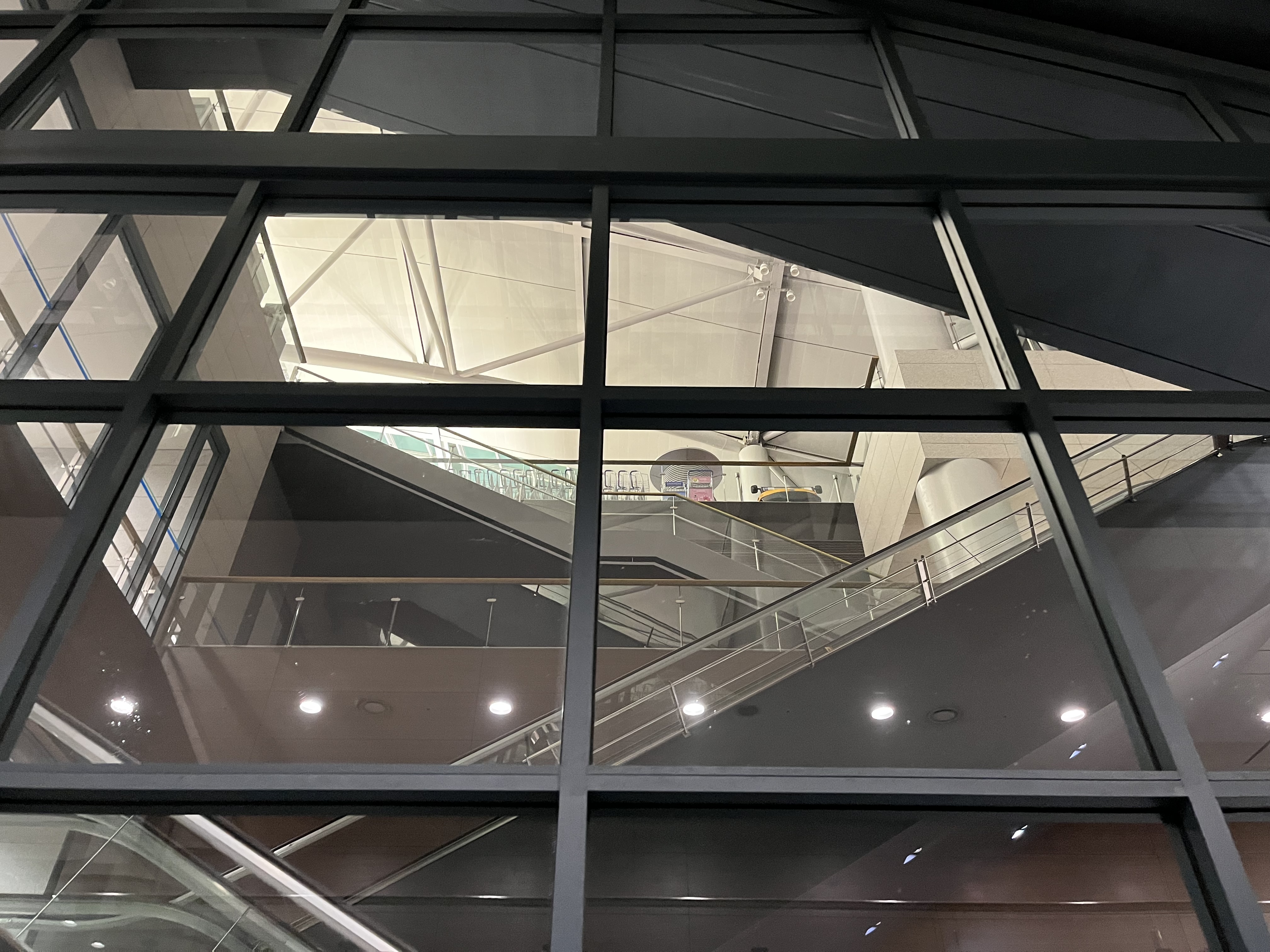
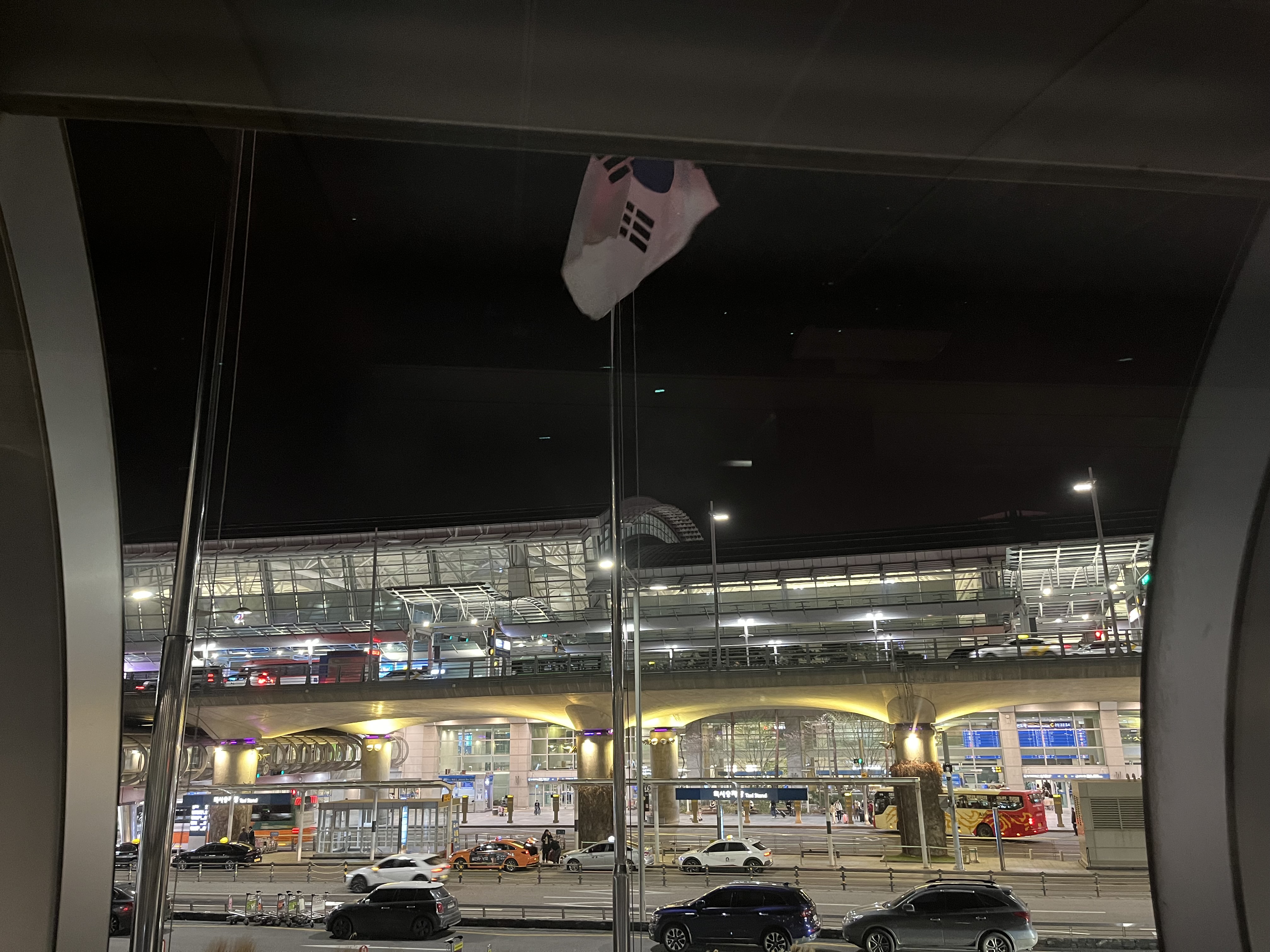
Ten thirty, onboard the aeroplane that will take us back south to Hong Kong. We are all seated, yet there is no sign that the aircraft has even any intention of moving off. Twenty minutes pass. Thirty. The Cantonese speakers around me begin to fuss, making snide comments about the plane not doing anything — classic Chinese behaviour, always wanting to get someplace sooner for no reason other than it might let them get through life faster. Despite the Franz Ferdinand blasting out from my earphones I nod off for a few moments, only to be woken up by a large thump underneath my feet. Turn to look out of the window, and it is then that I witness the loading ramp being installed right next to our plane, along with luggage-laden container being driven towards our plane. Only now, it seems, has anyone had the idea to load our luggage onboard; and even as our delay stretches into an hour and beyond the staff members below show no sign of hurry. Our baggage is flung, with worrying force, straight into the cargo hold; I fancy I can recognise my own suitcase and flinch as it lands, with what sounds like a deafening splat, into the pile of bags underneath my feet. Calm down, I tell myself. They’re experts at this.
At twenty minutes to midnight, the cart is finally empty, the loud quakings from underneath cease, and the ramp retracts at last from our little aeroplane. I breathe a sigh of relief as we are cleared for takeoff, and detach ourselves at last from the gangway that connects us to the country. Outside the lights of Incheon Airport are switched off and dimmed, and all seems to be quiet; we might be the only hub of activity for miles. But as the plane gathers speed and rumbles towards the runway, I catch a glimpse of the staff of Incheon International Airport silhouetted in the murky orange light, waving goodbye at our plane before politely bowing to one another and signing off for the night. And I can think of no better image to leave South Korea on than this — one last morsel of politeness and hospitality, one last surprise from a land that simply never ceases to amaze.

 Inkpot Shuffles in the Twilight