27 March
At some point during the night, I am jolted awake. Gazing into the darkness, I watch in horror as a vast chasm opens up before me. After a while the vast chasm resolves itself into the gap between the bed and the wall; even though it is impossible for me to fall into that small aperture, I still scoot deeper into the bed I am sharing with Eugene. This means that I am in prime position to kick him in the back, which I duly do at least three times. Apologise for this in the morning, only to discover that he never even felt a thing.
We traipse downstairs to the breakfast room. Soft jazz — the anonymous tinkly sort ubiquitous in every hotel lobby — plays over the speakers as we walk through a heavy glass door and into an antechamber lined with marble. There are only three other people in here: two Russians who glare at us and then swiftly finish up, and the cook herself, an elderly matron who works alone in her sparse kitchen. As she takes our breakfast coupons, I glance at the single pan on the stove, where a grand total of three sausages are sizzling away (decent-sized sausages, but still). That being said she still acquits herself rather well despite her rudimentary surroundings; the fried rice may be lukewarm and the cream of soup an odd choice for breakfast, but I’m still grateful that this elderly lady’s made an effort to ease the disorientation at all.


Walk down to our nearest metro station. Everything about Seoul’s metro system is big, really big, to the point where you just won’t believe how vastly, hugely, mind-bogglingly big it is: the trains, the stations, the entire network. The station we’re in right now might be a relatively minor interchange, yet it has ten entrances and exits and a vast labyrinth of grimy off-white tunnels linking them all. The line we take, line 1, is even more monumental in scope — stretching from the northeastern fringes of the capital all the way to Incheon, it proudly serves no less than ONE HUNDRED STATIONS on its own. Frequent readers of this blog will readily attest to my love for complex metro systems, but it literally hurt my head to read the map for the Seoul Metro, what with its web of stations and circuitous map. This constant state of awe-inspiring chaos is reflected in the train we take out towards the city, which is crammed full of people — people heading into work, people heading back from school, and people like us, trying to find out something about Seoul.
Alight at City Hall station — another station with endless entrances and exits — and head upwards, right into the middle of more chaos. To our left, the Deoksugung palace, a former royal residence whose traditional outside walls obscure the distinctly Victorian buildings within; to our right, six lanes of bustling traffic on the Sejongno avenue, a million cars honking their horns and gunning their idling engines; and right in front of us, a bunch of burly six-foot-tall men in traditional Korean dress, coming right at us waving their standards and their huge staffs in their hands (not a euphemism). Seoul, it seems, does not come with an “easy” setting — it charges at you full-throated, demanding that you take in all of it at once.


And yet all this energy can feel strange, even unsettling at times and threatening to bubble over. Walking up towards the Gwanghwamun Plaza, I begin to notice the protest banners lining the sidewalks: bright, gaudy colours filled with dense Korean text and a smattering of English, featuring a multitude of grievances and injustices. (Just by the American embassy up the road, the largest banner of them all shouts “Free Palestine”.) In between those hanging banners I catch glimpses of police trucks, huge anonymous vehicles that hint at the size of the protest to come; we quicken our footsteps, anxious not to be caught in it if shit should go down. And in a large makeshift tent, tucked into the shadows of the Deoksugung, pictures of those lost in the Sewol ferry disaster ten years ago hang in silence, a sombre reminder of the tragedies hidden amongst the accomplishments of the nation.
We walk on, and soon we reach Gwanghwamun Plaza itself, a truly gargantuan square stretching on for yards on either end and flanked by embassies and government buildings and huge memorials. This place is to Seoul what the Karlsplatz is to Vienna, or what Tamar Park is to Hong Kong (that is, if they actually allowed some actual protesting) — some of the biggest gatherings/demonstrations in South Korea have happened here, and it’s still the place to show if you need a quick establishing shot of the city. At the centre of it all stands a huge statue: that of King Sejong, a man who has legendary status here, for it was he who created the building blocks of the Korean writing system. (Those geometric shapes you see so often in the script? They’re his.) To commemorate Sejong’s work, there is a museum built into the base of the memorial, which has the unfortunate effect of forcing people who wish to learn more about the inventor of the Korean language to first pass underneath his bottom.


Behind the huge seat of the Sejong statue is another huge avenue. Tour buses, lorries, private cars roar past, their wheels scraping painfully close to the pavement. We wait anxiously for the lights to kick in, for the endless stream of traffic to cease. When it finally does, the vista we are left with is breathtaking.

Although Seoul is scattered with palaces galore, there is one that far outstrips them all in terms of size, history and tourist population. This is the Gyeongbokgung palace, one of the largest former residences of the Korean emperors. Despite its hugeness, its history isn’t what you might call “august”: burned down by the Japanese during their 16th-century invasion of Korea, it stood derelict for almost three centuries before the father of the Gojong emperor decided to restore it to its former glory — a glory that lasted all of three decades before the Japanese, who seemed to have a vendetta against this place, gutted the ruling Joseon dynasty and set about demolishing the Gyeongbokgung once more.
It wasn’t until the 1970s that the palace finally started getting its dues for its place in Korean history, and since then the Gyeongbokgung has been slowly rebuilt and restored. Today, thanks to endless K-dramas set in the past, it is the one place in Seoul that everybody might recognise on sight, and perhaps this is why the Gwanghwamun gate this morning is piled deep with tourists speaking a thousand different languages, all queueing up to take a picture in front of the palace (preferably next to a palace guard trying his damnedest not to laugh at the latest antics the people next to him are pulling). Many of them are wearing hanbok, the traditional dress of Korea; not one, not two, but more than half the tourists in the palace forecourt are wearing robes, so much so that I feel more like an interloper into 19th-century Korea rather than the other way around.


We wander through the grounds, wading through the crowds that only seem to thicken the higher we climb. Although I’ve been to many a palace in Europe, this is my first time wandering through anything similar in the Eastern hemisphere, and if anything the scale of the Gyeongbokgung feels even more staggering than the ones I’ve seen in France or Austria: endless palaces and walls and gateways attract an endless stream of tourists and cameras; even though very few of these palaces are open to the public (the ones that are lie dusty, empty and abandoned), there is still a veritable queue at many of the major ones, with tourists waiting in line for minutes at a time before sticking their phones in through the half-shut front door and taking a quick snap. Fighting our way to the front of the queue, there is just time to note the daintily-painted roofs, the majestic support columns soaring high above our heads, and the absolute vastness of the throne room before I am swiftly elbowed aside by another mainland Chinese visitor. Luckily for us the side entrance is less populated by tourists, which means we get a more prolonged glimpse of the majesty of the whole scene. It’s all very impressive and the detail is unparalleled, but I can’t help but shudder a little as I imagine the ghosts of courtiers past haunting the room, and feel the cold wind whistling through the open windows.


As we walk on, the size of the Gyeongbokgung complex grows ever more daunting, ever more confusing. Countless palaces with similar names seem to lie round every corner; the further in we go, the dingier it all seems to be and the more claustrophobic it seems. Pretty soon we find ourselves in alleyways which Eugene (being a relatively taller person) needs to stoop to get through; we come across more and more walls and fewer and fewer tourists. Then we turn a corner, and find a doorway where a couple of tourists have crowded round. We look in, and suddenly the entirety of the complex’s back gardens are revealed, a breathtaking vista refreshingly clear of buildings or indeed any sign of habitation; before us are only tall trees, specks of humanity and the large behemoth that is the Inwangsan mountain looming in the background. I breathe a sigh of relief, and the feeling of arrival finally descends upon me.
The gardens that form the back half of the complex are a huge contrast to its front half: whereas the latter was mostly a place designed to stun the foreign visitor, the former feels more intimate, a place for the kings and emperors of South Korea to unwind and frolic with their concubines and/or eunuchs. It’s a much nicer place to walk, too: no worries of bumping into loud tourists or blocking anyone’s view with your pauses to take photos; above us the sun shines with a crystalline clarity, bringing some much-needed warmth to late-March Seoul. As they stroll across the gardens, Sunny and Eugene both talk of how this place feels very much like Osaka or the other Japanese castles they’ve been to, all places of beauty, while Daniel and I discuss the large industrial vehicle that’s parked right in front of us. Gambolling randomly across the palace grounds, we stumble into a secluded back corner where our gaze falls upon some pink flowers, dangling elegantly from a tree. The false spring of this week means that we have just come in time for sakura season, and thus I gain my first ever glance of the famous blossoms, swaying gently in the breeze. “Everything has lined up perfectly today,” says Sunny, as we snap our pictures.


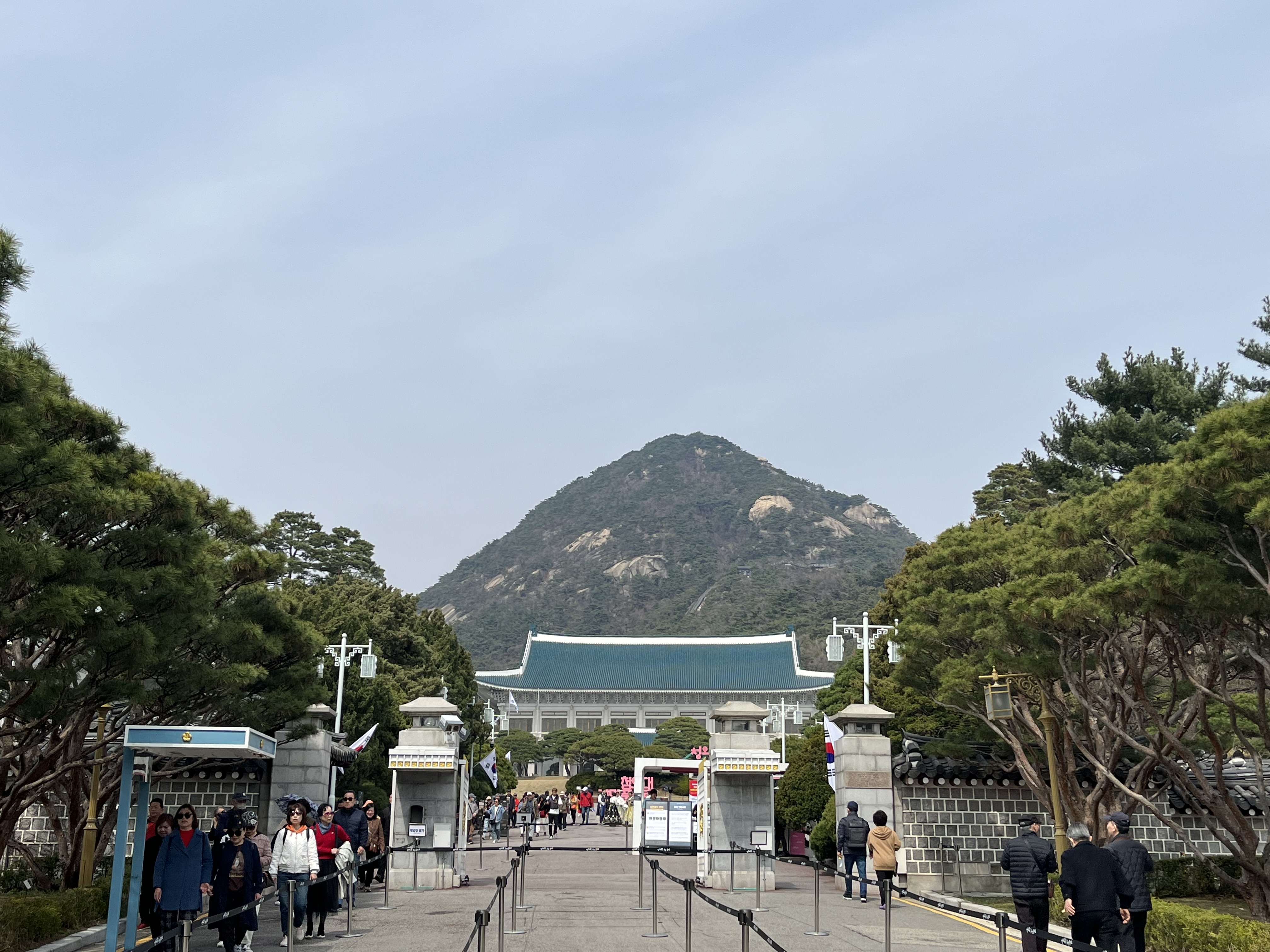
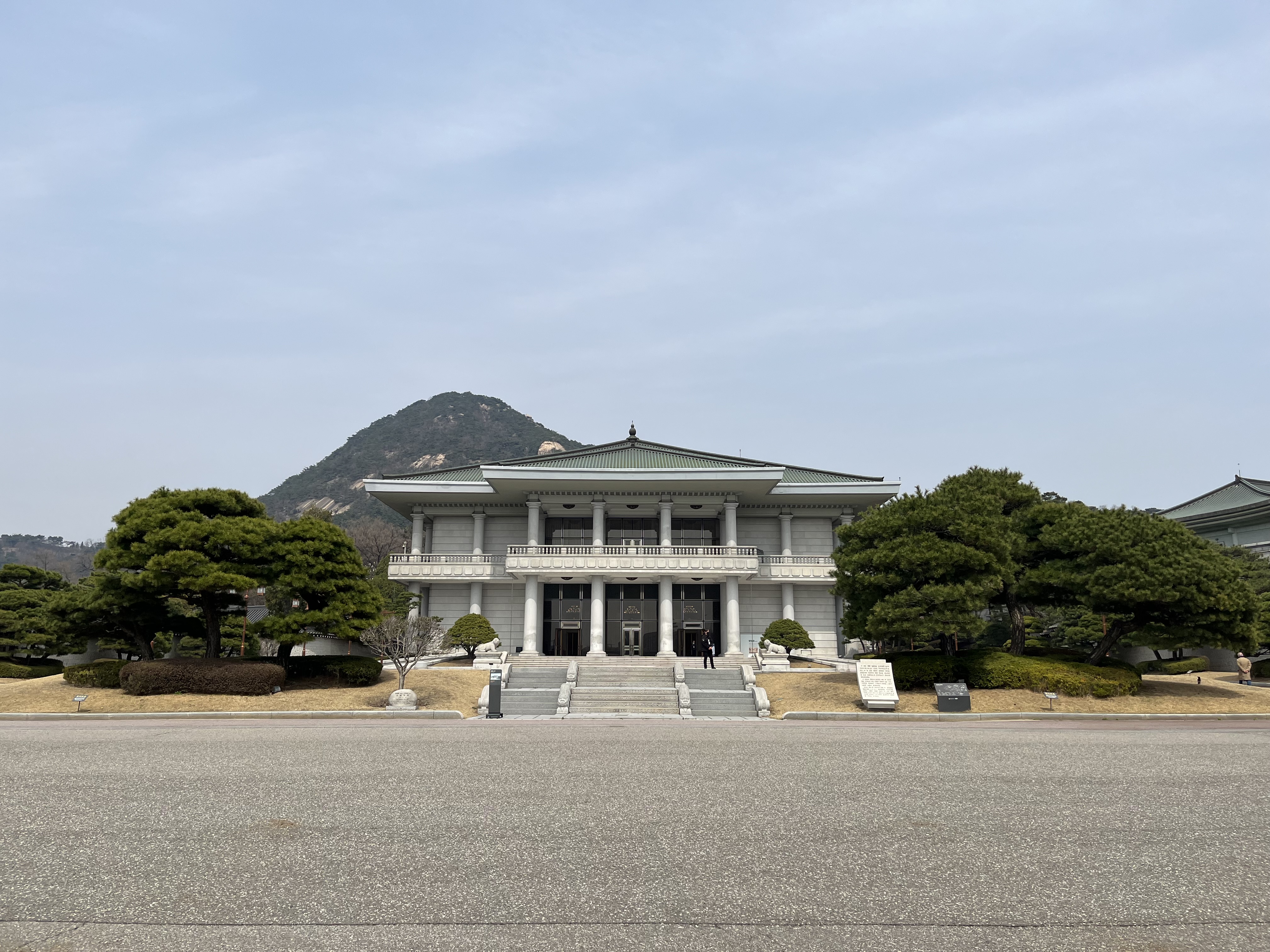
At the top of the Gyeongbokgung is a small, unmanned gate set into the walls. In a stark contrast with the crowd-swollen forecourt from which we entered, barely anyone seems to note this exit; anybody who does give it a second glance walks uncertainly forward before stopping, backing slowly away and then heading back down towards the main complex. Being slightly more self-assured because of our (my) superior map-reading skills we charge forward, and soon find ourselves standing on the street just outside the palace, staring across the street at another former seat of Korean power. This is the Blue House, formerly the residence and offices for the President of South Korea; for six and a half decades, it was here that policies affecting the lives of 51 million Koreans — given their neighbours, perhaps even more — were formulated before being sent out into the world. Today it’s open to the public (the current president, a man as fond of grand political gestures as his wife is of designer handbags, declared he wanted to be “closer to the people” and moved elsewhere), and so a steady stream of visitors are walking through the open gates today, towards the mansion with the turquoise tiles that visibly gleam even from miles away.

Much as I’d have loved to ramble through yet another official residence, however, it’s already one in the afternoon and my stomach is beginning to rumble. Doing his research last night, Eugene came across this nearby place that apparently serves excellent samgyetang, ginseng chicken soup — the quintessential Korean dish, and one which we’re all very eager to try. Unfortunately approximately half the tourists in Seoul seem to have had the same idea, as we turn onto the street and IMMEDIATELY witness freakishly long line of humanity stretches outside the restaurant. (Eugene lets out the loudest shriek I have ever heard from him in almost two decades of friendship.) We end up going for sol-sot, a kind of stonepot rice, at a restaurant just round the corner. Tastes rather nice, actually, and I never do think about samgyetang again for the next couple of days.
Three o’clock. We step out of Euljiro-3-ga station into warm sunshine. A bit of smog hangs about in the air — maybe from the construction sites nearby, maybe from the traffic — but otherwise it’s a beautiful day, and what better way to spend an afternoon like this than on the banks of a refurbished sewer?
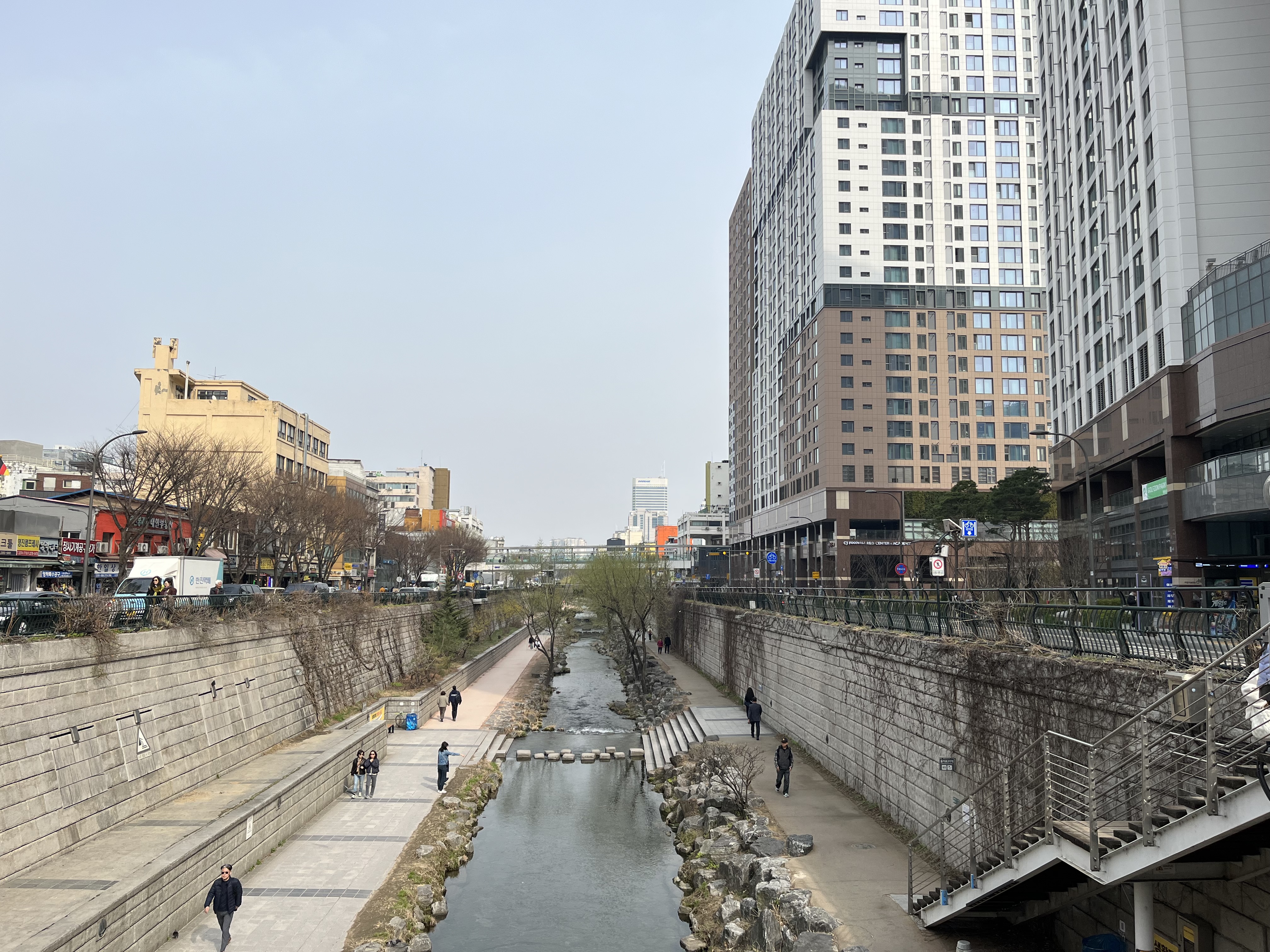
Although Seoul might bring to mind cramped buildings and inner city blues, there are occasional oases of relative calm and beauty hidden within this bustling metropolis of almost 10 million strong. One such place is the Cheonggyecheon stream, a sunken waterway that threads its way straight through the heart of the city centre on its way to the Han River. Originally little more than a drainage channel, it was converted in the 1960s into a six-lane highway; reversal came in the form of Hyundai Construction CEO Lee Myung-bak, who set about straightening out the Cheonggyecheon when he became mayor in the mid-2000s. (Later, he would go on to become the President of South Korea before getting arrested for corruption in 2018.)
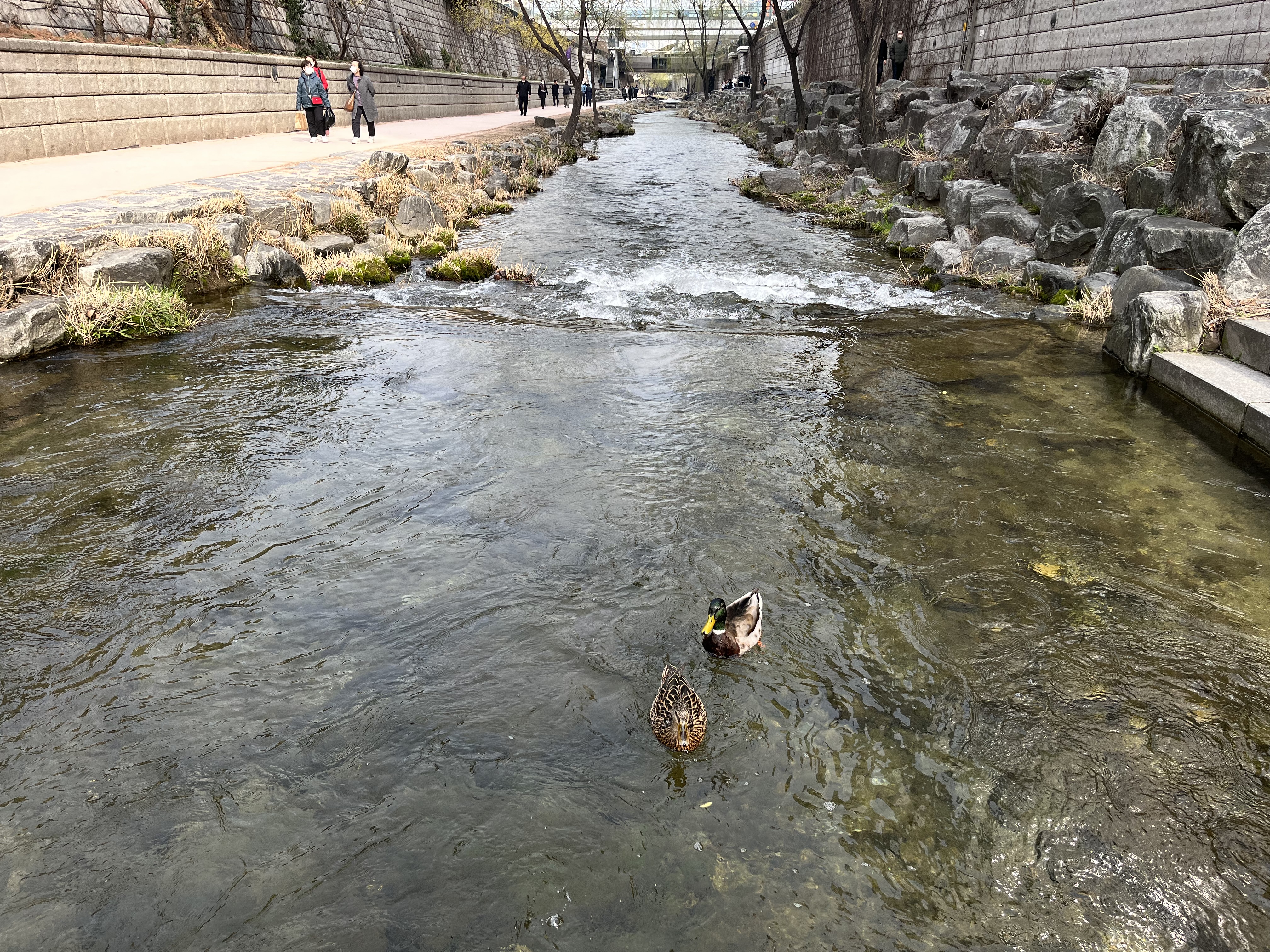
The result is one of the loveliest waterways I’ve seen on my travels. Artificial rivers are nothing new for me — I still remember my Brisbanite encounter from years ago — but the civil authorities went all out with the Cheonggyecheon: the banks of the river have been flattened and paved, and they’re wide enough to comfortably fit several vehicles in side-by-side (a point proven by the large repair truck reversing noisily down the bank below us). The water is so clear that I’m tempted to dip my toes in it, years of pollution be damned; a couple of ducks gad about on the waterways, chasing each other, oblivious to the tourists standing transfixed on shore. At regular points in the water are stepping stones that form a path across — big enough to comfortably stand on, far apart enough to make crossing an adventure. I hop down one at least three times, and the boys tear themselves away from duck shooting (the photography kind) to follow suit.


I can easily imagine sitting on the banks with a book and whiling the day away, but we have a city to explore, so down the riverbank we walk. The broth I drank for lunch is already getting to me, and the Cheonggyecheon is emphatically not the place to be in these situations: not only are there endless sounds of flowing water, but a cold breeze is also blowing through the arches and the treatment works hidden behind the high walls of the embankment even smell vaguely of a toilet. We leave the nullah behind and head towards downtown, across increasingly interminable lanes and courtyards with rustling grass. By now the wait is beginning to feel painful, and the endless cafes we pass by feel like a personal mockery now. (It doesn’t help that the boys are now stopping at every other store, discussing with relish and some definite malice about the coffee they might buy.) Eventually Euljiro-1-ga station looms into view, and I have never welcomed the sight of a metro station as much as I have this one: my friends have barely descended the station staircase before I’ve disappeared right into the station toilet.
A quick stop in Lotte Department Store to grab souvenirs — having unwisely told half the world that I was on holiday this week, I have now been burdened with the task of bringing home proof, so I grab a few random things off the shelves. Then down an underpass and cross the street into Myeongdong, one of Seoul’s most fashionable neighbourhoods: here tourists hurry here, there and everywhere, into big, brightly-lit stores with gaudy advertising and head-hurting music blasting out of the loudspeakers; into each other’s way while speaking in a dozen different languages; into narrow streets and congested alleyways in between the tall, tall buildings. Looming over all this is Myeongdong Cathedral, one of the largest churches in Korea and (fittingly for a Catholic church) an icon of Seoul in itself. Slip inside for a bit to get away from the cold, and the first thing I hear upon stepping in is the unmistakable drone of a vacuum cleaner, sweeping up the pews towards the altar. Quite the difference from the ones in Vienna, but this one is still architecturally impressive to say the least.


We walk back down the hillside to Myeongdong itself. It’s late in the afternoon now, and the shadows cast by the weak sunlight are lengthening. The streets of the neighbourhood have become, if such a thing were possible, even more lively than they were an hour ago. Myeongdong is one of Seoul’s most famous night markets, and as we descend into the labyrinth of its streets, the smells from the mobile food stalls, newly set up on either side of the road, begin wafting through the air; and pretty soon the entire alleyway gains that weird, comforting street food smell — a bit of diesel, a bit of cooking oil, but most of all the smell of fat and juice and crackling food. Eugene buys a whole cheese-covered lobster to munch on, while I opt for the slightly more modest offerings of fishcakes and a crushed red bean croissant. (Daniel, unable to choose between these options, simply goes for all of them.) We’ve already had a lot to eat in the past few hours, but somehow we find the space to fit it all in.
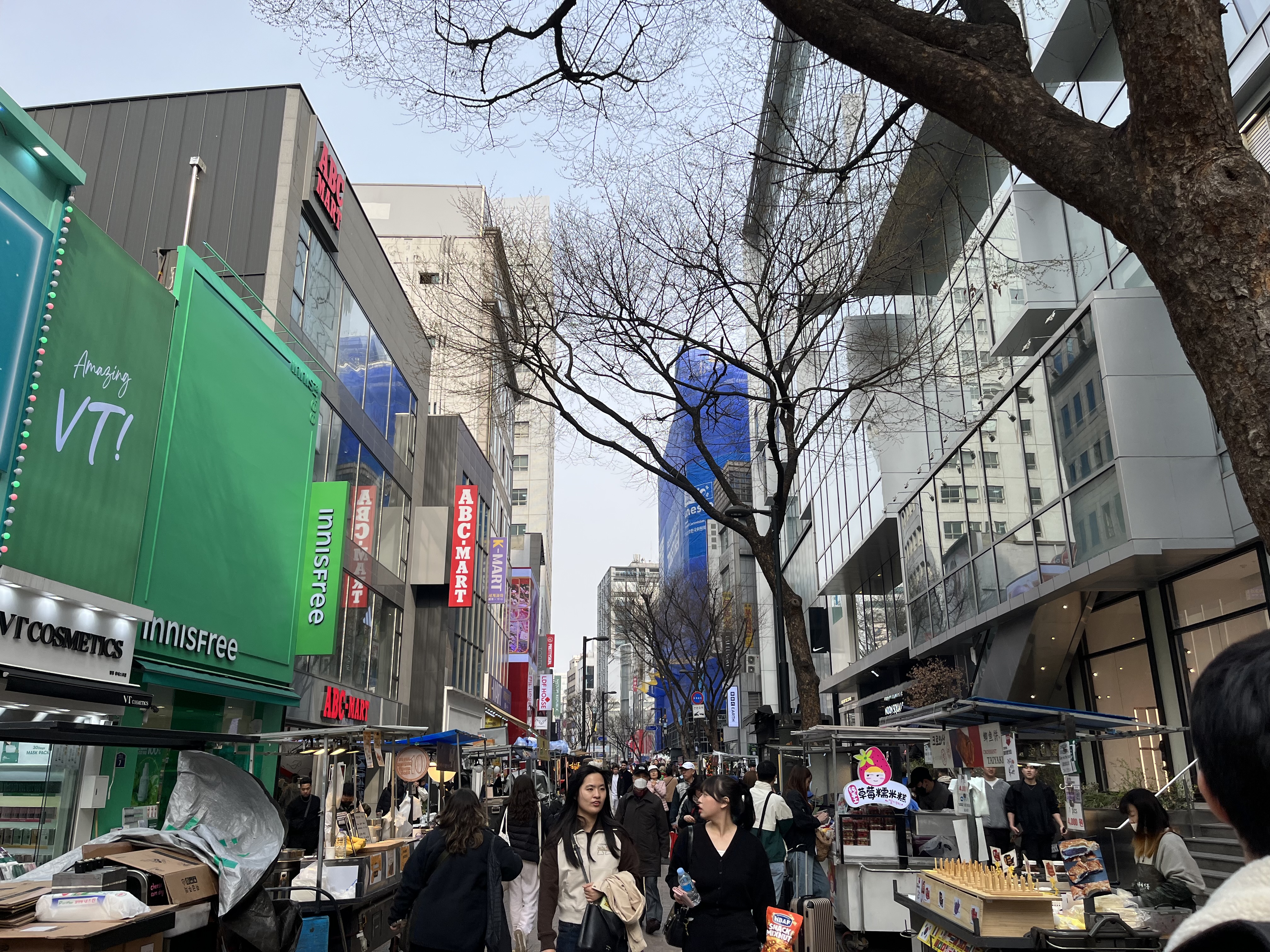


Six in the evening. Night steals fast through the streets of Seoul, and the cold breeze that greeted us last night is beginning to pick up again. All of us have walked close to 20,000 steps today, and even a seasoned walker like me is beginning to feel stiff in the lower extremities. Unfortunately for our feet, however, there is still one more place that we absolutely have to go to: this would be the N Seoul Tower, situated way up on top of Namsan mountain just to the south of the city walls. One of the highest points in the city, it’s long been a must-go Seoul landmark, and all of us have agreed that a visit to Seoul would be incomplete without it.
Unfortunately, getting to Seoul Tower is more difficult than it looks. According to my map of Seoul — already extremely wrinkled after 24 hours of folding and unfolding — it stands at the summit of a hill which can only be reached by cable car (or an extremely long walk), which itself can only be reached by funicular (or another extremely long walk), which in turn can only be reached by… a long uphill walk from the city centre. Either way, we find ourselves grumbling as we struggle up the road from Hoehyeon station, our feet aching more with every step while cars rush past us at 80 km/h. We eventually reach the funicular, only to discover that we are not the only people who are visiting Seoul Tower on this chilly Wednesday night. A long queue of people streams out from the base of the funicular building, yet another multinational snake of chatter and down jackets. Smatterings of Cantonese are audible here and there — loudest from the other boys, of course, but also from just in front in the queue, and the thirty-something couple two spots behind us.
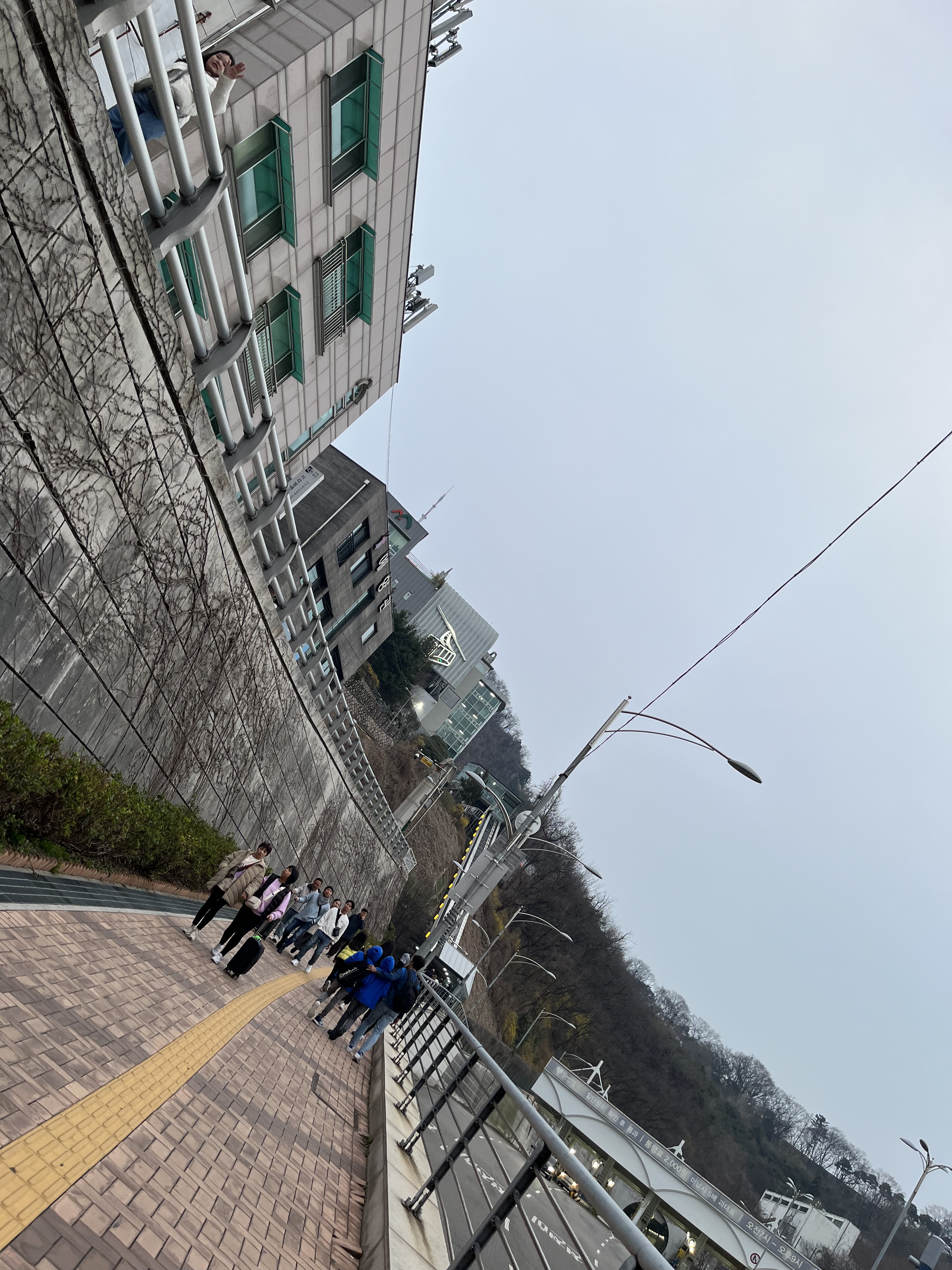

Meanwhile, the line itself moves forward at an agonising pace — there is only one funicular, which loads about a dozen people in at a time and then moves up the hill at less than a snail’s pace. The sky literally darkens by a few shades as I watch this ageing machine crawl its way up, looking as if it might give out at any moment. On its third go-around my patience finally snaps, and I charge up the stairs to the side, leaving my churchmates open-mouthed behind me. Such is the speed of the funicular that even after stopping halfway to admire the last vestiges of daylight over the Seoul rooftops, I STILL manage to beat it to the hilltop platform.
Yet the waiting is still not over. Not only are Eugene, Daniel and Sunny still freezing in the queue down below, but a HUGE crowd of primary-age girls have suddenly appeared out of nowhere, and I watch in dismay as they file, one by one by one by one by one by one, straight past the vestibule and into the queue waiting for the cable car. When the boys finally join me, we discover a queue that now stretches across TWO WHOLE FLOORS of the building, and by the time we finally break into the icy metallic cabin of the cable car, it’s closer to eight o’clock than seven.


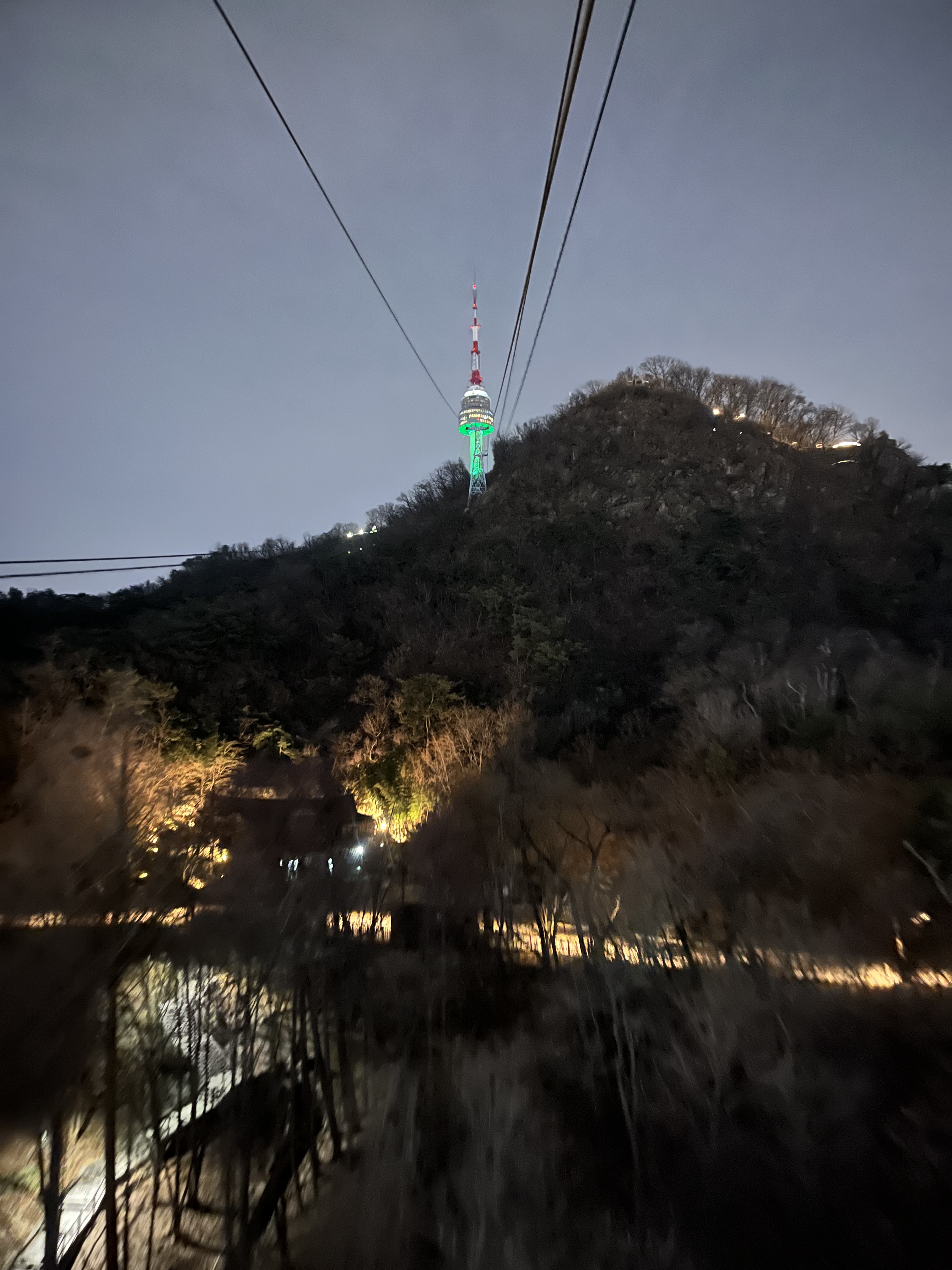
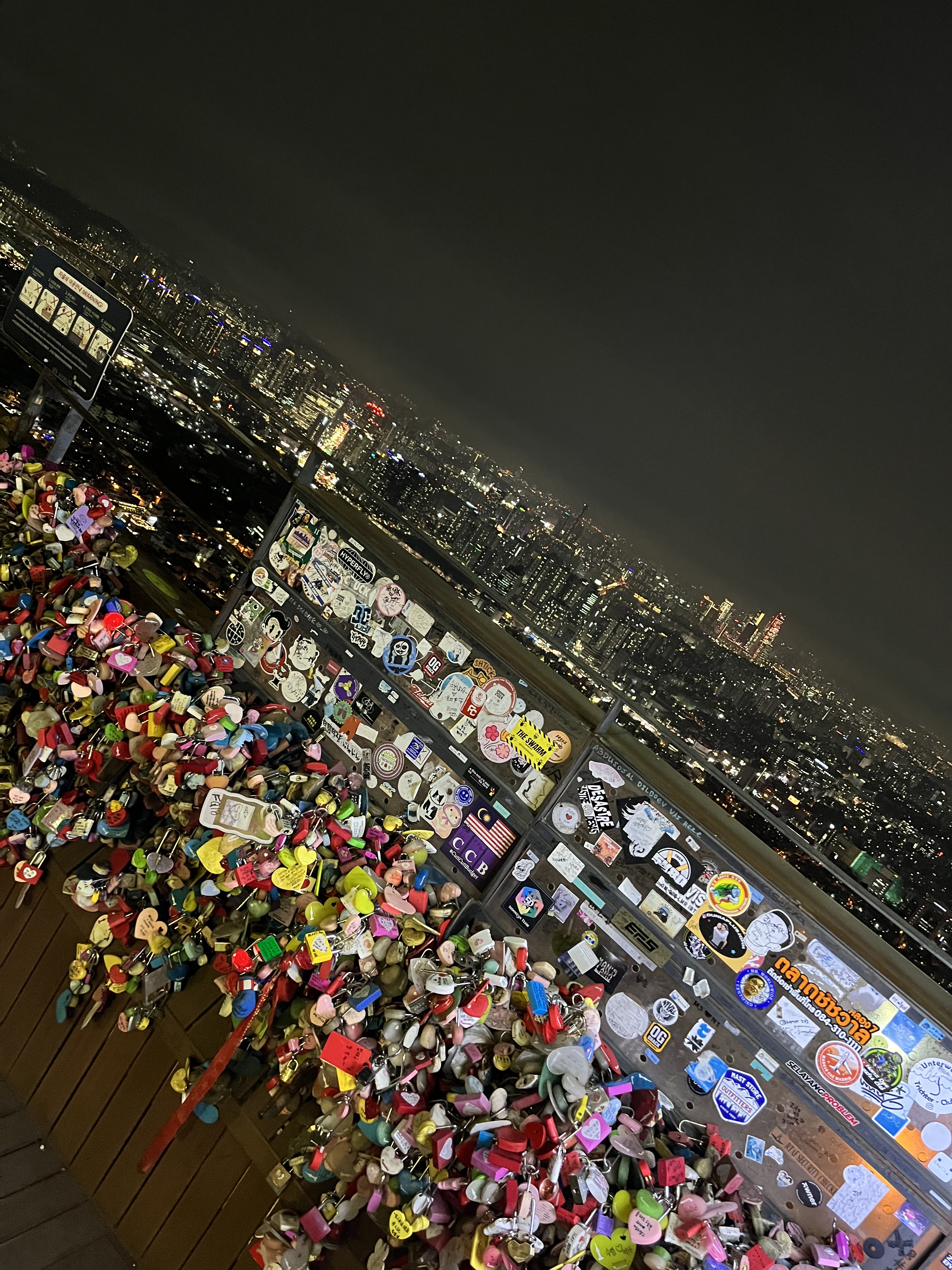
At last, the car slows and docks into the hillside. We are disgorged onto the slopes of Namsan, halfway up a staircase filled with endless lovelocks and graffiti. (Honestly, why do people feel the need to doodle everywhere they go?) In front of us, looming like a giant fungus out of the ground, is Seoul Tower itself, an awe-inspiring structure that remains popular even at this late hour. Even as we watch the crowd in front of us surges towards the tower and the shopping centre at its base. We, on the other hand, linger for a bit longer outside, taking pictures of this radioactive green mushroom and the traditional Korean gazebo standing in front of it. The contrast makes for a very amusing scene: the rustic charm of the wooden pavilion, softly lit against the austere concrete of the tower behind it.


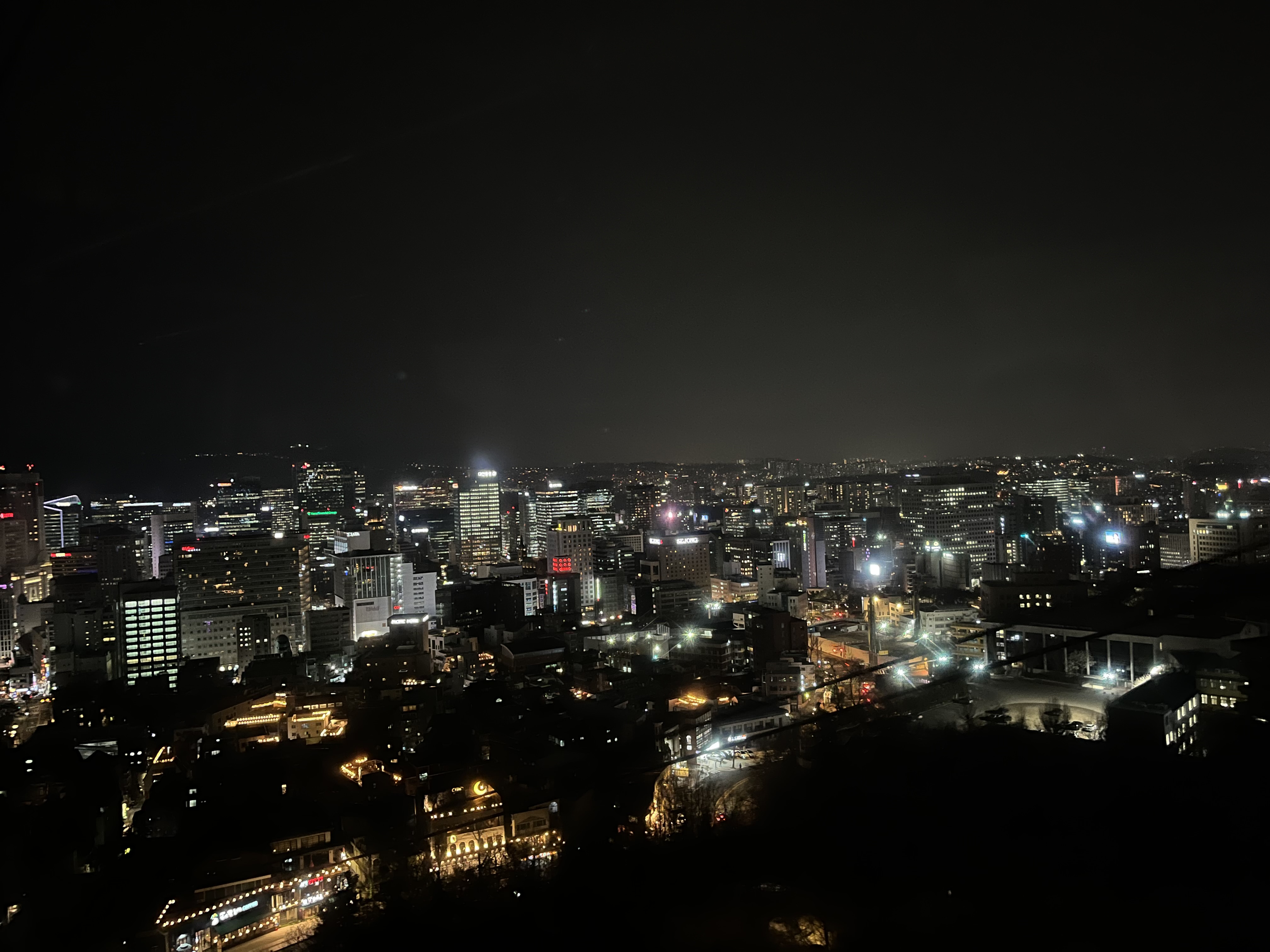
While the boys do their shenanigans in front of the pavilion, I head off to an overhanging balcony. From here one can see the vastness of Seoul and the surrounding Gyeonggi-do Province in all its nighttime glory: streaks of white glowing in the darkness, criss-crossing each other and rising from the earth below, while patches of pitch black countryside sit silently in the distance, an ominous shadow slicing across the landscape. It is quite simply the most beautiful thing I have seen all day. A Cantonese-speaking couple walk up beside me, the man trying to take a picture with fumbling fingers, the woman shifting uneasily from side to side. After a while I ask if they need any help, and he immediately gives me his phone. It’s nice to feel useful, every once in a while, especially in a foreign country.
It is also horrendously, numbingly cold. Between the base of the funicular and our arrival at the hilltop, the temperature has plummeted a dozen degrees and not even thermal undershirts and a down jacket are shielding me very well from the cold. Every time I take my hands out from my pockets to take a picture, I feel like I am experiencing frostbite all over again. Despite knowing that it’s the last thing I should do, I find myself blowing on my hands with increasing frequency — anything to get some warmth in my fingers. Anything to stop the razor-sharp pain of the cold. We take a picture against the nightscene, then make a beeline for the souvenir shop nearby, desperate for a respite from the wind. Inside, the lightly jacketed staff members mill about, barely noticing the freezing cold. Perhaps they’re used to it, working on this windswept hilltop day and night. Or maybe it’s just that they can pop down to the positively toasty confines of the shopping complex below every once in a while.


Now that we have done all the tourism for the day, there only remains the outstanding issue of dinner to solve — the lobster and the fishcakes having long been digested, my stomach is beginning to protest once more. I suggest that we head down to Namdaemun, a precinct just to the south of Seoul Station; web searches suggest that the night market there is even livelier than Myeongdong’s, which surely means we’ll be able to stuff ourselves silly. This excellent plan is slightly hampered by the fact that Namdaemun Market is apparently not open tonight, and when we turn into the alleyways that contain the alleged market, we are greeted by scenes of desolation: only one or two roadside souvenir shops, none of which sell food, are open at this point in the evening. Nightlife? What nightlife? The silence here is on par with a cemetery, and judging by the handful of people milling about tonight, about as popular too. The boys buy souvenirs from a subdued old lady, her radio blasting out tunes from another era, while I look around in vain for any signs of an open restaurant that might cater to four hungry tourists. We eventually walk back out into the main street, where the Namdaemun gate itself squats like a toad in the night, humongous, intimidating. Alone.


We end up taking refuge in a 24-hour restaurant on the Namdaemun-ro. It’s a homely little place, tidy and brightly-lit, and the proprietor seems actually welcoming — patiently explaining to us what the best items on the menu are, and taking the time to talk to us about the quality of the food and how we’ve found Seoul so far (despite her poor English and our abysmal Korean). When the stew we have ordered arrives, it is once again so plentiful that we are reduced to staring at it again, trying to figure out where to even begin with in that huge pot of cabbages, pork shoulders and chilies; she calmly whips out a pair of scissors and begins cutting it up for us, much to our slight embarrassment. But it’s a lovely meal all round: the hot soup is very welcome after the freezing cold outside, and even if it’s a little too spicy for my liking, everyone else around the table is digging in with gusto — and feeling more relaxed than ever.
The streets of Seoul look livelier than they were an hour ago. As we walk towards the metro, cars and buses rush past on Namdaemun-ro, while night owls walk unsteadily on the street, their faces flushed with the alcohol inside their bodies. The lights of Seoul, so dark when we approached the Namdaemun market, are back on in full force as we approach the Bank of Korea, bright and lively and as prosperous as the heart of the fourteenth-biggest economy in the world should feel. It is then that I realise that we are walking in the wrong direction, away from the closest metro stop. It is also to my friends’ eternal credit that they do not show any annoyance with this latest development.
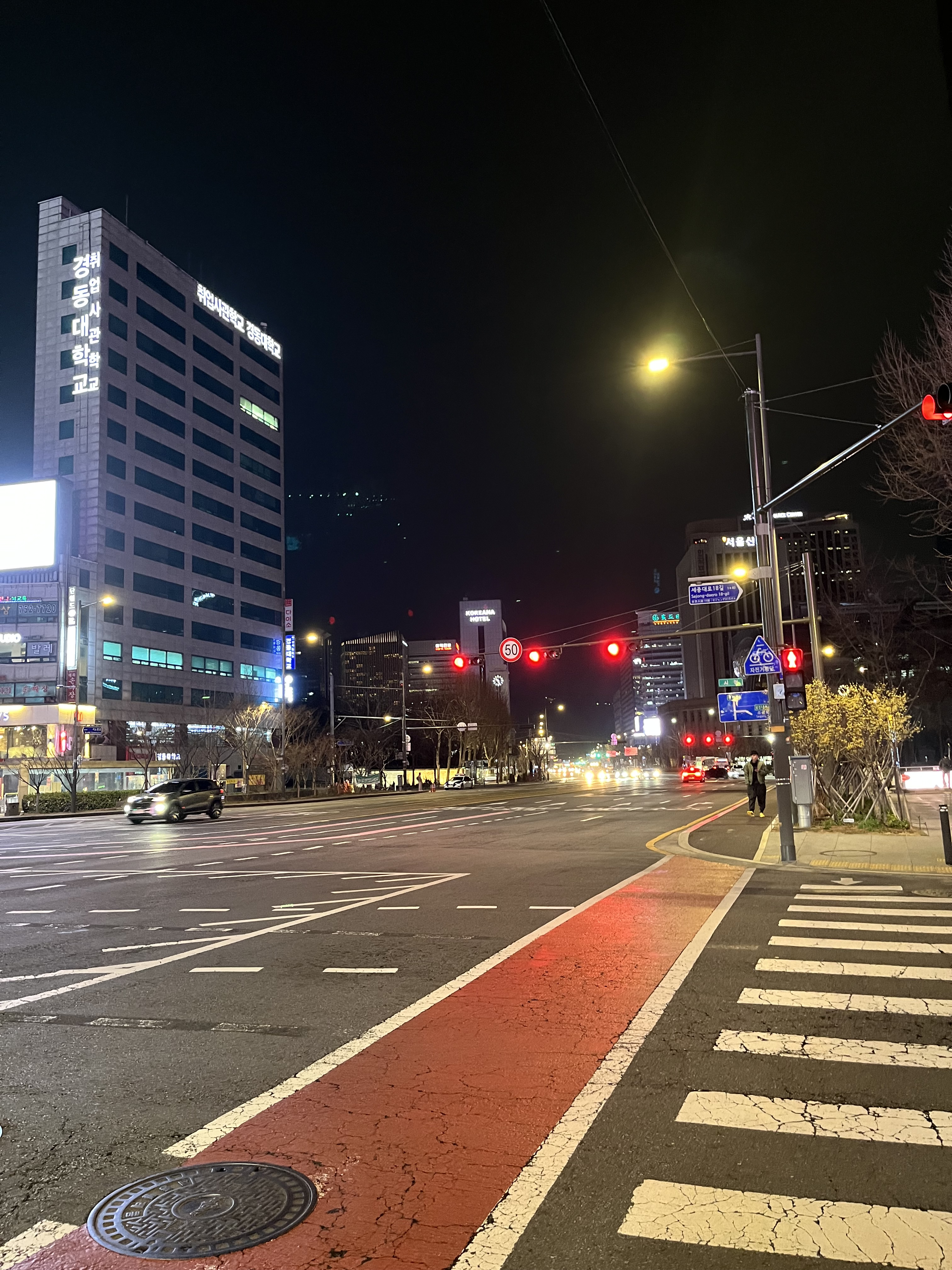

At last, the signs of the metro station. As we cross the road to the entrance, I happen to look up. The statue of King Sejong looms back into view, along with the faraway lit-up gates of the Gyeongbokgung. We are back at City Hall station once more, having completed a big infinity loop around Seoul. It is a measure of how tired they are that both Eugene and Daniel fall asleep before our train has even left the platform.

 Inkpot Shuffles in the Twilight