26 March
It is 27°C as I step out of our apartment block and head out onto the streets. The weather is overcast, the environment stuffy, the air full of bugs squeaking. Later, says the Hong Kong Observatory, the temperature will climb as high as 33°C, an insane record for March, even by our city’s standards. By contrast, the BBC weather report for Seoul suggests that it will be as cold as ONE degree during our stay, and that’s not even taking wind chill into account. I am a man with incurable phobias of both animals and the freezing cold, but this time I find myself eagerly looking forward to the latter — even now, I’m not entirely sure where the humid air ends and my sweaty skin begins. And yet we have at least seven more months of this weather to go…
After a long and arduous ride on the bus to the airport, seated next to a heavily made-up elderly woman with a seemingly inexhaustible supply of renminbi to count, I find myself once more at Hong Kong International Airport. Reclining on a seat near one of the many entrance ramps is Sunny, a wiry young man with an indefatigable sense of humour and an easy-going personality that I can only envy; barely five minutes later, Eugene turns up, a long, lanky silhouette against the morning sun, already exuding authority despite being the baby of our bunch. Returning from the toilet, I’m just in time to catch the final member of our entourage coming down the ramp: pudgy yet playful, Daniel has a spryness that belies his physique, and also a suitcase that belies how little stuff he has inside it.
“How many hours did you sleep last night?” they ask each other. Eugene seems to have slept only a couple of hours; Daniel close to none. (Feel a bit smug for having at least copped six hours, even if the fatigue is already beginning to show at ten in the morning.) Everybody seems a bit nervous about what lies ahead. We’ve never been on holiday together before, and none of us really have an idea of what Seoul is like — what if things go wrong? But then the lady at the counter calls us forward, and we heave our heavy suitcases onto the scales, sending everything we have into the great labyrinth of conveyor belts that lie somewhere underneath the airport. (I’ve seen Toy Story 2.)
Luggage checked in and nervous bowels subsequently relieved, we head inside, where it’s a short walk and a ride on the people mover to the gate. The warmth of the late morning seems to have pervaded the terminal, and the air is uncomfortably warm as we lounge on the sofas, sipping from our water bottles and waiting for our flight to be announced. There seems to be a slight delay, and so we wait. The minutes tick by. The Sun blazes through the Plexiglas windows. Sunny and Eugene head over to the windows and peer down at the plane, which looks laughably small down on the tarmac. It feels impossible that that puny Boeing can take 20 passengers, let alone 200.
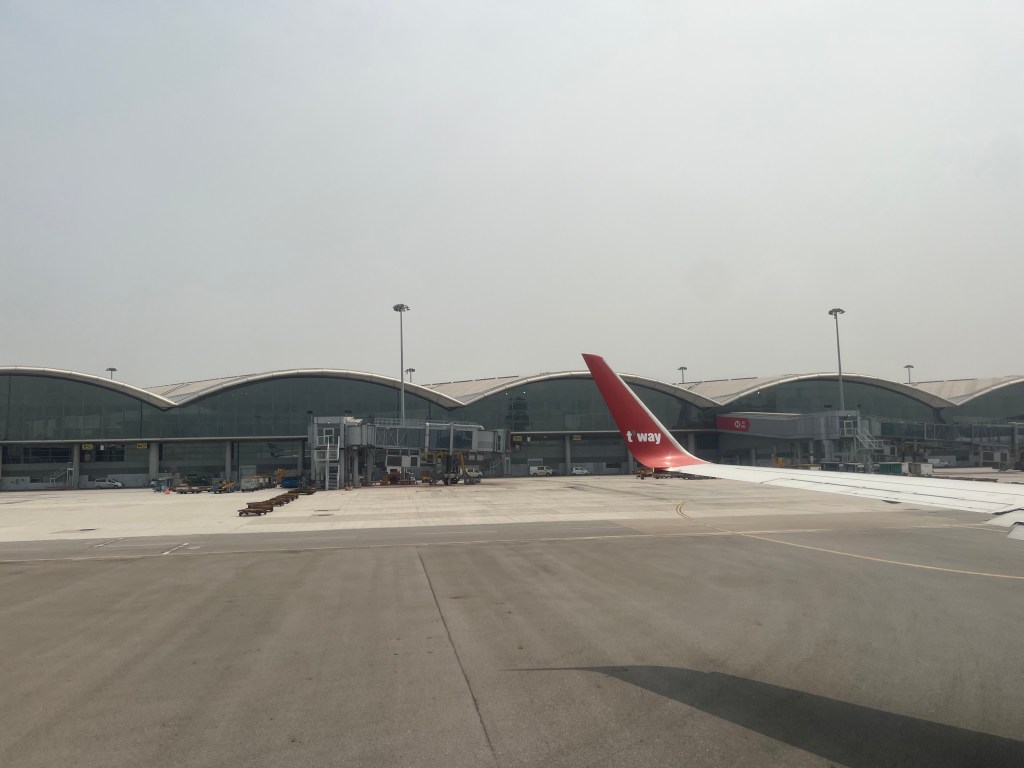
Some hours later that puny plane is in the air, heading steadily northeast over the seas of China. The weather is clear but drab, the Sun blaring its dull light into the cabin and scorching my face. The air hostesses amble up and down the plane, trying to interest numerous passengers in numerous unnecessary wares. A couple of our fellow travellers also get food. As impoverished twenty-somethings, none of us have had the luxury of ordering in-flight meals, so while all three of my friends nod off in their seats, I dig out my Gordon Ramsay sandwich (at HKD70, without question the most expensive sandwich I have ever eaten, by far) and then dig in. On my left, the hills and valleys of Taiwan fly by underneath, and I spend some time guessing which township I’m looking at — “maybe that’s Jiayi, or is that Changhua?”. On my right, Eugene continues to slumber, his neck at an unnatural angle, his mouth comically open.
The clouds begin to gather again as we fly over the East China Sea. They speckle the skies below us, their silhouettes fooling me into thinking I’m seeing land where there’s only shadow. Soon there is nothing to see outside the window except a ceaseless stretch of blue and white; I lean against the walls of the cabin and read Dominic Sandbrook’s White Heat, while allowing myself to drift in and out of consciousness. When I wake up I peer out the window, eager to catch my first glimpse of Korea, but the clouds are still there, shielding the peninsula from view. By this point Sunny is awake, partially because I have just clambered over him and Eugene on my way to the toilet. We scrutinise a map of Korea that he has on his phone, and try to extrapolate how far we must have flown — then as if by magic, the clouds break apart temporarily, and we have our answer.
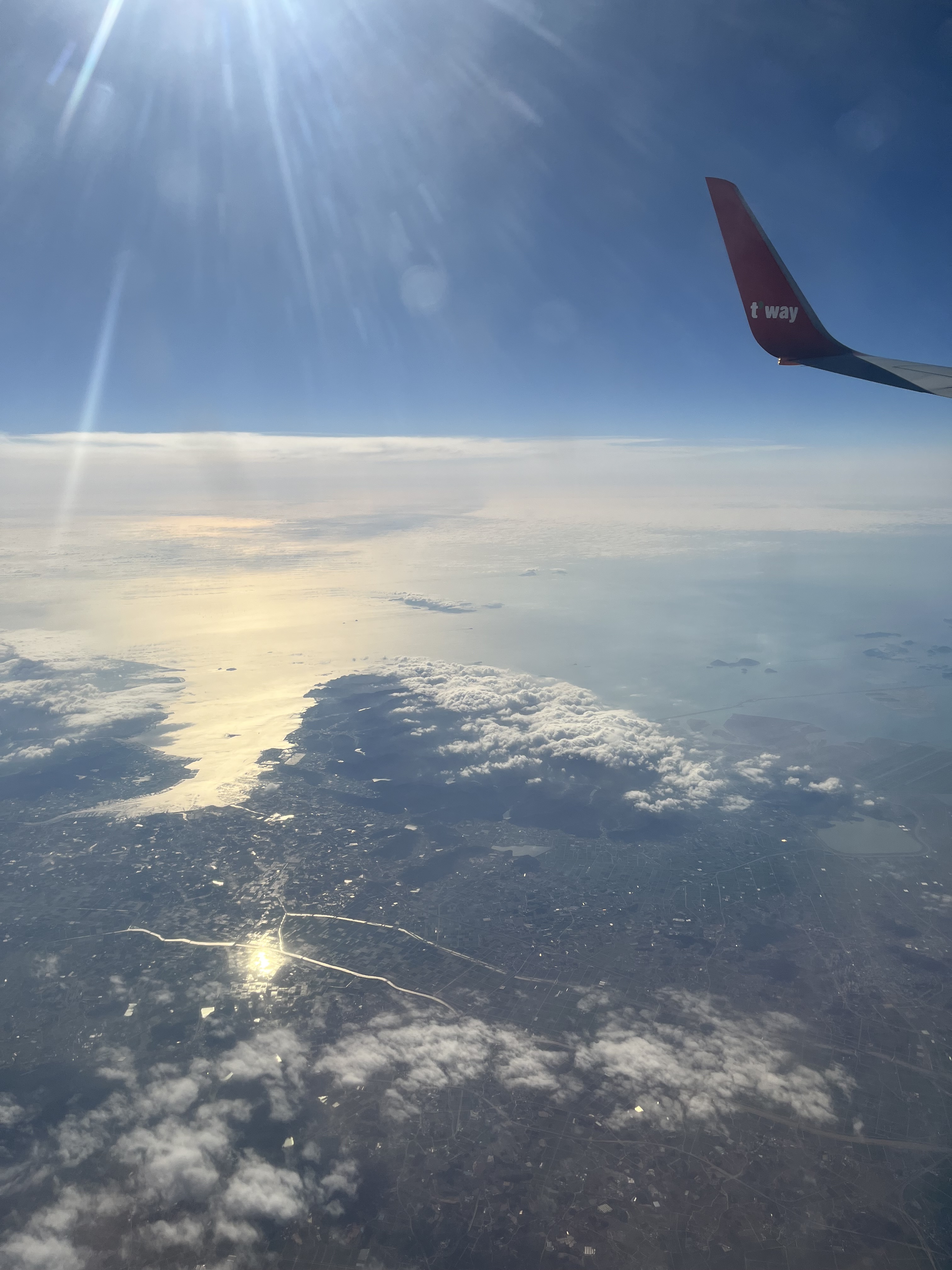
16:30, South Korean time. We have dipped below cloud level, and now instead of an unending sea of white we have an unending sea of sea, gently rippling below. In the far distance I spot a power plant, ferociously puffing out grey smoke; it sits there, solitary against the waters, a first testament to the country’s industrialising power. I’m reminded of the fact that Seoul is just 40 kilometres from the North Korean border — surely we must be there by now? Surely the pilot hasn’t miscalculated and put us in a Crash Landing on You situation? We seem awfully high for a landing… then a six-lane motorway appears out of nowhere, followed by a whole convention centre, and before I have time to register what’s happening the plane is thumping down on the runway, thumping down with a violence that almost rearranges my organs, and the stewardesses announce our arrival at Incheon International Airport.
The first image I have of South Korea is of kinetic energy. It seems to be everywhere: in the verve of the air hostesses as they bid us goodbye, in the excitement of the tourists as they throng through the terminal, and in the drone of the people movers that take us to customs. Even when we reach said customs line — a tortuous bureaucratic snake of monstrous proportions — there is still a buzz to be found within it, as if a great big secret is passed from stranger to stranger. Even non-humans seem to be getting in on the act: a solitary suitcase grabs our attention as we shuffle forward in the line, unclaimed by any passers-by yet mysteriously moved forward every time we catch sight of it. Of course it’s probably just a particularly lazy tourist refusing to lug his baggage around a long queue, but we remain transfixed by its self-propulsion long after it disappears.

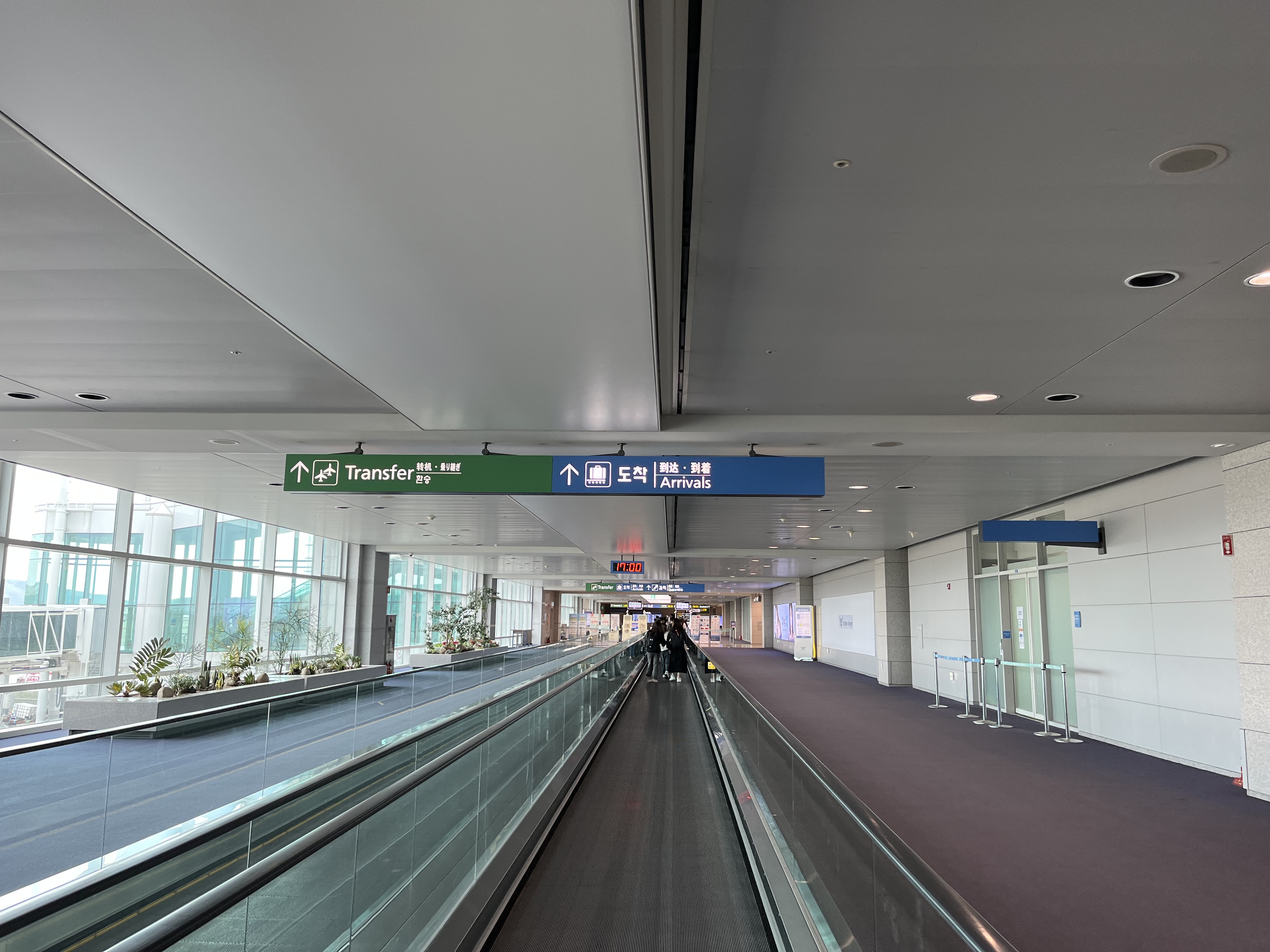
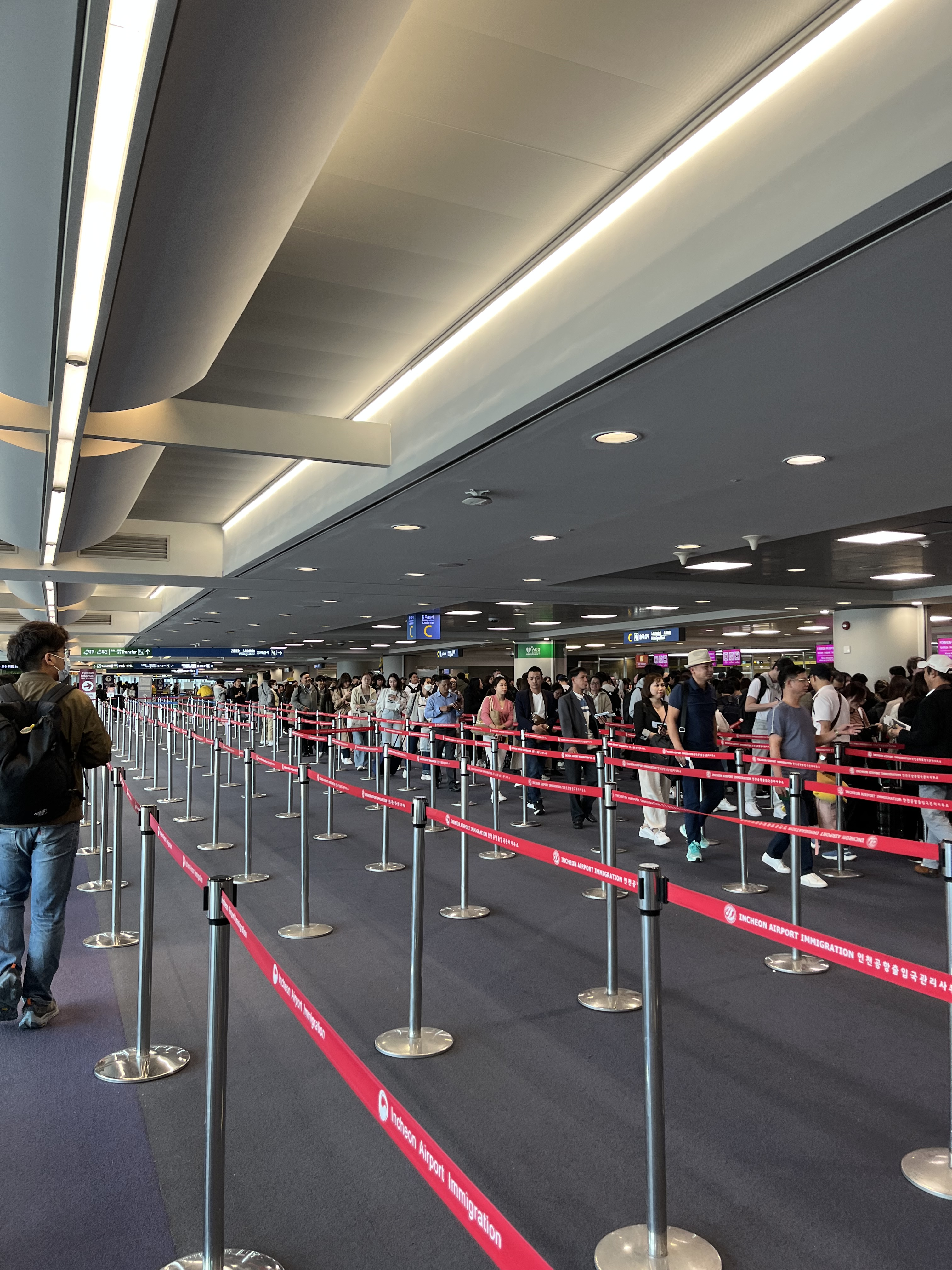
Another wait. Another bout of nervousness. After what seems like an eternity, our turn to be processed. Step hesitantly up to the counter and put on my most charming smile; the customs officer, who can’t be a couple of years older than me, does not return the favour. Perhaps he has to deal with laboured grins like these every day. My passport is left on the scanner for what feels like an eternity; the seconds tick by, and out of the corner of my eye, I spot Sunny and Eugene exiting into the hallway ahead of me. Finally the scanner comes off and the barriers open; look back just in time to see the officer for Daniel’s line leaving his post and my friend being forced to queue up all over again.
While Sunny waits for him in the corridor, Eugene and I go to pick up our bags and exit into the arrivals hall, once more, to wait. Outside people rush to and fro, gabbling at each other and trying to find their way out into the city; the late afternoon sun glows weakly through the glazed windows. I am left alone with the bags while Eugene heads off to sort out some currency; sitting there alone in the terminal, I notice so many figures my age, emerging alone from the arrivals hall behind me, who cast one careless look around them before disappearing down the escalators. What kind of balls does one need to have, I wonder, to travel alone into such a crowded and unfamiliar country, and to be so at ease with the mistakes you might make?


We board the AREX train, bound for downtown Seoul. A long ride into town awaits. By now dusk is beginning to fall; the streets outside are suffused in that navy-blue gloom which always precedes the streetlamps switching on. The train is packed with rush hour commuters, but despite this the carriage is deathly quiet — everybody is too busy tapping on their phones or reading their books. In the distance we see glimpses of the city of Incheon proper; although its airport technically acts as a gateway to Seoul, Incheon is no subservient backwater to the capital — in fact, it’s the third-largest city in South Korea and a tourist destination in its own right. Such are the sizes of the two cities that even though they are 40 kilometres apart as the crow flies, it is hard to tell where Incheon ends and Seoul begins; and no sooner have the wide spaces of the former disappeared then the cluttered skyscrapers of the latter looms across the Han River. They crowd the riverside, stretching as far as the eye can see; their lights dot the sides of the concrete, creating random and meaningless constellations. But I barely have time to register it all before the whistle of the wind reaches fever pitch, and we hurtle into a pitch-black tunnel, where the city lights shine around us no more.
Eight o’clock in the evening. We are walking down a narrow street in Seoul, dark and desolate, a tangle of electric wire above our heads. We no longer have our luggage, because we have deposited it in our hotel room; I am wearing two more layers of clothing, because it is ten degrees Celsius and way too cold for a subtropical boy like me. For an inner-city backstreet this place is rather well-lit, if inconsistently so; in between huge glaring billboards and yellowish city lamps are huge patches of darkness, from which looms unoccupied cars, bundled-up passers-by and the odd seedy karaoke joint. We are headed towards the Sinseol-dong area, in search of a restaurant I threw out as an afterthought two months ago. It has been many hours since I had my sandwich, and even more since my friends had their brunch at Hong Kong International; all of us are desperately hungry for food, and Korean barbeque feels like the perfect way to start learning about the country’s cuisine. A bitterly cold wind whistles through the alleyways and the gaps of buildings, and I shiver as I contemplate my already-tired feet and the strange cityscape of Seoul.
At last, the restaurant. Situated on the banks of a river right next to a dilapidated garage, it is so unobtrusive that we almost pass it by, our eyes still struggling to make sense of all this fancy new Korean script. Inside it’s homely and warm, the (faux?) red-brick interior and the movie posters on the walls making it feel like a slice of generic Europe that’s drifted halfway across the world. The sizzling sound of grilled meat blends incongruously with Taylor Swift and the occasional Korean shout across the restaurant. A vague smell of charcoal and burnt fat hangs in the air, fainter than the scents that I’ve encountered once or twice in Korean restaurants back in Hong Kong, but noticeable nonetheless.
We sit down hesitantly, and peer at a wall of indecipherable words. It appears to be some sort of menu, what with all the pictures of pork and won signs, but we aren’t really sure. Finally a waiter comes over and looks at us quizzically. We smile back at him nervously. He tries Korean, but nobody at our table speaks the language. He rushes off to fetch another waitress, who looks at us equally strangely. Then she opens her mouth: “what would you like to eat?” she says in accented but still perfect Mandarin, after which progress is much expedited to our relief.

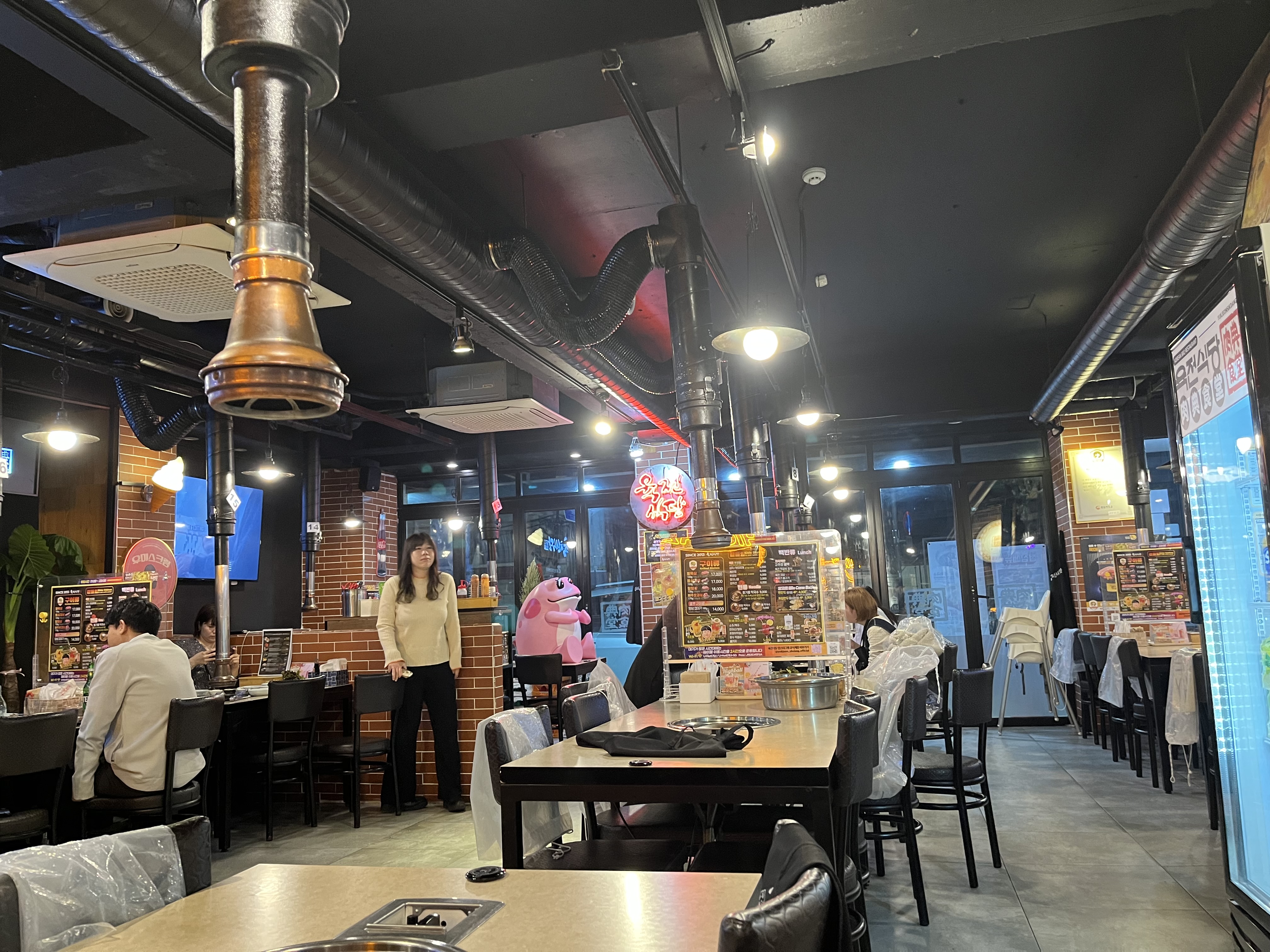
At last the food comes: slabs of pork belly, shoulder and God knows what other parts of the pig, as well as soups and vegetables and a simply dizzying array of sauces and dips. We gaze stupidly at everything that is in front of us, not entirely sure where to start. After we have sat in this petrified state for a minute or so, the waiters finally realise just how out of our depth we are and come to our rescue, placing these huge hunks of animal onto the grill and cutting them up for us. The smell of pork fat, sizzling away on the brazier, is absolute heaven to my starved body, and I find myself swallowing thin air in anticipation. Finally the waiter places the first slice of meat into my bowl, and motions that I should place it in the small urn of salt in front of me and then into my mouth. The resulting experience is like applying ten thousand volts to the tongue: the taste of the salt, the pork, even the hot oil, all of it exploding like a depth charge. I am sure that I have tasted something better in my life before this, but right now they all seem like distant memories.
Given that I am sharing a table with three friends from church, I have to physically restrain myself from saying “holy shit”; so instead I resort to widening my eyes, jabbing my finger REPEATEDLY at the grill, and nodding like a man possessed. My friends’ responses are a little more subdued than mine, but I can see that the food has the same effect on them: we clear out almost everything on the table within minutes, including the cloves of garlic meant as a garnish. Yes, our hunger must have something to do with it, but that doesn’t take away from the richness of the food, the cavalcade of flavours attacking our senses. As we raise our cups of water and toast our arrival in Seoul, I can’t help but feel excited — perhaps South Korea isn’t such a scary, inaccessible place after all.
We walk back to our hotel, bellies full, strangely euphoric. The streets are bitterly cold, and even more deserted than they were an hour and a half ago. It all feels a bit odd: Seoul has this reputation of being a city full of nightlife — bars, restaurants, karaoke joints — and yet there are few people on the streets tonight, and not many more cars. The only human activity of note is three workmen toiling around some construction on the pavement; as they pass by Sunny and Eugene, both of whom are engineers, can’t help but critique their handiwork. (“A hazard of the job,” says Eugene.)

Turning back into the alleyway that leads to our hotel, we pass a 24-hour self-serve laundry. There’s only one washing machine active in the shop right now, its contents spinning around at a speed too dizzying to contemplate at this late hour. The sole customer slumps against the wall below, listlessly reading a Korean novel to pass the time, her hoodie scrunched up tight over her head. Our eyes meet for the briefest of moments. Then she goes back to her book, and I walk on into the night.

 Inkpot Shuffles in the Twilight