18-19 May
The excitement’s bubbling up. It’s been bubbling up a long time, ever since we bought the tickets four months ago, but as I step out the door of the family flat I feel it positively boiling over, transforming into that spring in my step and that sense of purpose. This is the first time in four years that I am taking an aeroplane to distant lands, and the possibilities just feel so endless. As I enter the Airport terminal and check out the departure board, I realise with a delicious thrill that it’s really happening — I’m going to be on one of those planes.
It’s there that I meet up with the dramatis personae for this narrative: Dennis is just as the reader remembers him, stocky, soft-spoken and even more obsessed with buses than he was in 2019. Wilson, on the other hand, has disappeared and was last heard leading a life of lawyerly contentment in Adelaide; instead the third member of our entourage is Charmaine, a bright-eyed friend of ours from our undergraduate years whose passionate love of coffee is perhaps only rivalled by her passionate love of animals and perhaps snark. (She surprised me already by agreeing promptly when I invited her on this trip back in January, and then continued to surprise me by completely messing up her itinerary. It’s not often that I’m the most gaffe-prone person in the room.)
A motley crew, but two things unite us already: our suitcases are unanimously humongous, and we are already exhausted. Not just from lugging said suitcases around, but because we are now adults with full-on day jobs and we’ve chosen to set off on a Thursday evening. Dennis and I have literally dashed home from work to pick up our suitcases; as it happens we make it to gate 47 with only minutes to spare, during which I eye the clock nervously and wonder about the protocol for missing a flight. Will my holiday come to a crashing halt before it’s even started?


I take a look at my fellow passengers as I sit down. Many of them seem Turkish, which is frankly what you’d expect from a flight operated by Turkish Airlines. Most of them seem to be watching Disney movies — I count Coco, Soul and Encanto from just the rows surrounding me. In the next row, however, there is a woman round about our age who is not watching anything; her entire row is unoccupied by anybody except herself, which meant she had the outrageous luxury of being able to stretch her whole frame across three seats and start snoring about ten minutes into takeoff. She does not get up for the dinner service, which is a shame because Turkish Airlines serves some of the best in-flight meals on Earth, the flavours of which I can only recapture by relaying the menu:
Smoked salmon and celeriac salad
Cumin chicken with vermicelli
Roasted basa fish with potatoes and Tuscan-style vegetables
Chocolate cake
Maybe it’s just the excitement of travel messing with my tastebuds, but the food is delicate yet flavourful, and above all exquisitely satisfying — a wonderful primer for the flavours abroad.
Dinner is over far faster than I expected; I may have polished off four courses but by the time they’re dimming the lights to a fetching turquoise, we’re still off the coast of Vietnam. Try to get some sleep, but the roar of the engines is horrifically deafening, and every now and then the plane is shaken by bouts of turbulence that seem to strike at the exact moment I’m beginning to drift off. As we fly over Dhaka, I can hear the girl in the next row is chatting animatedly with someone on the phone (how on earth did she get reception?!). I have no idea when (or even how) I drifted off, but by the time we enter Turkish airspace I am awake again, my brain in a haze that deadens the senses and refuses to clear. An airhostess bears down upon me and I briefly panic, but it turns out that they are serving breakfast at three AM and our choice between eggs and congee is urgently needed. To my right, my travel companions have the airline’s blankets draped firmly over their heads, looking like Orientalised ghosts, and I can’t help chuckling when they pull them off and I see their dour, grumpy faces.
The plane bumps down onto Turkish tarmac at five o’clock sharp, and we exit into a vast, empty, desolate terminal building. Istanbul Airport was opened just four years ago, when the old Atatürk Airport was deemed unfit for purpose; the Turks, confident that absolutely everyone in the world would want to see their ancient metropolis, moved all of the city’s aviation into a building of truly gargantuan proportions. This terminal has everything your heart desires, along with a lot of things your heart did not desire from an airport (the signs in the departure lounge proudly advertise a museum situated just across from the food hall). It is also stuffed with every kind of shop imaginable, and even though it’s still only six in the morning, many of them are already open for business, their elaborate lattice exteriors clamouring for your attention. While Dennis goes off in search of food, Charmaine ponders whether it’s too early to buy chocolate or spices; mindful that I have 27 different people to buy souvenirs for, I grab a tote bag off the rack.

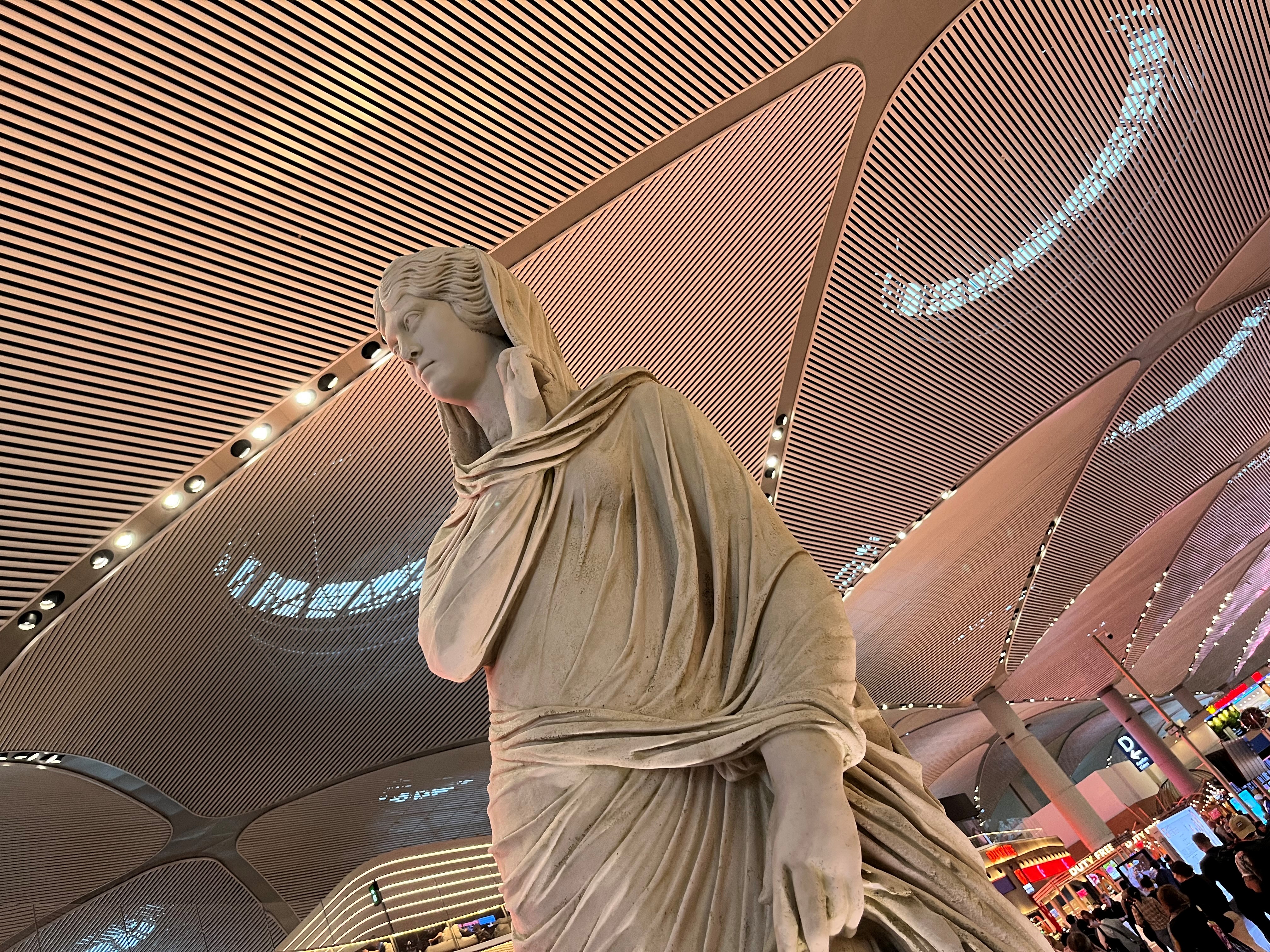
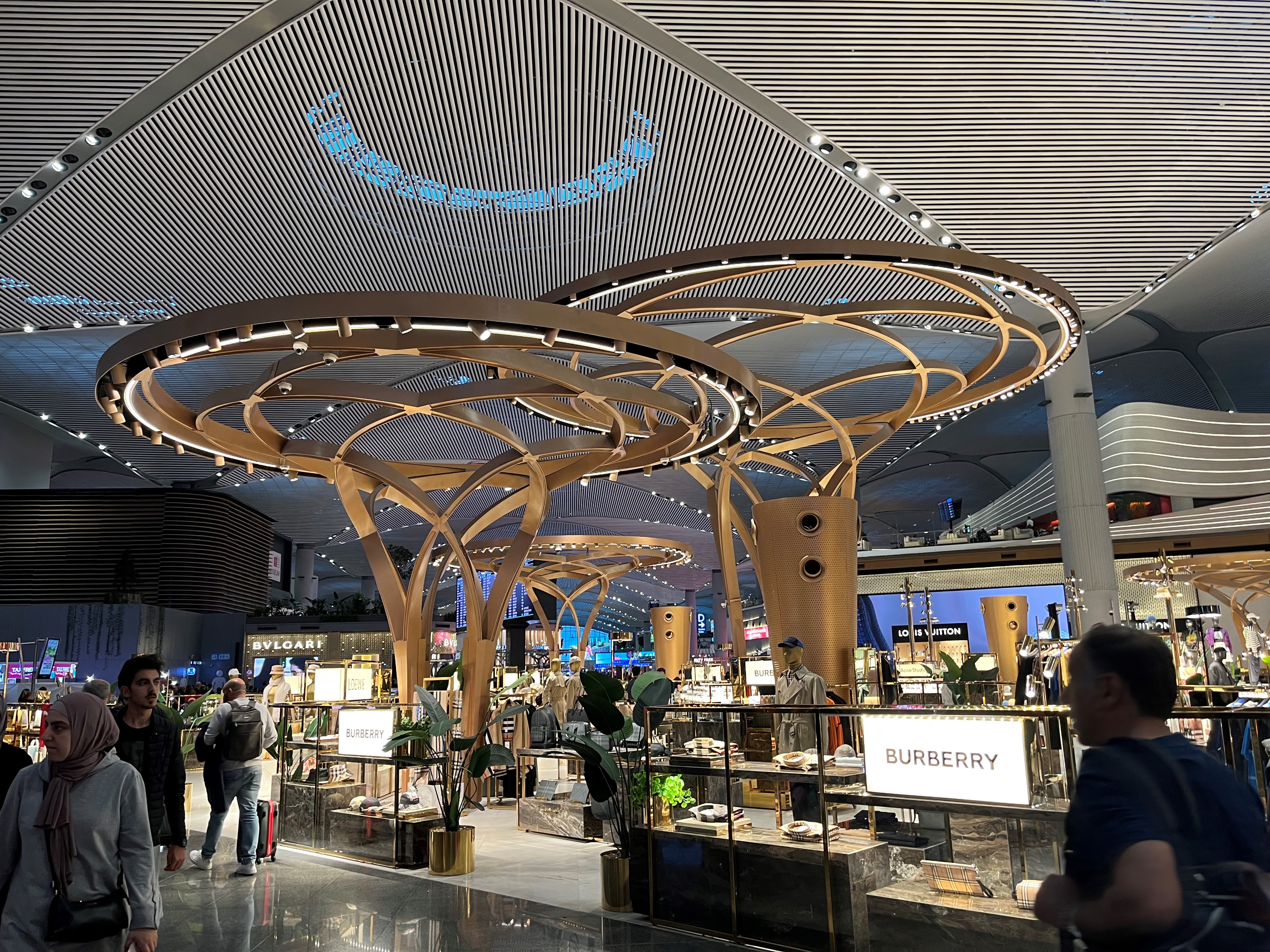

The downside to a three-and-a-half-hour layover is that there’s very little you can do — there’s not enough time for us to make a quick trip into the city proper, but there’s not enough here to entertain us for 200 minutes either: the museum doesn’t open for quite a bit, shopping has never been my strong suit, and the food, as Dennis finds out to his cost, is quite bad. An hour before our plane takes off, we are already bored and restless, and it’s with relief that we queue up for our connecting flight, hungry for the prologue to be finally over.
Once we’re flying high above the Balkans yet another meal is served (Charmaine, who has gone off to the loo, is startled upon her return to find a large slice of börek staring up at her). While my friends doze off, their eyes heavy with the sleep they didn’t get, I busy myself with travel notes, cataloguing with what I imagine to be minute detail the towns and cities that fly past us. There is an inexplicable thrill in whispering all of their names under my breath and typing them into my phone, a weird kind of wanderlust for which I have no real explanation. Perhaps by copying all these accents and diacritics, we will somehow feel closer to them; perhaps we hope that this process of saying and memorising these placenames means they have left a part of them in us. Whatever the reason, I can’t stop myself from doing it, and making a mental note to look them all up on Google Maps afterward.


Just south of Budapest I catch my first glimpse of the Danube — a river I’ve seen many times before from previous trips and Michael Portillo’s documentaries, but my heartbeat still kicks up a gear when I see it, for its reputation precedes it by far, immortalised by films and literature and the ever-ubiquitous waltzes. Today it’s neither beautiful nor blue, as Johann Strauss famously described it; instead it is a muddy, slightly sickly shade of khaki that perhaps belies its legendary status. We follow it upriver as we descend into Vienna Schwechat Airport. Customs process us with that famous Alpine efficiency, and less than an hour later we are already on a train into the city, gazing expectantly at the scenery around us as it resolves from industrial heartland into verdant countryside, from the squat compact houses of suburbia to the wide expanses of concrete-and-glass structures. My first impressions of Vienna are just as I remembered it from my last visit eight years ago: a fascinating blend of old and new, a city of subtle beauty and style. Meanwhile, our unsecured suitcases are rolling all around the carriage; as Charmaine tries to roll them back in the other direction, she slams them straight into my ring finger.


After a whole lot of ups and downs (and the first of many “entschuldigung”s — “excuse me”s — we will utter on this trip) we arrive at our hostel, situated just opposite Vienna’s largest market, the bustling Naschmarkt. Having sorted out our luggage, we go inside for a walk, and find a smorgasbord of delights on offer: stuffed veg, cured meats, mounds of seafood and loads and loads of sweetmeats. Nor is everything on sale purely for eating: we count at least three souvenir shops and two clothes stalls. Charmaine is visibly excited — she always enthused about visiting the markets here, and here she walks forward, taking time to look at everything that’s passing our way. “Look at the size of this market!” Having grown up in Hong Kong, where markets usually connote cramped stalls and dank smells and intolerably loud haggling, it’s a huge sea change for all of us.
By now it’s time for lunch, and despite the three meals consumed on the way here my stomach is growling in loud protest. Our stroll has informed us of the dizzying array of food on offer here, but all the restaurants we see here either look extremely pricey, or extremely no-nonsense. Our eventual pick is the least intimidating one, and after a long, long time spent trying to get the waitstaff’s attention we manage to order some things off the menu. Waiting for our food to arrive, I look around for a bit while Dennis and Charmaine get chatting, admiring the wooden interior, listening to the chatter of the couples and families, feeling the warmth of the Viennese midday.


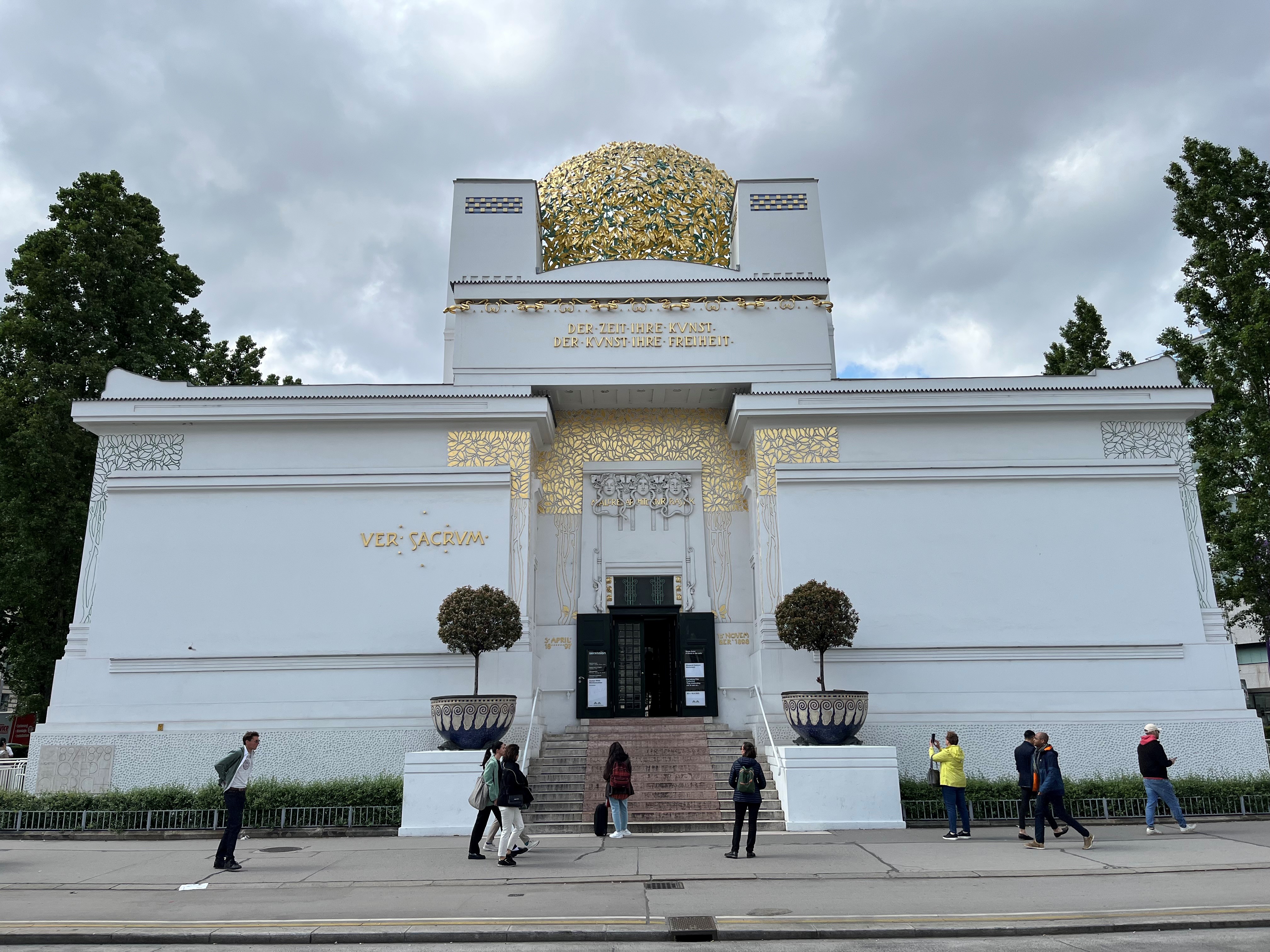
Lunch over, we make our way towards the city centre. Up the Wienzeile we walk; out of the Naschmarkt and past the Secession Building, with its dome of golden leaf and its entrance flanked by sculptures of the Gorgons; then down into the labyrinth of tunnels underneath the Karlsplatz we go. As we approach the Opernpassage, a wide, dimly-lit underground plaza surrounded by old-fashioned shops, I can hear the rumblings of the trams above our head, converging and diverting on the streets above. Choosing an exit by random, we ride up the escalators and suddenly find ourselves blinking at the sudden afternoon sunlight, on one of the most famous streets in the world.


Built in stages throughout the late 19th century, the Ringstrasse is now one of the most famous streets in Europe. (I wanted to say the most famous, but unfortunately the Champs-Elysees exists.) Almost ALL of the famous buildings in Vienna can be found here: the State Opera, the Parliament, the University, the Stock Exchange, and many more. A lot of them were built in one go after the Emperor Franz Joseph knocked down the city walls to build a gleaming new capital for Austria-Hungary (and make it harder for those pesky revolutionaries to march); this means that anybody walking down the Ringstrasse is visually bombarded by buildings that all look the same kind of gorgeous. If you watch anything that mentions Vienna, it’s a dead certainty that you’ll see this tree-lined avenue, proudly positioned front and centre. As well it should.
We stand at the intersection, blinking in the sunlight, trying to get our bearings. The State Opera looms large across the street, tourists swarming in and around its base like tiny matchstick figures. For a moment the immensity of the city suddenly seems forbidding: every other building seems to be worth exploring, seems to be a treasure trove of history and awesomeness. Where does one even begin? But then pure wonder takes over again, and I join my friends, disappearing under the portico of the opera house, determined to see as much of the Inner Stadt as possible. Charmaine soon finds a walking tour to latch onto, while Dennis and I decide to simply wander around the inner city, and see what we can find.


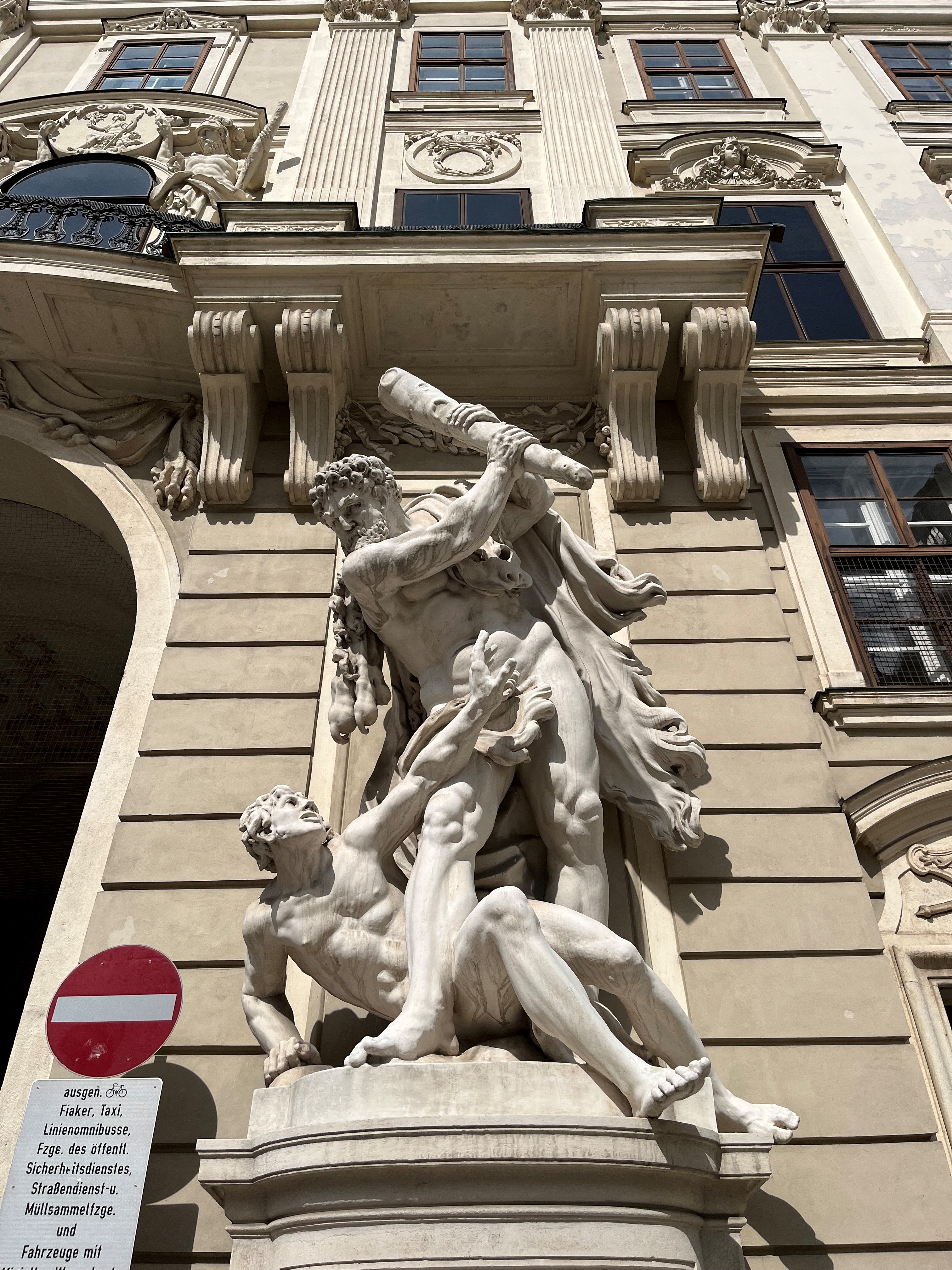


It’s at this point that I must make an editorial intervention. The following three hours were indeed filled with joyful explorations of the most wonderful and interesting buildings, but if I were to describe in detail our itinerary for that day, this chapter would be ten thousand words long and devolve into a monograph on 19th-century Vienna, which I have no interest in writing and you have no interest in reading. So instead I’ll just mention one standout: I first learnt about the Peterskirche when I was eleven, in a documentary about architecture and the Orient Express. The host, a grumpy old Englishman who seemed to see everything with the coldest cynicism, was comparing churches in the city when he came across this one, “tucked away just behind the fashionable Graben” pedestrian zone. In an instant he became an architectural fanboy, gushing about the Baroque interior and how its compact nature hadn’t stopped the designers from making it visually stunning (although he still couldn’t help jibing at what he saw as the excess of the side-chapels); it was the first time he’d had a kind word to say about anything in Vienna, which he’d describe later in the programme as “mute, clean, and smug”.
A standout as far as anyone was concerned, then; yet I never did manage to go inside it during my previous visits to the city. It was either closed, or holding mass, or just wasn’t interesting enough for my travel companions. (An uncle who chaperoned me on my last visit: “it’s a Catholic church, and we are Christians, we do not enter such sites. Plus, they’re all the same anyway.”) So when Dennis and I walk up the few steps to the church, there’s a slight flutter of anticipation, a sense of finally having reached a promised land. We push hard on the heavy wooden door and it creaks like a psychological thriller as we stumble in; the temperature drops, my eyes adjust to the dark of the entryway, then we pass through a curtain and enter, at last, this holy of holies.
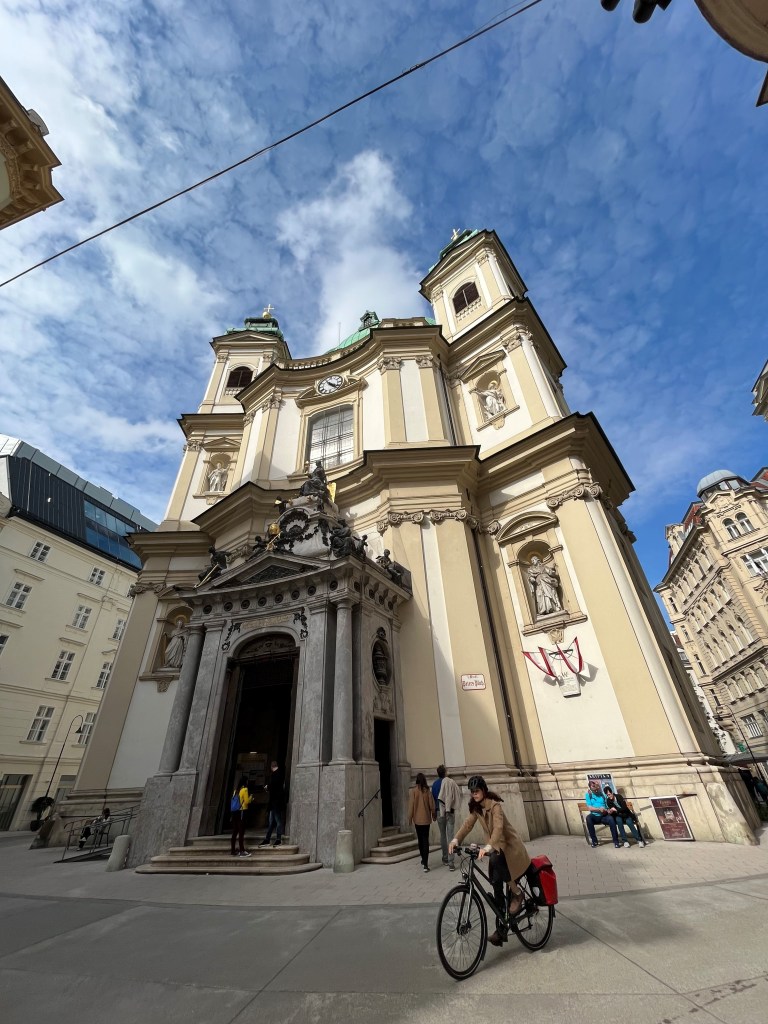
The first thing I notice is the noise, or rather the lack of it: it’s very close to masstime, and the church is eerily quiet, as if God Himself has turned on a soundproofing system. Gone is the ambient hubbub of the Viennese streets; not even the grave would feel this quiet. Even though there are perhaps fifty or sixty of us standing in the vestibule, none of us speaks a word, for we are all too busy being astonished; we are astonished, because we have just laid eyes on the interior of the Peterskirche. I must’ve watched the documentary I mentioned twenty times, yet what I realise now is that it did a TERRIBLE job of showcasing just how opulent and colourful this place was: lamplight glistening off every surface, the soft whites and peaches of the marble a sharp contrast with that ostentatious tabernacle, the sunlight from the cupola streaming straight in and drawing your eyes to the beautiful fresco on the ceiling. And all of this, contained in a building that barely takes twenty steps to traverse; they had so little space that the building is a compact oval shape, and from the vestibule you can already see every single feature of the whole breathtaking church.
Mass begins as we continue to gawp. The organ, somewhere a thousand feet above our heads, begins its haunting melody and the deacon drones the introductory remarks. He’s speaking Austrian German, so I can’t understand a word; but then through the heavy dialect I make out the words “bitte stehen Sie”. The congregation duly stands for the hymn, and even though it’s just one simple action, it creates such a deafening roar that my mouth drops open: the noise reverberates up to the heavens and back down again, a peal of sonic thunder in the dwelling of God. I can’t remember when I was last impressed by the sight and sound of people standing up, but that experience of unity, of conviction, of utter devotion moved me more than my church ever has in this decade — and that’s saying something.
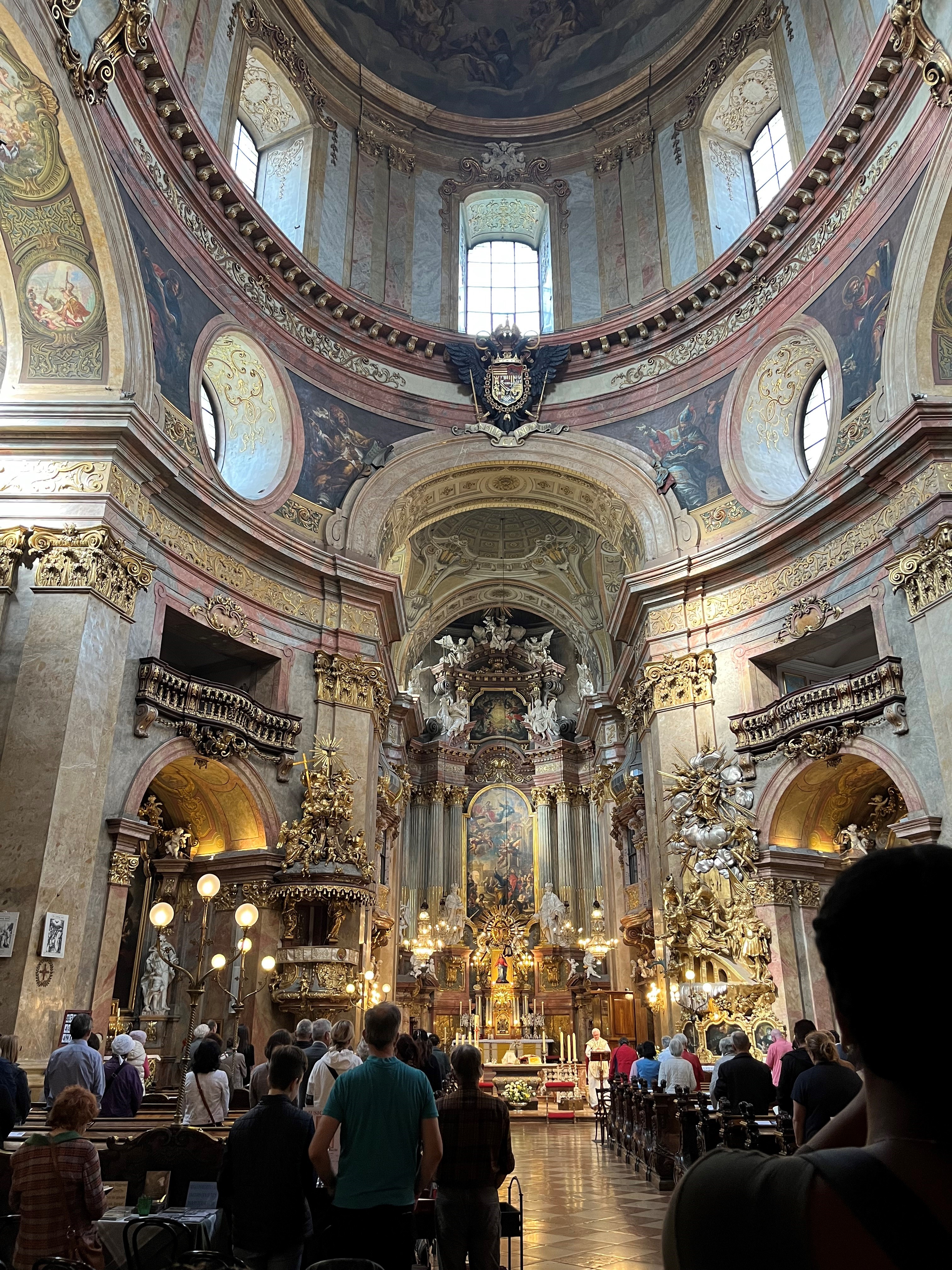


Words do not do the experience justice, so I went back the next day, just to take more pictures. Because I care about my readers and everything.
Six o’clock, and I find myself in another temple — this one for capitalism. Having reunited with Charmaine, we’ve decided to round off our day with a visit to a shopping centre, tucked away under a large railway station in the west of the city. Unfortunately when we arrive at said shopping centre it is a disappointment: it may be called “BahnhofCity” but the row of slightly scruffy shopfronts that greet our eyes do not exactly suggest consumerist ecstasy. It does have a shop full of bus and train models — Dennis has disappeared inside like greased lightning — but precious little else, and the bookstore that lured me and voracious reader Charmaine to this place only has a single shelfful of English novels. Most of which she’s probably read anyway.
While my crestfallen friends look around for something that’ll make this excursion worth it, I head next door to the platforms of the adjoining station. Once a bustling termini for trains from all across the Continent (including the Orient Express), the Westbahnhof fell from grace after a newer, larger station opened in the southeast in 2015; these days its only clientele is passengers bound for Salzburg in the west. It all looks slightly neglected and sad, a far cry from the heaving terminal I remember from my first visit to the city — only a thin trickle of passengers remain, loitering and looking listless, waiting for their train to depart. The late afternoon sun bestows a little light on the station, but the effect is more ambient than vibrant, and I’m not sorry to turn my back on it and rejoin my friends.

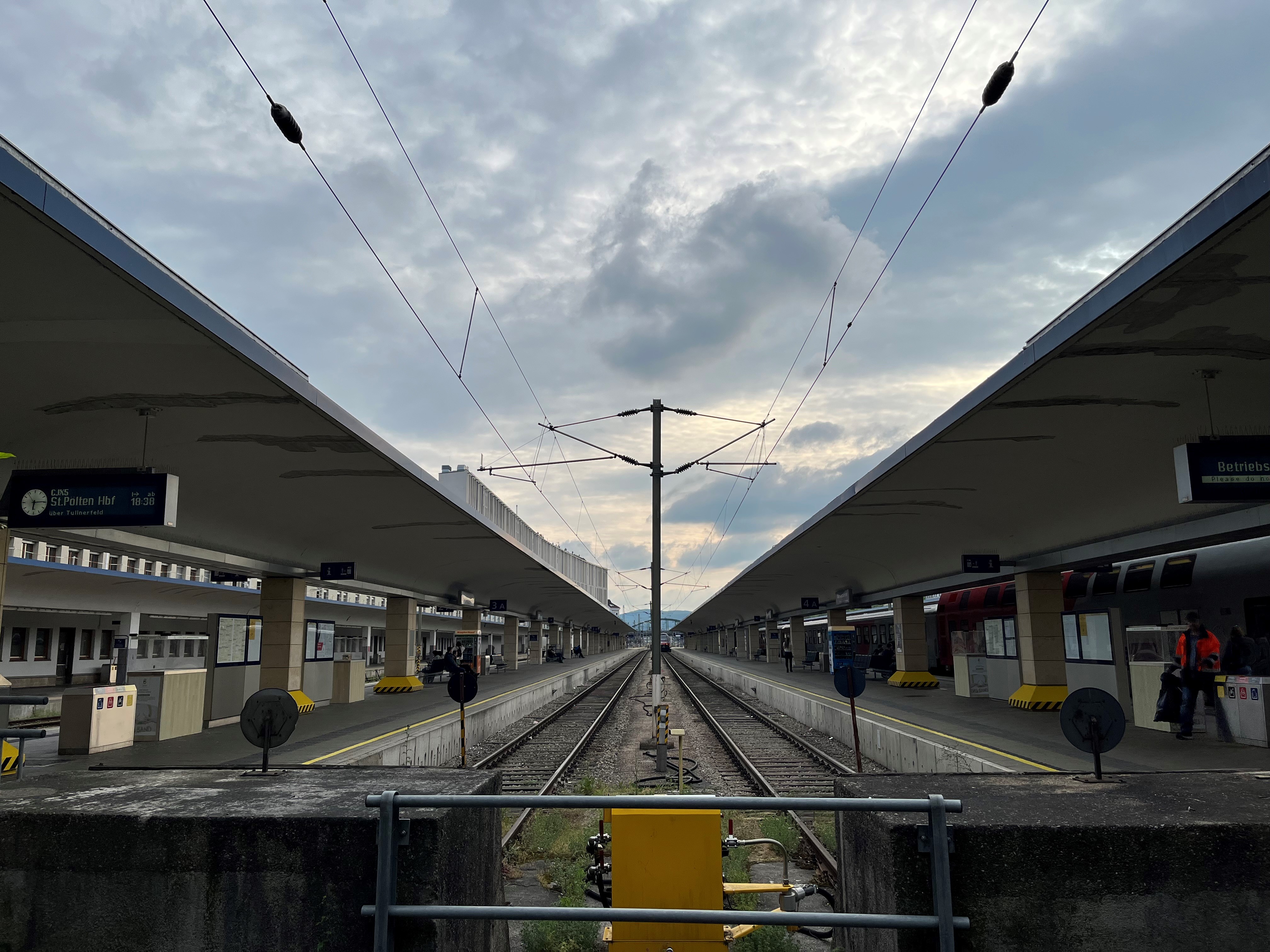
Retire to the pasta chain Vapiano’s next door for dinner. While Dennis tries to instruct the staff on how to cook a great seafood pasta Charmaine and I settle down to eat our freshly-cooked meals (literally, they stir-fry the pasta in front of you while you stand there feeling slightly like a voyeur). There’s a ragtag bunch of customers crowding in on this Friday evening: loads of families, businesspeople, tourists from across Europe. A smartly dressed man in his fifties comes in, plops his stalks of celery on our table, and then sits there for half an hour without ordering anything.
We finish up and head for the exit. A pink-haired server called Olivia takes our bills and tots up the total, all while grinning like she’s just received some very good news. I watch as first Dennis, then Charmaine pay their share and walk out the door, all the while rehearsing the German sentence I’ve constructed in my mind — a sentence which naturally erases itself from my memory the moment I step up to the counter.
Resort to English. “I’m so sorry, it’s my first day in Vienna and I only have fifties, would you mind…”
“Oh of course not!” she says, reaching over to flip open the register and counting out an almost obscene number of 10-euro notes; to the casual passer-by, it looks like I’ve just hit the jackpot at a casino. Olivia is, by some distance, the friendliest face I have encountered in Vienna today — when we came in earlier, it was she who pointed us to the English-language menus — and I impulsively decide to try something I have never had the courage to do in a foreign country.
“Do you get a lot of people doing this?” I ask, looking her straight in the eye.
“Yeah, it happens a lot… we get questions like these all the time you know, being next to a train station.”
“Oh damn, should have given you the hundred then…”
She lets out an almighty chuckle — perhaps the first laugh I’ve heard from a local today — and taps the side of her head. “Well, that’s the mindset that a lot of people have,” she says. “How’s your first day in Vienna been?”
“Really good so far! There’s been a lot of lovely sights, looking forward to a lot more later…” We smile at each other, and I feel a flush of warmth rushing inside of me. “Anyway, thank you for the notes, and auf wiedersehen.”
“Hope you have a good time here!” she beams. I take one of the coins she’s just given me — didn’t even check whether it was a euro or two — and put it in the tip box as I walk out the door. She brightens up even more, if that was possible. “Thank you so much!”
“You too! Have a nice day…”

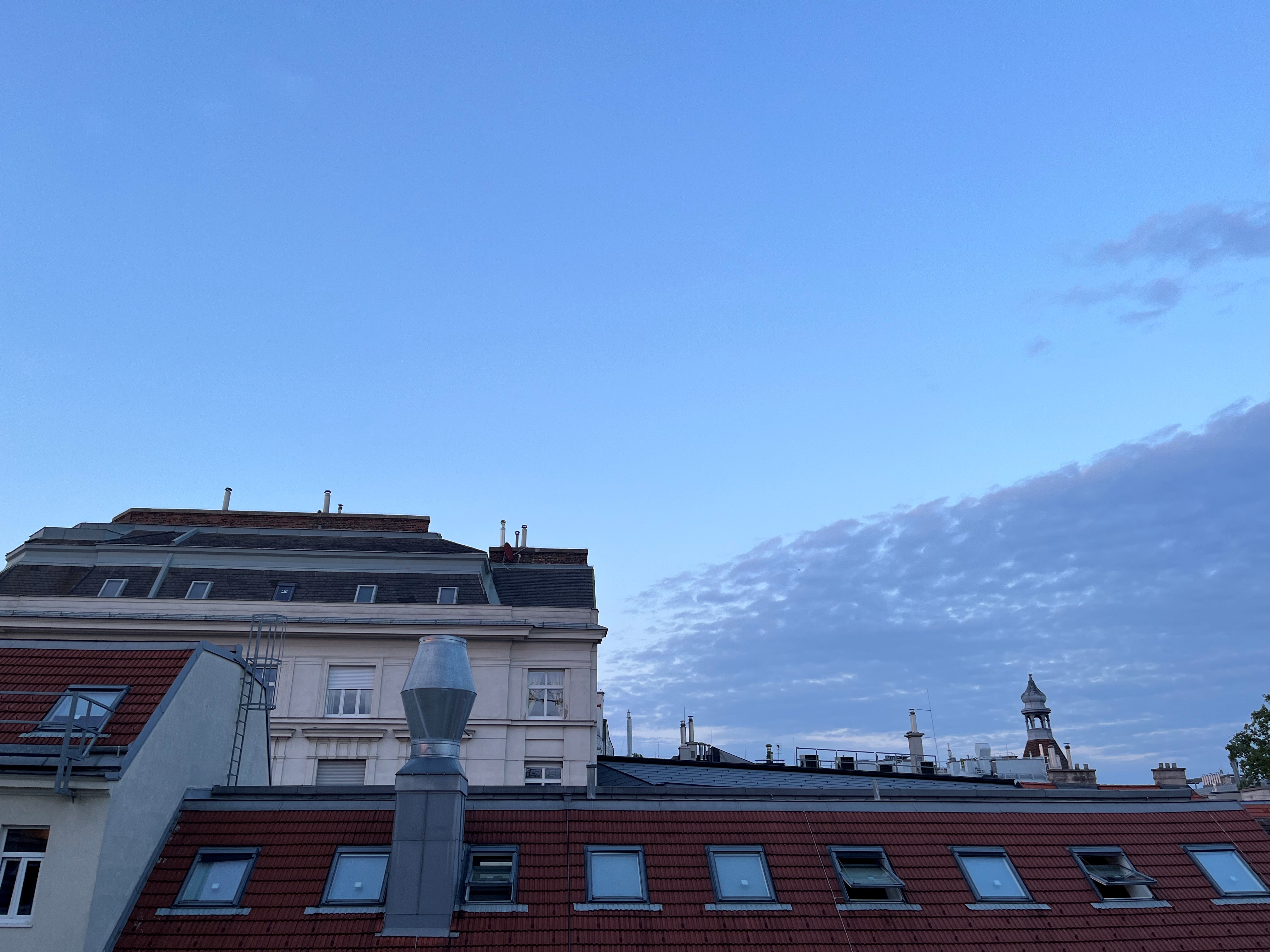
Join my friends in the coolness of the Europaplatz outside, still flushed from the success of making an actual connection with another human being. Germanic people have always been somewhat notorious for their frigid nature: perhaps they feel that smiles are best left for special occasions, or perhaps they’re just unaccustomed to foreigners not operating on their level. Indeed, while nobody’s been outright hostile to us today, everyone just looks slightly dour or exasperated as the three of us get to grips with the cultural norms of Central Europe. But talking with Olivia has made me realise that Vienna is full of surprises: surprising sights, like the Peterskirche and the Naschmarkt; as well as surprising people like her, smashing to pieces any lingering stereotypes of aloof Austrians. That one single conversation, however brief it was, provided some much-needed compassion and familiarity for my day, and it’s a much-needed reminder of the need to be open to surprises for the remaining days of travel — and that human warmth, despite my attempts at cynicism, is still very much in abundance in the world.

 Inkpot Shuffles in the Twilight