In Between the Lines is my wandering journey through each and every line of Hong Kong’s efficient MTR system, as well as a reflection on their place in a network I love.
(A quick note about photos: my phone is dying on me, so some of them may be a bit blurry. Hopefully this’ll change by the end of summer!)
2002 — TSEUNG KWAN O LINE/Po Lam
Commenced operations: 4 August 2002
Most recent extension: July 2009 (one planned for the 2030s)
Stations: 8 (4 unique)
Colour on map: purple
I have very little to say about Po Lam. Normally with these pieces I have a lot to work with: a huge transport interchange with commuters flooding the halls, wide airy structures that I can gush over for endless paragraphs and so on. I have no such luxury with Po Lam, one of the smallest stations on the network and also one of the strangest it has to offer.
Let me illustrate what I mean by walking from exit C onto a train. This is a process that would normally and easily fill up a thousand words or more on my other pieces, as I wander around the hallways and comment in my cheeky way about how it bears witness to an important part of MTR history, or whatever works. The experience at Po Lam, however, is simply walking in a straight line from the exit, through all six feet of concourse and the ticket barriers, then across its single platform, and then getting on the train, all in the space of about ten seconds. That is it. There are no hidden layers, no sections waiting to be built, not even an interesting plaque for me to spin some history yarn on. (I mean, there is a plaque, but it’s basically just repeating facts everybody knows.) It’s all very, very functional and compact, except I can’t play that card either because I used it three months ago.
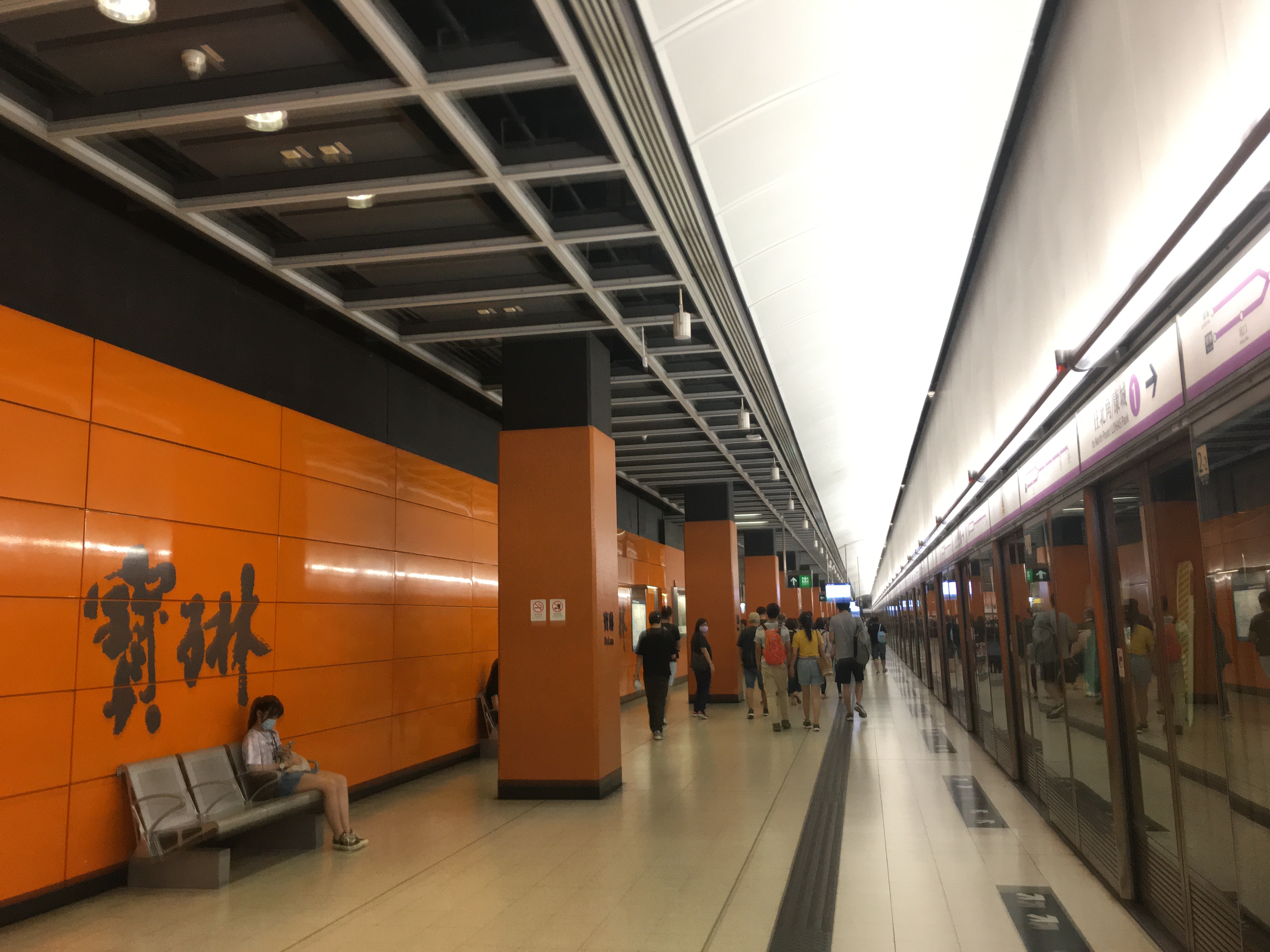
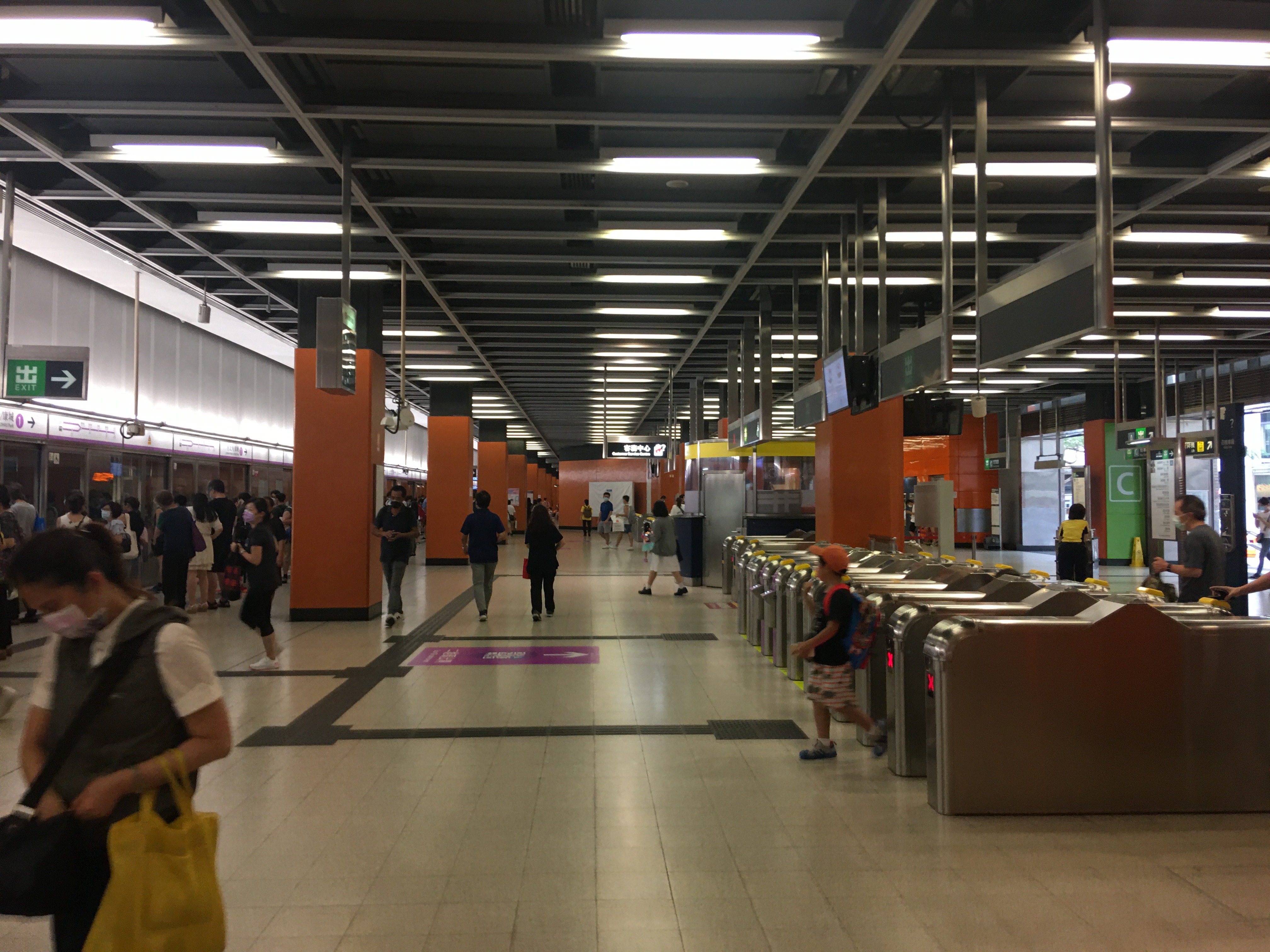
That compactness bugs me, to be honest. When a station is this small, it’s usually down to spatial issues: Whampoa station on the KTL and half the stations on the Island have a single platform on each level because digging two would cause the neighbouring buildings to collapse. Yet this is not a concern for Po Lam, where there is a great big avenue next door and also a siding that sits next to the platforms. (There is even talk of connecting a second line from East Kowloon to this station, which should speak to how much space there is here.) So why, in their infinite wisdom, did the MTR suddenly throw all sense out the window here?
Let’s start with the name. As with almost everything related to Hong Kong, Po Lam is a fabrication, two words plucked out of nowhere as a placename for the middle of nowhere: the place takes its name from a nearby road that was built in the 1950s, connecting the refugee camp that’d sprung up around the nearby Rennie’s Mill to the outside world. That road in turn took its name from the wife of the missionary stationed at said camp. (Mrs. Barbara Whitener’s thoughts on giving her name to an entire district is sadly not recorded.) So basically, we have Christianity to thank for the thinkpiece on Po Lam station you’re reading now.
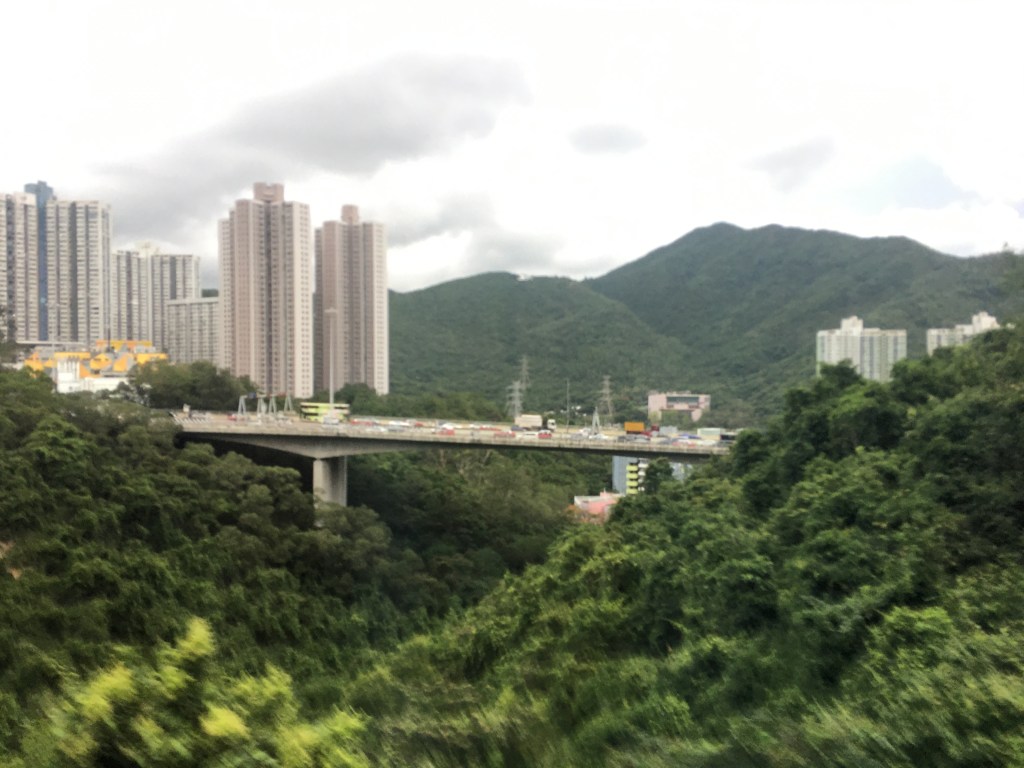
Fast-forward a third of the century, and the refugee camp is overflowing. It’s got horrendous living conditions, it’s hard to get to, and everyone just wants out and better. Meanwhile, the Hong Kong government is on the hunt for the next large piece of countryside they can open up for one of their “new towns”, which is their funny way of saying “suburbs”. It takes one look at the area surrounding Rennie’s Mill — an area charmingly called Junk Bay — and realises that it’s prime real estate. After a lot of legal manoeuvring, mostly on the government’s part, they take the bay as well as almost the entire valley leading down to it, rename it in English to Tsueng Kwan O (General’s Harbour), and go absolutely to town on the construction work. (They also decide to build a huge university nearby, because hey, while you’re at it…)
This was most excellent news to the MTR. Suburbia, as we’ve talked about in previous pieces, was becoming increasingly crucial in the development of the system: after all, more than 40% of Hong Kong residents lived in one of the nine new towns that’d been established since the 1970s. These people would need to get in and out of these newfangled residential districts on their way to work or play, preferably as quickly as possible. The MTR took one look at Tsueng Kwan O and were immediately appreciative of all the dollars up for grabs, so they wasted no time in sidling up and modestly volunteering to get the job done.
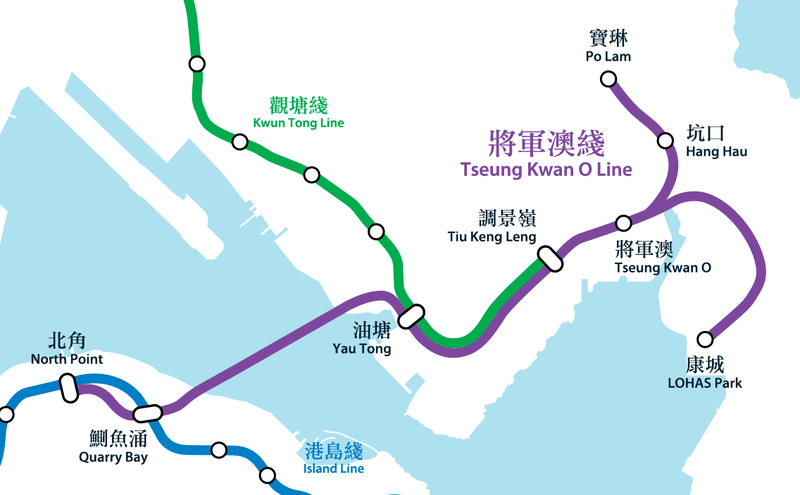
On paper, they did exactly that. The Tsueng Kwan O line (TKL) snakes its way from Po Lam — the northernmost point of the new town — down through the centre of the suburb to Tiu Keng Leng, where it then joins the heavily urban Kwun Tong line for a couple of stations before striking across Victoria Harbour towards North Point. And then nothing. It stops once it’s on the other side, as if all that burrowing through tunnels has utterly drained it and it can’t be bothered to go any further. We can see this brevity in action here in Po Lam: that short walk from exit to train cuts out all the faff that station concourses normally represent, there are no complicated staircases or escalators to distract the commuter, and you can’t find your way onto the other platform by mistake because there is no other platform. It’s a short line, one that fulfils its exact purpose of shuttling people to and from a specific new town, and then gets out of the way. And it bores me.


There is something about the brief functionality of the TKL that makes it one of the duller lines of the MTR. Functionality is, of course, a perfectly legitimate reason for a line to exist: metro systems are merely vessels for transportation and there is no real reason why a line shouldn’t just shuffle between residential areas and the outskirts of a bustling inner city. But good God, this one seems outright lazy in the way it’s functional. In fact, let’s start by examining that functionality: the line is bisected into almost equal halves, with the four westerly stations all possessing connections to the heavy urban lines. But what North Point, Quarry Bay, Yau Tong and Tiu Keng Leng have in common is that they are nowhere near the heart of the city. If you look at a map of the system, you realise that the TKL is an almost imperceptible patch of purple in the lower-right corner. This is why it’s such a pain to get to Tsueng Kwan O: you need to go to the back of beyond just to get there. There is no direct line to the city centre — you need to change trains a couple of times before you find yourself in Tsim Sha Tsui or Mong Kok, and if you’re meeting with friends in the western end of the city you might as well give up and ask them to come to you instead. (I have so many friends living in Tsueng Kwan O these days, and I can only imagine how annoying it is for them to spend an hour just on transit.)
I am reminded at this point of the Tung Chung line, which opened a couple of years before the TKL. In many ways the two are quite like each other: both were rapid transit lines that served a far-flung suburb, built during a population boom in Hong Kong, and were an attractive colour on the MTR map. But the TCL is different, and not just because its stations are built better: it also end in the humbly-named Hong Kong station, slap bang in the middle of the city and a stone’s throw away from our financial/political/cultural hubs. It took people places, and pretty quickly at that too: By contrast, the best the TKO line can do is offer people an exchange to the aforementioned university, and nobody wants to hang out at a university. So, a line that can’t take you anywhere — not what you want from a metro system.
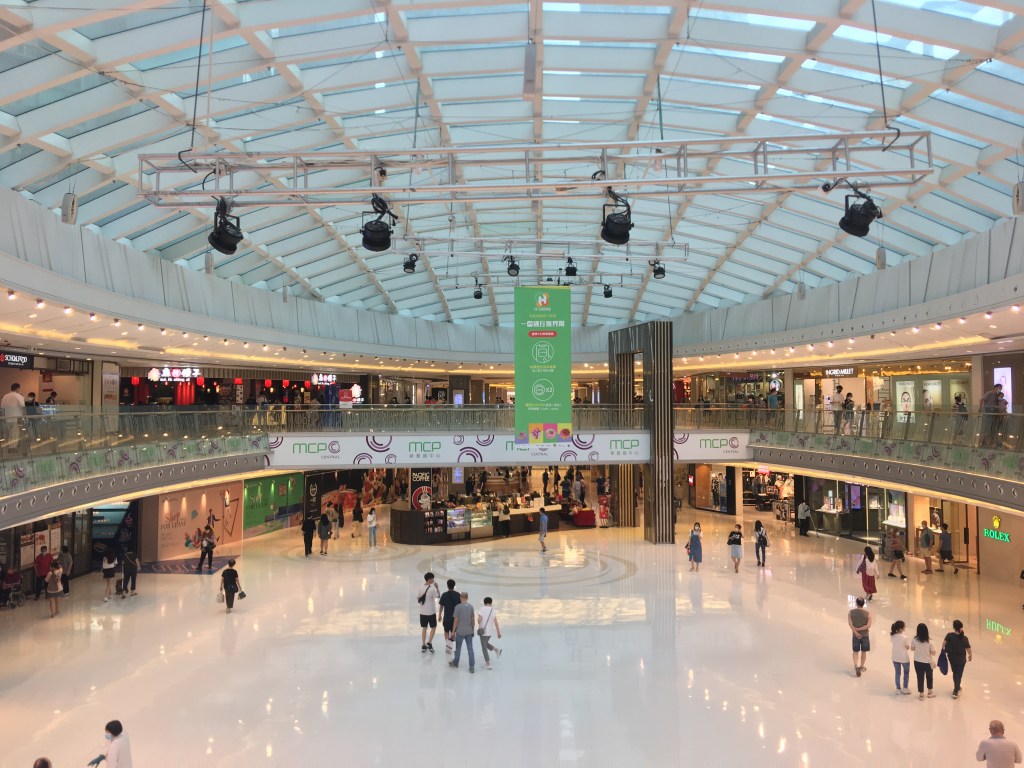
The other half of the line isn’t any better either. All the unique stations on it are all situated in the new town — all small rectangular affairs that open out into strictly residential areas. Take any exit at Po Lam station and you will be greeted either by the sight of high-rise residential buildings or one of infinite entrances to MetroCity, the large-ish shopping mall that’s meant to anchor the area yet still feels tackily bourgeois, a dolled-up place that never really earned its status as the centrepiece of the area. You can’t escape the feeling that all this is perfectly mundane, uninteresting, there to serve without developing a personality. It’s not even an airless box. That would be unfair to coffins, for their inhabitants usually have intriguing stories. Here… nah.
And to think, this district has so much potential. It contains Hong Kong’s only velodrome, an institute with absolutely stunning architecture, and (although my friends will probably dispute this) our most popular TV station down in the Industrial Estate. Yet the stations that serve it are paltry and uninteresting affairs that don’t really reflect its character: they’re all built to the same template, the same coloured panels and Chinese calligraphy that make it feel like a cheap knock-off of the Island line designs it was based on. These stations don’t tell me where I’m about to go, unless they’re trying to tell me Tsueng Kwan O is an airless jungle of steel whose sole purpose is to cram people in its tiny confines. (Not that that description’s too far off…) It’s not just me saying these stations are soulless either: I reached out to a friend who lived in the area for some personal memories of the station, and Chels’ response verbatim was “not much actually”.
The thing is, why did the MTR not realise this? I am aware, of course, that the Corporation is a huge bureaucracy whose aim is not to induce human enjoyment of a transport system, but as I’ve said before, this line fails even when you’re restricting yourself to pragmatics, barely making an effort to reach the more exciting districts. It performs the bare minimum as a metro line, serving one district and one district only. I don’t know about you, but I want more from my metro lines: I want them to feel like they can take me places that I’ve never been, places that I could spend a single day wandering around. And Tsueng Kwan O IS a place which you can spend some time getting lost in, as I’ve said up there — but the line doesn’t do that. It takes you to somebody else’s backyard, and that’s it. It has no ambition, and is content to simply drag itself to some other place and back. It’s like one of those poor workhorses whose sole purpose in life is to go to the office every working day, and we laugh at this kind of person nowadays.

This, then, is a special type of planning failure: one where the fails come from a lack of vision. Don’t get me wrong, I genuinely think we have one of the better planned metro systems of the world — it’s nothing like the London Underground, of course, but it’s at least much better than cities like Melbourne or Berlin, where multiple lines stop like a mere 800 metres from a connection that would massively improve commuting. But even when the Berlin U-Bahn fails, for instance, at least it fails intriguingly: when you get out and walk at the Hauptbahnhof or the Kurfürstendamm, you find yourself looking into shop windows or pondering other places you could go. When I find myself on the TKL (almost always under duress), my first impulse is to think about where I can change to a much more interesting line. I’m that kind of railway nerd.
“Well then, Chamois,” I hear you say, “if you feel like such a smart-arse with your opinions, let’s see you do better for Hong Kong.” Alright, let me just reel off a list of potential extensions. The university I mentioned earlier. A beach and country park to the south. Or if you want something on the Island, a dozen different housing estates and districts that could really use the connectivity. Some of these extensions have actually been mooted. I say all this because anybody can do better.
It’s quite baffling, honestly. Because up till then, they’d done well. Everything they’d built so far had connected perfectly, fit into something that looked like a bigger picture. The urban lines had been a massive success, the TCL and Airport Express entwined like two perfect lovers. Yet here the system conceived its first blunder, the first sign that they were missing the forest for the trees. It would not be the last either: as the years went by, railway planning in Hong Kong sunk further and further into the insular (and insipid) shuttling that the TKL “pioneered”. Lines were built just to connect suburbs to slightly more accessible suburbs, their stations built to much the same formula. Other lines tapered off after only a few stops, as if the planners didn’t know what to do with them. Sometimes they even made transport more confusing. Amidst all this, the MTR Corporation, witnessing the success of their housing projects at Olympic and Kowloon, and struggling with their newest massive white elephant — of which more in November — simply shrugged and focused on the money they were making.
The world rarely offers us a chance at a happy ending, but funnily enough there is one as I write. There are plans (though with this government God knows how long it’ll be before it’s put into action) to extend the line through the northern coast of Hong Kong Island all the way to Admiralty. It’ll act as a kind of express/relief alternative to the Island line, in the same way the TCL was an express version of the Tsuen Wan line. I welcome this development, because it would give the line a significant upgrade. It would connect communities, give commuters another choice in their commutes. And most importantly: it would finally make the Tsueng Kwan O line interesting and worth talking about.
Next time: with a neat divide between the urban and the rural, the soon-to-be-defunct West Rail Line sends the MTR’s rival company roaring back into the limelight.

 Inkpot Shuffles in the Twilight